

What will it take to plough new furrows on the traditional political landscape?

Date Published: 06-Mar-2013
I never really paid a huge amount of attention to Italian politics until its general election last month.
I had been flabbergasted when the Italian political system buckled under in November 2011 and allowed the European Union to impose an unelected technocrat upon the State as prime minister. And he went on to appoint a cabinet populated wholly by ministers with no electoral mandate whatsoever.
What interested me last month was if Italians would give any level of endorsement to Mario Monti and the EU's counter-democratic decision to essentially crown him as Italian leader.
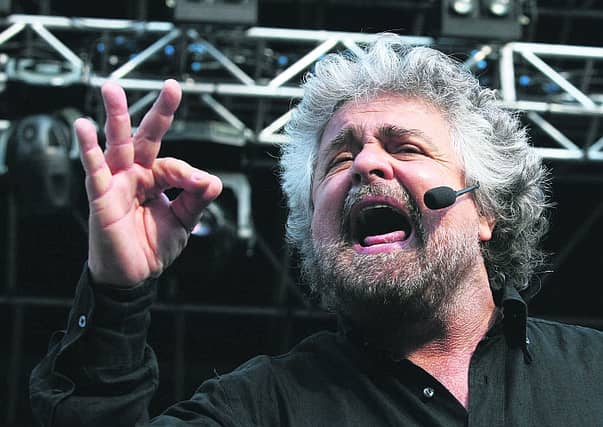
Well the answer was no. He was associated with austerity and his policies were unpopular. Those who did comparatively best in the election were the parties led by populist anti-austerity figures - the protest movement led by comedian Beppe Grillo and the coalition run by the irascible but not exactly loveable Silvio Berlusconi.
The election ended in a bit of a mess with no party or identifiable grouping in a position to form a government, although it looks like Grillo's movement may do its first U-turn and be involved in forming a government.
It was fascinating to learn that the Italians describe its electoral system as 'porcata' (which literally translates into, and there's no other way of saying this, 'pig's arse').
There are two houses in its parliament. In the lower house, the biggest party of coalition gets what's described as a 'prize', which takes its representation up to 54 per cent, thus guaranteeing a majority. The device was introduced as a means of giving stable government.
Unfortunately, the 'prize' is not available in the upper house, which kind of defeats the purpose. The reason is that when Berlusconi changed the system less than a decade ago, there were concerns that the rival socialists might gain control of the upper house if that were available.
Grillo's Movimente 5 Stele did phenomenally well on a complete protest vote.
I am being a little trite – but not that trite – to say its message was that all politicians are corrupt and a plague on all their houses. It's a new movement but when you look at it, all of the parties vying for Government are hardly older than 20 years.
What's unusual about Italian politics is that it is one of the few countries in western Europe whose current political parties didn't emerge from the ravages of the second war. As a point of fact, that was the case for nearly half a century when Italian politics was wholly dominated by the Christian Democratic Party on the right and Socialist Party on the left.
But from 1992, a major corruption scandal, Tangentopoli, rocked Italian politics to its core. Essentially both of the major parties were wound down and Italians also voted to change the electoral system.
As a general rule, and there are quite a few exceptions to this, the major political parties in western democracies can trace their beginning back to a seismic event that wholly changed everything, be it a war or revolution or a time of huge social and political upheaval.
For more, read this week's Connacht Tribune.