

Public fury evident in march against health cuts

Date Published: {J}
By Darragh McDonagh
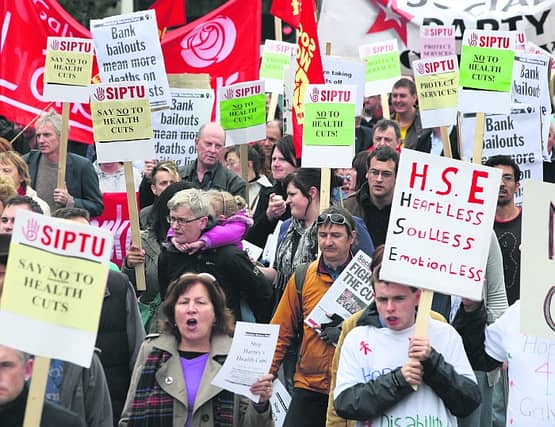
Around 350 demonstrators took part in a march from Galway Cathedral to University Hospital Galway (UHG) on Saturday in protest against further cuts to health services in the region.
Representatives of the trade unions SIPTU and Impact joined members of the Socialist Workers’ Party and apolitical group Galway Says No to Health Cuts to participate in the rally on Saturday.
Politicians were precluded from speaking at the protest but among those in attendance at the march was Independent Deputy Noel Grealish, who last week withdrew his guaranteed support for the Government until the issue of health cuts in the West was clarified.
Labour’s Michael D Higgins TD called for protests to be redoubled and for communities to “stand up and shout stop” to prevent the further erosion of health services in the Galway area.
A meeting between local Oireachtas members and HSE West management last week heard that the health services executive could not impoase further cost-saving measures without compromising patient safety and would not achieve breakeven status this year.
It is now a matter for the national executive to decide whether the regional authority will be punished for failing to balance its books by deducting the massive overspend from its budget for next year.
Mr Higgins said that the meeting had re-emphasised the need for the debate on health cuts to be brought “directly to the door” of Minister for Health Mary Harney.
“Patients are going to suffer enormously and patient safety will be compromised. It is critical that communities stand up and shout stop, and these efforts and demonstrations are redoubled,” he said.
Meanwhile, a survey carried out by the Irish Association for Emergency Medicine showed that Galway University Hospital was short staffed in that department though the hospital wasn’t listed in the worst off category.
The survey found a shortage of Emergency Medicine consultants with only 58 of them spread across 31 hospitals which means that Irish hospitals are overly dependent on junior doctors and that certain shifts are left uncovered or are reliant on locum doctors. And the Association is concerned that the situation is worsening as there is a significant fall off in the number of applicants for posts in these hospitals.
The Association has called for the situation to be addressed by appointing of permanent fully trained doctors. This would require a significant increase in the number of consultants and the development of a new grade of doctor.