

Galway hookers could disappear if urgent move not made
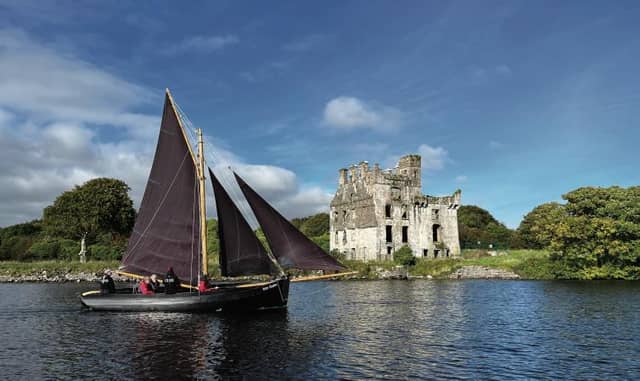

The Galway Hooker has served as the traditional sailing workboat of Galway Bay and Connemara since the early 1800s, carrying turf, seaweed, cattle and other cargo around the bay and along the coast
A campaign is gathering pace to secure heritage recognition for the iconic Galway Hooker tradition, with warnings that the specialist skills needed to build and maintain the boats could disappear without urgent action.
Cumann Húicéirí na Gaillimhe (Galway Hooker Association) is backing calls for the traditional craft, knowledge and customs surrounding the boats to be added to Ireland’s National Inventory of Intangible Cultural Heritage.
Successful applicants to the inventory may subsequently be considered for nomination by the State for inclusion on UNESCO’s Representative List of the Intangible Cultural Heritage of Humanity.
Boatbuilder, teacher and chairperson of Cumann Húicéirí na Gaillimhe (Galway Hooker Association), Dónal Ó hUaithnín, said recognition could help protect a tradition that remains deeply woven into the identity of Galway Bay and Connemara.
“It’s a boatbuilder’s way of life. It’s part of who we are, part of the community we live in,” he said.
The Galway Hooker has served as the traditional sailing workboat of Galway Bay and Connemara since the early 1800s, carrying turf, seaweed, cattle and other cargo around the bay and along the coast.
Before modern roads connected Connemara, the boats were the lifeline of coastal communities.
“The sea was the infrastructure,” Dónal said.
“Having a small little boat that would carry a sail was like having a car today.”
The boats became so deeply embedded in coastal life that their influence extended beyond transport. Sailing terminology became part of the language of the communities where the tradition survived, passed down through generations alongside the boats themselves.
While sailing remains vibrant today, Dónal warned that the specialist craft of building the boats is in decline.
“We do have a good and very vibrant sailing scheme. The boatbuilding one is dying down,” he said.
With existing boatbuilders ageing and fewer young people entering the craft, Dónal said the knowledge risks disappearing within a generation unless a structured training route is put in place.
He believes a new training or apprenticeship programme is essential. A training scheme established in 1996 produced four boatbuilders, showing that the skills can be passed on when people are given the opportunity to learn them.
Dónal also sees traditional boatbuilding as an opportunity for young people to develop practical skills that can lead into other trades.
“Academia is not for everyone,” he said. “There’s an opportunity there for boys and girls.”
For Dónal, UNESCO recognition would be about far more than prestige.
“The big thing really is you’d go to bed knowing the boats are safe,” he said.
“We see ourselves as custodians of these boats — living artefacts.”
He points to the fact that many vernacular crafts around the world now survive mainly in museums, while Galway still has boats being built, maintained and sailed by the communities from which they emerged.
“Most vernacular crafts worldwide are in museums. We have living, breathing artefacts here for the next generation.”
But without recognition, investment and training, Dónal fears the fleet will gradually decline.
“There will be boats there, but they will dwindle. People won’t be able to afford to keep them. Numbers will fall.”
The Galway Hooker remains one of Galway’s most recognisable cultural symbols, woven through its language, songs, families and coastal communities.
“It’s so unique and so intertwined in our society, our culture, our language, our songs and our families,” Dónal said.
For Dónal, protecting the boats means protecting far more than a traditional craft — it means preserving a living part of Galway’s identity.
“It’s part of our DNA.”