

Disaster still casts long shadow over hero of Munich

Date Published: 22-May-2012
EVEN those with little more than a passing interest in football – or indeed a deeply-held antipathy towards Manchester United – know that the 1968 Munich Air Disaster left a lasting pain that has never healed.
Eight United stars – collectively known as the Busby Babes – were among the 21 people to lose their lives when their plane crashed and caught fire shortly after take-off, with 38 passengers and six crew on board.
Among the survivors – and heroes of the hour – was a feisty goalkeeper from Coleraine called Harry Gregg, once the world’s most expensive goalkeeper when he joined United from Doncaster for £23,000.
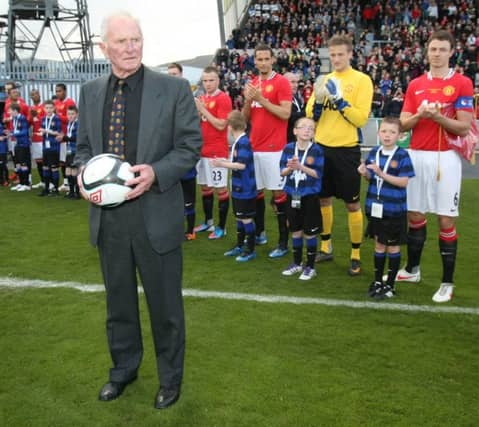
Last week, his old club came to Belfast to play in a testimonial match in his honour against an Irish League selection – and the BBC took the opportunity to reshow Re-United, a documentary made in 1998 to mark the 40th anniversary of the disaster.
It was the first time that the club’s former keeper had returned to the scene of the disaster – and to the stadium of Red Star Belgrade, from which United had been returning after a European Cup match – as he met with people who were also impacted by the events of that fateful day.
Gregg relived the moments the plane disintegrated in graphic detail, with the pain still etched on his craggy face.
He wasn’t just one of the survivors; despite the blood pouring from a gaping head wound, he had gone back into the wreckage to rescue a number of people, including team-mates Bobby Charlton, Jackie Blanchflower and Dennis Viollet – as well as mother and baby, Vera Luki and her daughter Vesna.
Unknown to her rescuer, this Serbian wife of a Yugoslav diplomat was also pregnant at the time of the disaster, so Gregg also saved another life – that of Vera's son Zoran Luki, whom Gregg was shown meeting in an emotional reunion during this gripping documentary.
By all accounts, the big Ulsterman was a fiery character in his playing days; and even in older age he showed no sign of losing his edge. He himself said he had a stubborn streak ‘as long as the strand’.
Since this documentary was first aired 14 years ago, Gregg has suffered a stroke – but from the footage of him with Alex Ferguson at last week’s testimonial, his spirit remains unquenched.
For more of Dave O’Connell’s TV review see page 18 of this week’s Sentinel