

The future is looking brighter for the Corncrake
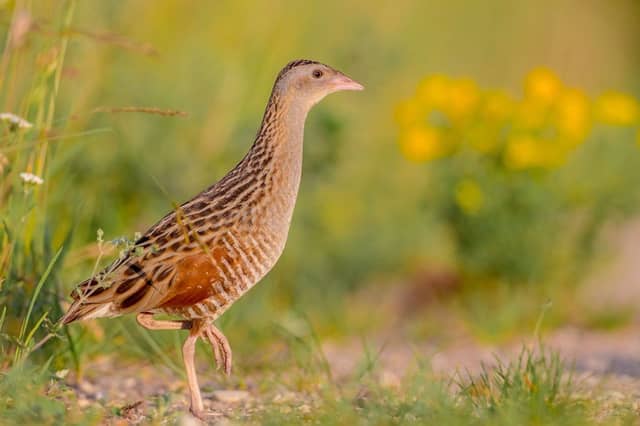

The future is turning brighter for the Corncrake, whose numbers have been increasing in recent years thanks to conservation measures, researchers at the Atlantic Technical University (ATU) have found.
The Corncrake was once abundant in rural Ireland but became an endangered species – plunging in numbers from 4,000 breeding pairs in the 1970s, to 900 in the '80s, and just 150-200 in recent years.
Their dwindling numbers has been due to change in land use, intensification of agriculture, increased generalist predators, and recreation.
But the tide is now slowly turning, according to the ecologist and researcher Dr Andrea Parisi.
Her PhD project 'Improving the Knowledge of Corncrake Ecology through Acoustic Monitoring and Airborne Thermal Imaging' has been published in international specialist publications.
Supervised by ATU’s Dr James Moran and Dr Joanne O’Brien and Corncrake LIFE project manager Dr John Carey, Dr Parisi conducted his research in counties Galway, Mayo and Donegal between 2021 and 2024 using acoustic recorder devices and drones for airborne thermal imaging.
His findings indicated that novel technologies can be used to count these birds and may help with the conservation of the corncrake. Thanks to the EU funded Corncrake LIFE project, numbers are steadily increasing since new conservation measures were introduced.
“Farmers and other stakeholders came on board, changing and adapting practices to protect these precious species and their habitats, for example leaving vegetation patches alone from February to September as nesting places and refuges for female corncrakes and their fledglings.” said Dr Parisi.
“Protecting the corncrake, along with breeding waders and other ground-nesting birds, helps safeguard far more than a single species. The corncrake is considered an ‘umbrella species’ meaning that conservation efforts focused on it also preserve the wider ecosystem of semi-natural grasslands.
“By maintaining these habitats, we create space for invertebrates, amphibians, and other ground-nesting birds such as the meadow pipits, skylarks, whinchat, and many more.
“Other birds are equally endangered and part of the Irish landscape and culture, for example Eurasian curlews (Crotach in Irish) are threatened with national extinction as only about one hundred pairs are left breeding in the country.
“The Northern lapwing (Pilibín in Irish) is the national bird of Ireland, and yet it is in dangerous decline.”
Dr Parise said that he was hopeful, as there had been a tide turn in the past few years with political will to undertake the issues around these species, which were ecologically and culturally challenging.
“Corncrakes were part of the fabric and culture of old Ireland and hearing them evokes strong feelings. For many, it brought back memories of their early days and childhood,” he said.