

Setbacks fail to halt Liam’s momentum

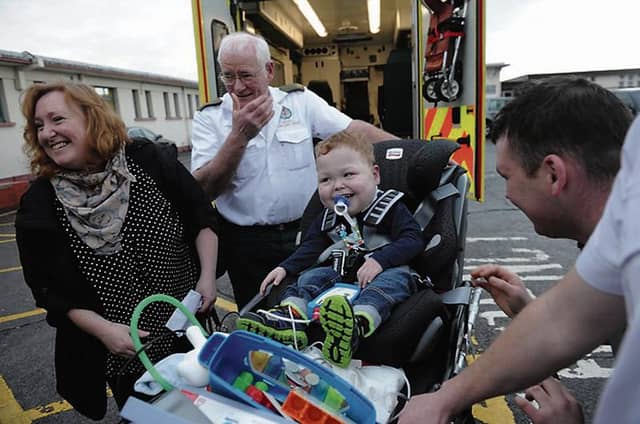

Liam Mac an tSaoi has changed schools, joining an autism unit in Creggs National School where he is being taught in a class with just five children.
The move is the latest in Liam’s rapid progress since he returned home to Galway having spent nearly four years of his life in hospital.
The Clonberne boy was diagnosed with autism before Christmas. His mam Louise said he was lost in a classroom with 22 pupils.
“He couldn’t cope with being in Clonberne School at all, it was just too loud for him after being in isolation for so long, without any other kids around,” she said.
“It was proving too upsetting for him and it wasn’t fair to keep him there.
“He was playing beside the children and not with them and the teachers didn’t know what he was taking in,” she added
While the family were sad to see him leaving the school where his two brothers were educated and where Louise spent 15 years employed as school secretary, they were also delighted he would be getting specialised attention at the sunshine class of Creggs National School.
“Since after St Patrick’s Day, he is being taught in a class of five children and can access the mainstream classroom for his phonics, table top work, maths and socialising,” she explained.
So far, his educational experience has already seen him make great strides.
Liam can spell out his name on a magnetic board – a feat few thought possible when he first became a pupil last year. He knows his numbers and letters and can recognise words.
In May, he spent three nights in hospital to see if he could be weaned off the ventilator at night.
He lasted one night and had to be put back on the machine to help him breathe after he became exhausted.
“His lungs just aren't ready yet to go it alone but he did one great night which is one night more than the last test.
“They had told me he would always need the ventilator.
“He’s completely off it during the day now,” his mom recalled.
Liam can now take a spoon from the bowl to his mouth and feed himself a full meal.
But there have also been setbacks.
His medical team discovered that his femur on his amputated leg had stopped growing, probably because the growth plates were damaged at amputation.
Doing nothing would mean he could get curvature of the spine.
Louise said they had considered sending him for a series of limb lengthening operations in Bristol so that he could keep his knee joint which would make it easier for him to get future prosthesis.
But after hearing the pain would be excruciating, they have opted now for a second amputation, which will likely happen before Christmas.
Liam continues to communicate through Lámh sign language or though his iPad.
He attends school with the help of a Special Needs Assistant and a transport escort while at night he still has a nurse care for him.
Louise has given up her job to care for Liam as well as her husband Sean, 54, who was diagnosed with Pick’s Disease, a rare condition that causes progressive and irreversible dementia.
Throughout it all, Louise is remaining her usual upbeat self.
“I’m getting all the help I need with Liam, he’s very stable since he started school, he’s thriving.
“I’m caring for Sean with the help of my sons Fiachna and Sean. You just have to deal with what life throws at you,” she said.
Liam was kept in hospital for nearly four years due to the lack of homecare and equipment available to facilitate his discharge.
He finally made it home to Clonberne in June 2015 when a package with full-time nursing care was approved after his plight became public.
Born on September 19, 2010 at 23 weeks’ gestation and weighing under a pound, Liam was given an hour to live.
He underwent his first operation of many just three weeks later when he weighed 488g.
He had 27 blood transfusions, an amputation following a bowel infection, laser eye surgery, a tracheostomy, gastrostomy and a colostomy after infections and bowel blockages.
Indeed his parents were told he would be blind, deaf and have severe Cerebral Palsy.
He is currently managing to live with Chronic Lung Disease and PKU, a condition in which the body cannot break down one of the amino acids found in proteins that is in almost all foods.