

Portumna Workhouse gathering commemorates our darkest days
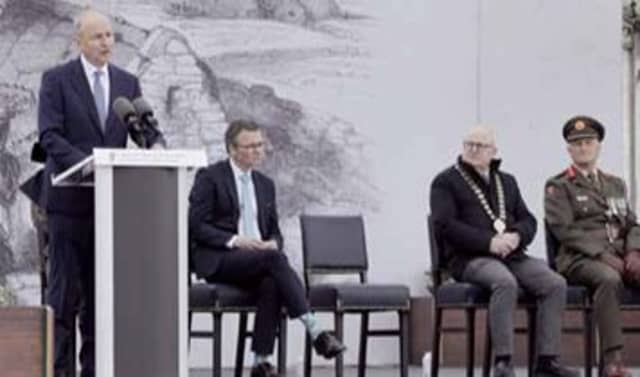

The National Famine Commemoration provides an important opportunity to reflect on one of the most profound and defining periods in our history.
That’s what Taoiseach Micheál Martin told distinguished guests in his keynote address at the National Famine Commemoration held at the Irish Workhouse Centre in Portumna on Sunday – the first time this event took place in Galway.
“While the Famine represents immense loss and suffering, it also reminds us of the resilience of ordinary people and the enduring strength of community in times of hardship,” said the Taoiseach.
“The Irish Workhouse Centre stands as an important place of remembrance and education, ensuring that the experiences of those who lived through the Famine are honoured with dignity and that the lessons of compassion, solidarity and humanity continue to resonate with future generations,” he added.
The 19th National Famine Commemoration remembered all those who suffered, died or was forced to emigrate due to An Gorta Mór.
The event was hosted by the Minister for Culture, Communications and Sport and the Chair of the National Famine Commemoration Committee, Patrick O’Donovan.
The Apostolic Nuncio Luis Mariano Montemayor and the Cathaoirleach of the Galway County Council, Councillor David Collins, also took part in proceedings.
Cathaoirleach of the County of Galway, Councillor David Collins, introduced community and creative performances. They included The Famine Song written by Johnny McEvoy and sung by Cathal Sweeney – and a new composition called the Workhouse Lament was written and performed by Ger Fahy.
The poem, Na Fataí Bána (The White Potatoes) written in 1846 by Peatsaí Ó Callanáin, was recited by 85-year-old Pádraig Ó Conghaile. Róisín Mannion sang Crucán na bPáiste (the burial place of the children) by Brendan Graham.
And the Taoiseach unveiled a commemorative plaque and children from fifth class at St Brendan's National School in Portumna assisted in the planting of a native Irish oak tree to mark the occasion.
Minister O’Donovan described it as an honour to host the 2026 National Famine Commemoration in the Irish Workhouse Centre, ‘to remember all those who suffered due to the Great Irish Famine’. “I thank all those who attended thisdignified and solemn event and acknowledge all those who made this event possible,” he said.
“Special thanks are due to the team of the Irish Workhouse Centre and the people of Portumna who have opened their town to us to facilitate this opportunity to remember.
“In this county where the Famine destroyed communities, they did not remain broken, they were rebuilt, strong, vibrant and diverse in all their forms. This is surely one of the most fitting and important tributes to our ancestors,” he added.
“The story of An Gorta Mór is deeply interwoven with the history and identity of the county of Galway, shaping communities across the county and its wider diaspora, including places such as Portumna, where loss, survival and emigration from that period can still be felt today,” said Cllr David Collins.
“This event honours the memory of those who suffered or emigrated, acknowledges the strength and resilience of communities, and encourages us to recognise the importance of compassion, dignity and solidarity in society Irish today.”