

Named Galway man learns fate after sexually assaulting colleague at hotel

Reading her victim impact statement, the woman said it took a long time to get him out of the room, which he entered without the woman’s consent, and was someone she had worked with for many years and considered a friend and ally
A man who sexually assaulted a colleague after convincing hotel staff to allow him into her room without her permission has been jailed for four years.
Dublin Circuit Criminal Court was told that CCTV from the hotel showed Colm Dillon (37) knocking on the hotel room door after the woman had gone to bed.
A staff member later let him into her room, where he remained in the room for close to two hours. Dillon sexually assaulted the woman and didn’t comply with her repeated requests for him to leave during this time period, the court heard.
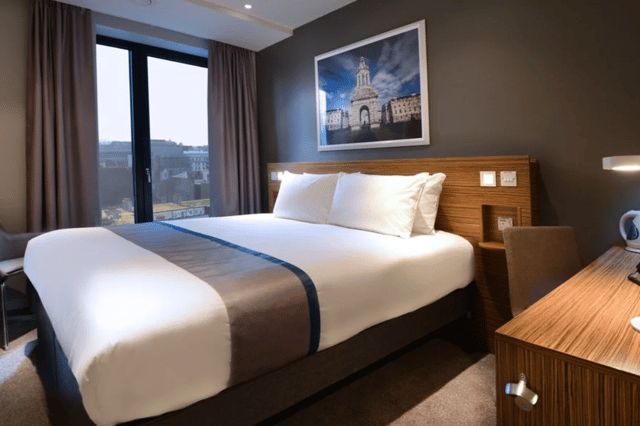
Dillon, of New Forest, Newbridge, Ballinasloe, Co. Galway came forward on signed pleas to sexual assault on a date in May 2025 at the Travel Lodge, Townsend Street, Dublin 2. He has no previous convictions.
The court was told that the injured party wished to waive her right to anonymity.
Reading her victim impact statement, the woman said it took a long time to get Dillon out of the room, and he was someone she had worked with for many years and considered a friend and ally.
She said what happened has affected every part of her life, and she felt embarrassed and ashamed in the aftermath. She said it took a long time to understand that the embarrassment isn’t hers and what happened was not her fault.
She had worked in construction for 22 years and “never felt unsafe” in the industry, though she became used to bad jokes and innuendo and learned to stand up for herself.
The woman said her career has “always been a huge part of who I am” and in the aftermath, her workplace no longer felt the same and that “something deeply personal became part of my work life”.
She said she decided to leave the company and found it embarrassing to explain to prospective employers why she had left her job. She said her new employer has been very supportive.
“I should never had to leave and rebuild my career as someone else sexually assaulted me at a work event.”
The woman said she wants to be able to stay at a hotel alone without putting an extra lock and chair against the door and to trust others as she did before.
She said she wants women to know they should be able to travel for work and go to events without fearing for their safety or feeling responsibilities for another person’s actions.
She said she wants to stop questioning her actions that night when she went dancing, had some drinks, went back to her hotel room and went to sleep.
“None of those things give anyone the right to sexually assault me. I did nothing wrong.”
Judge Martin Nolan said this was a “serious sexual assault” aggravated by Dillon entering the hotel room without the woman’s consent.
He said the woman “was entitled to feel safe in this room and for his own purposes this man entered the room without her consent”. He said the court didn’t know what Dillon said to the hotel employee, but “obviously it was persuasive”.
He said there was “good mitigation”, but the court viewed it as “particularly aggravating” that Dillon entered the woman’s room without consent as “your room is your home for that particular night”.
He imposed a four-year sentence and refused a defence application to suspend any portion of it.
The investigating garda told Tessa White BL, prosecuting, that the woman and Dillon were both attending a work event and accommodation was arranged for employees at that hotel.
Dillon and the woman shared a taxi back, then he walked her to her room, where they said good night and the woman went inside alone.
She went to bed, but heard persistent knocking on the door, which she didn’t answer.
She later woke up and could feel someone stroking her back and an erect penis against her.
The woman was frozen and in shock. She closed her eyes as she thought if she pretended to be asleep, this person might leave.
Instead, Dillon grabbed her shoulder to turn her over and said her name.
She asked him how he got into the room and Dillon told her security let him in. He told her to turn around and when she did, she saw he was naked.
The woman asked him to leave. He pointed to his penis and said: “What am I to do with this?”
She refused his offer of a massage, and attempted to distract him by talking about work and telling him to leave.
Dillon also touched the woman inappropriately and kissed her twice. He asked her for a hug, which she gave him to placate him.
He continued to pester her, and she gave him a kiss in attempt to get him to leave and as she was scared.
She asked him again to leave the room. He got dressed and left.
The court was told that the woman arrived at her room around 3.49am, with a staff member allowing Dillon to access the room at 4.29am. He was seen on CCTV leaving the room at 6.27am.
The woman made a complaint to gardaí several days later. Dillon was voluntarily interviewed and initially said the interaction was consensual.
The garda agreed with John Moher SC, defending, that his client had written a letter of apology which the woman did not wish to receive, but had indicated she was okay with the court receiving it.
It was accepted that the letter expresses shame and remorse for his actions, and that Dillon is aware of the betrayal of trust as they were both colleagues for many years.
The garda agreed that Dillon is from a good family and that his wife is supportive of him. It was also accepted that Dillon was very drunk on the night and has since engaged with treatment.
In her victim impact statement, the woman described how difficult it was to tell her husband what had happened and that he had to watch her deal with something he couldn’t fix. She also spoke about the challenge of continuing her work and parental responsibilities.
She said the criminal process was difficult and she worried about giving evidence and that things she said in therapy might be used in court against her or misinterpreted.
“The guilty plea was a relief, but none of this should have ever been necessary”, she said.
She continued: “being strong does not mean I am the same person I was before that night”.
Dillon resigned his role in the company and has since taken up a similar job in another company. He had brought €10,000 to court as a gesture of remorse, which could be donated to a charity selected by the woman.
A number of testimonials from Dillon’s family and friends were handed to the court, which Mr Moher said expressed their shock and spoke of “someone who couldn’t do enough for others”.
Mr Moher said his client accepts full responsibility for his actions. He said Dillon sought help for his alcohol problem and took steps to “correct something within himself”.
He submitted to the court that his client is someone who is “not going to offend again” and asked for a suspended sentence to allow his client complete a counselling programme.