

Presidential race is still wide open with only months to go

World of Politics with Harry McGee
Collaboration between Fianna Fáil and Fine Gael isn’t something that was invented after the 2020 election; it’s been a fact of political life since the foundation of the State. At critical times in the past, they have come together if they thought it was in the interest of the State – or indeed, in the interest of both their parties.
That modern portmanteau word, frenemies, does not really capture it as they were never that close; that’s really what changed after 2020.
Back in 1938, a letter was written to Senator Douglas Hyde on behalf of the leaders of Fianna Fáil and Fine Gael, Éamon de Valera and William T Cosgrave.
“Fianna Fáil and Fine Gael would be honoured if you were to be named as President of Ireland. We will be very grateful if you agree to this and to reply as soon as you have an opportunity to do so.”
It was an early example of collaboration between both parties, elective as it was.
The rationale was strong. Hyde was a Protestant as well as a renowned writer and dramatist. He was central in establishing the Gaelic League and in the language revival movement. So he had strong credentials that could be claimed by both parties.
Hyde was not the only President chosen by consensus. It happened twice in the 1970s too and again in the early part of the century.
Erskine Childers was elected President in 1973 but died suddenly in office in 1974, only one year into his seven-year term.
Childers has been a Fianna Fáil politician, but all parties agreed on a consensus candidate to replace him.
That was the former Chief Justice Cearbhall Ó Dálaigh, a legendary Constitutional jurist who had been responsible for landmark judgments on personal rights.
Within months, however, he was falling foul of the Fine Gael/Labour coalition. The Fine Gael side was very conservative at the time, and emphasised its law and order credentials as well as a really strong clampdown on subversives, including the use of emergency powers
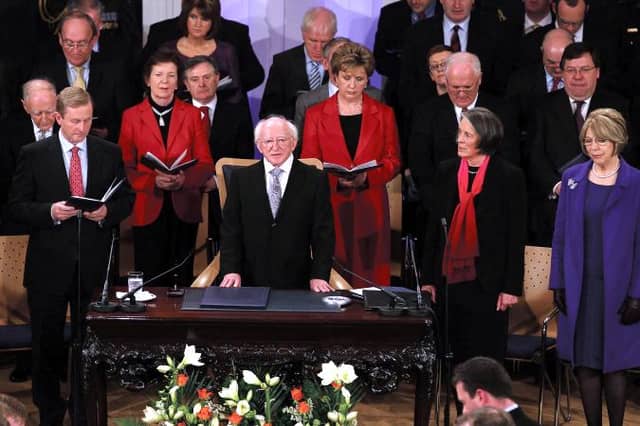
Pictured: President Michael D. Higgins after receiving his seal of office at the Presidential Inauguration ceremony in 2011.