

Pakistani clinic for children’s disorders being run from Corrandulla!

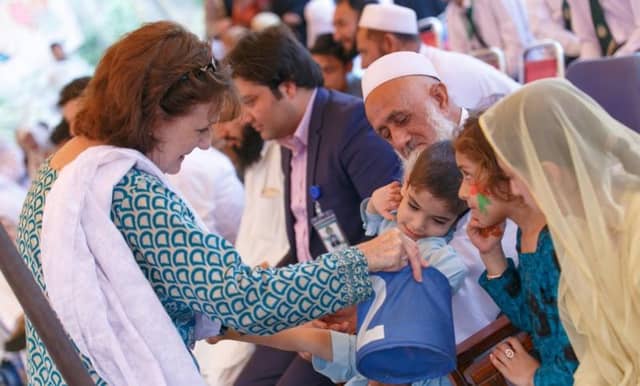

Yvonne Frizzell’s eyes light up at the prospect of returning to Pakistan before the month is out. When the pandemic hit, Yvonne and her husband Jim left their adopted home – where they run a free clinic she founded to help children with disorders such as cerebral palsy and spina bifida. They spent the lockdown with their son John in Corrandulla, where he is renovating Cregg Mill, an imposing 18th century watermill. Their daughter Louise lives in Salthill. Yvonne continued to manage the staff of 34 at the clinic remotely from a cottage behind the mill. While it was closed twice due to local restrictions, they kept the orthotic department open to help children whose parents can travel for days to attend. The London-Irish paediatric physiotherapist first went to Pakistan in the early ’80s on an adventure with her husband, who is a Geordie. He had fallen in love with the subcontinent in South Asia when he was a young engineer. “My husband had a friend in London who said why don’t you come and have a meal in my mother’s house. He said ‘I’d love to, what night?’. Abdul said, ‘no, not in London. In Bangladesh’. So they bought a car and went over land from London to Bangladesh. My husband is a bit eccentric, he goes wherever the wind blows.” They spent five years in Peshawar where she began intensively treating a three-year-old boy with cerebral palsy whose family she met while volunteering in a school. When the family decided to quit Pakistan in 1989 for County Kildare to allow their son and daughter to experience childhood in Europe, Akbar, then aged 7, fell into a deep depression. “My husband said why doesn’t he come to live with us in Athy. Luckily, we had a big old house. His mum and dad used to come over once a year in the summer and we would bring him back to Pakistan every winter. We got him an Irish passport and we had guardianship of him until he was 21.” His family then suggested Yvonne return to live again in Pakistan and set up a clinic for children like Akbar. They were wealthy industrialists and wanted to give something back. That was 2005 and since opening the doors, the Akbar Kare Institute has treated 17,000 children with atypical developmental disorders. “We’re the only ones doing this job – there are over 200 million people in Pakistan. Just 6.4 per cent of these children go to school – 72 per cent of their mothers have no education at all. Every year we’re seeing more and more children – in the three months up to August we’ve seen 670 new families and 840 previous children,” she explains. “They might travel hours and hours and hours to see us. The majority of them come because of word of mouth. We have an open-door policy, there’s no fee for anything. It really does change lives.” As well as hosting a school for both parents and children, and treating children with physio and occupational therapy, fitting them for braces and splints, the institute has an appliance workshop where they make wheelchairs and standing frames from recycled material and upholster wheelchairs to make them bearable for children to sit long hours in. Jim has trained up carpenters to make the equipment after designing several weight-bearing devices to help children walk. The couple sold their house at the right time during the Celtic Tiger and invested wisely. All their work in Pakistan is voluntary. They stay in a home belonging to Akbar’s family, who have since moved to Islamabad. Yvonne happily browses pictures of the children whose lives the institute has transformed – children who are doubled over can sit up, others who are confined to the floor find themselves whizzing about on a set of wheels. She can’t wait to be working among them again.