

John lays his demons to rest in beautiful, brutal memoirs

Date Published: {J}
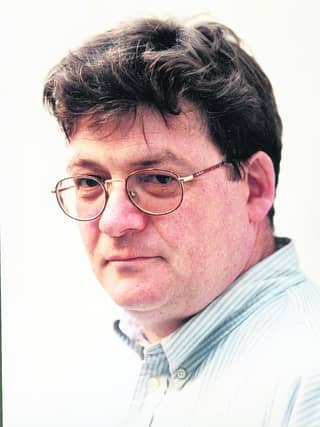
For better or worse we all have parents,” observes writer John Burnside, whose memoir about his childhood, A Lie About My Father, seems to indicate that, in his case, it was for worse.
That might seem like a severe conclusion, but John’s childhood was blighted by his father’s black humours, his bitterness, his drinking and his violence towards his family. A Lie About My Father, the first in a series of three memoirs, is John’s attempt to lay his father’s ghost to rest and to find some human quality in the man he feared and, ultimately, despised.
It is a gripping read, with fantastic detail and imagery, no surprise perhaps, given that John is one of Scotland’s finest poets. His poetry collections have won him a slew of awards, including the Faber Memorial Prize and the Whitbread Poetry Award and he has also been shortlisted for the Forward Award and The T S Eliot Prize on two occasions.
One of the participants in this year’s Cúirt Festival of Literature , John is also an accomplished short story writer and novelist, so, it’s no wonder that he’s taking part in a couple of Cúirt events. One is a poetry reading with Irish poet Gerard Smyth and the other is a discussion on memoir, in which the other participants include Rupert Thomson and Mary Gaitskill.
Although he has received huge acclaim for A Lie About My Father and subsequent volume, Waking Up In Toytown, John joined the league of memoir writers by accident.
“My wife was expecting our first child when I embarked on the project. I didn’t become a father until I was 45 because I always thought I’d be like my own father.”
And as he prepared to become a parent, he found himself mulling over his own childhood, trying to make sense of his troubled relationship with his father.
“It was building up,” he explains.Once he wrote the first book, he realised he had to carry on.
“It’s grungy stuff, a bit seedy in places. People say things to me like ‘I love your book, why did you write it?’!”
John didn’t set out to write a ‘misery memoir’ but in both the first and second books, he’s in “a mess, all the way through, more or less”.
That’s no exaggeration. His father was a harsh, unfulfilled man, who did not know who he was – literally. He had been dumped on the doorstep of a house in West Fife as a baby in 1926 and as a child was passed on from family to family, never knowing a proper home. It was an inauspicious beginning and the adult he became was not a happy one. He was the stereotypical Scottish hard man, highly regarded among his drinking buddies, but with a dark edge and a bitter quality. Even on the rare occasions when he tried to do something decent, he usually botched it up.
John’s mother tried to care, but, after a life of hardship she eventually stopped, dying prematurely of cancer. His sister Margaret continued to look after her father while rearing her own family, but John went on another trajectory entirely. His descriptions of drinking and drug taking make you wonder how he survived that period. He describes himself as being on a quest to disappear and he almost did. From a young age he seemed to be on a path to self-destruction that reflected the one taken by his father.
For more, read this week's Galway City Tribune.