

‘I am and have always been their mother’ – Woman with strong Galway ties fights for her children’s citizenship

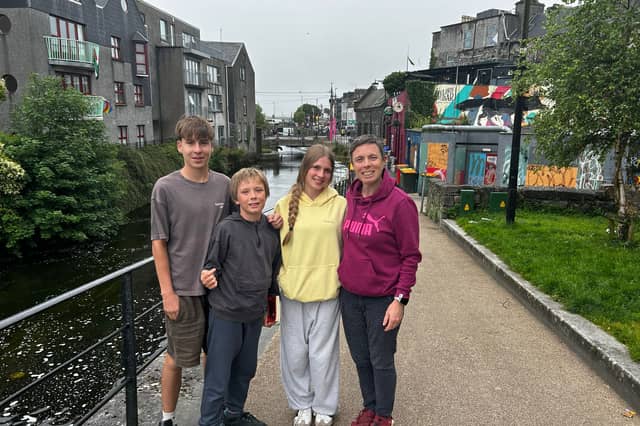

In Spain, Brenda Kelleher is recognised as the legal mother of her three children - Fionn, Nayra and Lennon Kelleher-Torres. In Ireland, she is not
Although Irish law recognises her as the mother of her youngest child, it does not recognise her parenthood in relation to her eldest twins, leaving the family with different legal rights depending on which country they are in.
It is a distinction that has left Brenda questioning whether Ireland will ever recognise her family equally.
Originally from Midleton, Co Cork, she moved to Galway in 1998 to complete a Master's degree in Health Psychology at University of Galway.
Brenda worked with AIDS West, the Neighbourhood Youth Project in Westside, Forum and Ballybane Family Services, spending her career in community development before travelling abroad.
It was while travelling that she met María José Torres de la Osa in La Palma.
The couple married in Spain in 2007, years before Ireland introduced marriage equality. Together they planned the family they had always wanted.
“We went back to where we met and we got married,” Brenda said.
“It wasn't a reality here at all at the time. We moved to Spain when María was pregnant with Nayra and her twin brother, Fionn. We had taken sabbaticals there - but there was a sense that, maybe, we were going to stay.”
Twins Fionn and Nayra were born in Spain in 2009 with María as their birth mother. Their younger brother, Lennon, was born in 2016 to Brenda.
Although Brenda and María later separated after 18 years together, they continue to co-parent their children 50-50.
Her search for recognition has taken her family through campaigns, petitions and changes in the law in Spain, yet still leaves her searching for answers in Ireland.
“When Nayra was small, she would say that María was her biological mother and I was her ecological mother,” said Brenda with a smile.
The couple used to own a health food store together in Spain.
“Because I am not their birth mother, that is the only reason I am not considered to be their parent in Ireland,” she continued.
“In my situation, there has only ever been one birth certificate. I have always been their mother. I have always been there. I want that recognition. There is a sense of injustice.”
It is not just a question of passports and citizenship for the twins; there is also the issue of identity. The family itself is recognised differently in law.
Brenda's wish is that all three of her children – Fionn, Nayra and Lennon – enjoy the same legal recognition.
She believes all three should have dual Irish and Spanish citizenship, with no distinction between the siblings, as all three are recognised as having the same parents in Spain.
As it stands, the siblings do not have equal legal recognition in Ireland.
That disparity has significant legal implications, including issues around inheritance tax and parental decision-making rights.
“I would really like my children to be treated equally,” she said.
“We form a family. Yet it has two tiers. Lennon has an Irish passport. Fionn and Nayra don't. They would like to be recognised too.”
She fears that, without legal recognition of her parent-child relationship in Ireland, her ability to make important decisions on behalf of her children could be called into question.
As a result, the possibility of returning permanently has always been overshadowed by this uncertainty.
Brenda explained that she is safer in Spain, where her parental rights are recognised.
“I am safer in Spain,” she said.
“I am legally completely 100 per cent protected in Spain. It has always been a bit of a deterrent in terms of thinking about coming back.
“Our kids would be more protected in Spain in terms of the State's recognition of me as their parent.”
It is the ordinary practicalities that worry her most: signing school forms, making medical decisions, dealing with official paperwork.
“It would be a legal minefield if I were to come back here in terms of signing them up for school, for doctors, all of the things I would need to be able to do as a parent, I wouldn't be entitled to,” she explained.
“It's a bit like being an exile. I don't have equal rights as a mother in Ireland and it's better that I stay away.
“There is that sense of not being fully protected in Ireland. That sense of vulnerability if something big were to happen. A sense of powerlessness.”
Spain, she said, has not always been perfect.
When Lennon was born, she found herself with two separate family books - one recording her marriage and twins, another listing her as a single parent with her youngest child.
Together, the couple campaigned vigorously to have that corrected. The records were amended and the original family book replaced.
“In Spain, when you get married, you have a family book,” Brenda explained.
“And then, when you have your children, they all get put into it. They wouldn't write Lennon into that book.
“I had one family book - married with two children - and I had another family book that said I am a single parent with Lennon.
“That was one of the challenges when he was born. I had a newborn baby and people were concerned as to why Lennon wasn't considered part of the family.
“We had a huge amount of public support and started a petition. We got 100k signatures and changed one of the clauses in Spanish law.
“After that, he was included in the family book, and the other one was ripped up.”
For Brenda, that experience demonstrated that governments can recognise when legislation no longer reflects modern family life.
She believes Ireland has not yet reached that point.
Although the family has built its life in Spain, Ireland remains central to who they are.
“The three of them feel Irish,” she said.
“They have an Irish Mammy. We do an Irish Christmas dinner. They all feel Irish-Spanish. The children have grown up with Irish grandparents, Irish traditions and regular visits home.”
She never imagined she would spend years trying to explain something that had always seemed obvious to her.
"It is homophobic discrimination from my point of view,” she said.
“There is no man claiming parenthood. If I actually had adopted Fionn and Nayra, they would be entitled to Irish citizenship, because they are my children.”
Those feelings resurface whenever the family travels between Spain and Ireland.
“We want to travel together as a family and not be stopped at the border or looked at with suspicion because we have different passports,” she said.
“It doesn't feel fair. There is a sense of being stopped and looked at. Before, I would have travelled with María to Ireland, so their birth mother was always around.
“Now, I travel on my own and there is that 'what if' something were to happen. Where would I stand in terms of decision-making for the kids?”
There are other families in Ireland who face similar circumstances, especially those who are caught in legal loopholes that pre-date marriage equality.
“It's the silent few,” she said. “One is too many.”
She has launched a public petition on Change.org calling on the Irish Government to recognise her children as citizens.
“My motherhood and their right to Irish citizenship should not be questioned because of the means of their coming into the world,” she wrote in the petition.
“I urge the Irish Government to mirror the progressive statutes of Spain. I ask them to ensure that all children of Irish parents have equal recognition.”
Earlier this year, in response to parliamentary questions, the Government said proposed amendments to assisted human reproduction legislation are intended to address outstanding issues relating to parentage and citizenship.
The reply acknowledged the importance of recognising parentage in a wide range of circumstances but did not indicate whether the proposed changes would apply to families in Brenda's position.
Brenda said that uncertainty has become increasingly difficult to live with.
"It is about equal treatment,” she said.
For now, she continues to raise her children in Spain, where her family is recognised in law.
But she hopes that one day Ireland will recognise her parental rights as a mother.
You can help Brenda and her family by signing her online petition here.
Funded by the Local Democracy Reporting Scheme