

Galway gets behind lobby to save the 'G' as rebranding project put on hold

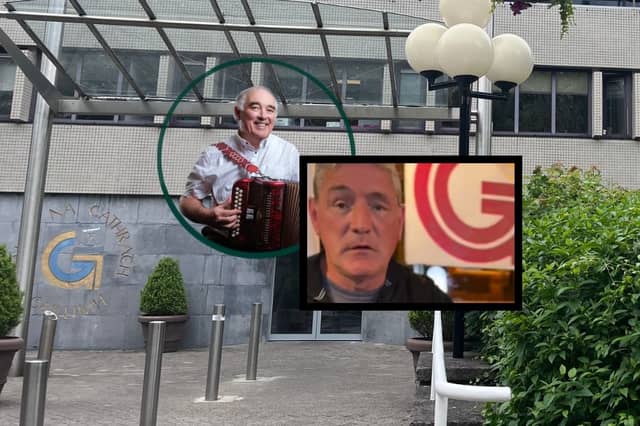

A spontaneous plea to ‘keep the Galway G’ has struck a chord after Galway City Council proposed changing its familiar logo.
It followed an impassioned plea from Fergus McGinn of McGinn’s Hop House in Woodquay, who believes the history and heritage behind the Galway ‘G’ - created by Spiddal based designer Jimmy Conneely for the city’s quincentennial celebrations - should be preserved.
What began as a last-minute social media post quickly gained momentum at home and abroad.
“I am really delighted with all of the positive feedback,” he said.
“Thank God, it has all been positive. Some of the messages have been beautiful and touching – old Galwegians saying they knew Jimmy, people talking about it. It has been a rollercoaster, as they say.”
For Fergus, the reaction shows that the attachment to the Galway ‘G’ goes beyond the design itself.
If Galway is to adopt a new symbol, he believes it should have a strong connection to the culture and character of the city.
“We were so upset about the whole thing the last couple of days,” he said.
“If that logo that they came up with was a bit arty, or was something cultural, or something to do with Galway, then yes, by all means, put it out there if it is better for our city.”
Part of his frustration is his belief that the history behind the existing logo had been overlooked. But there are still people in Galway who remember not only the origins of the design, but the man behind it.
Brian Nolan of Galway Walks worked with Jimmy Conneely and remembers an era of graphic design before computers and design software, when artwork was painstakingly produced by hand.
“I worked with Jimmy when I was with the Irish Tourist Board,” he explained. “And we came up with all sorts of stuff.
“He did a lot of the print work and I would proof stuff. He was a serious designer. He had to do everything by hand, with razor blades and magnifying glasses and ink. There was no help from any sort of software, and it stood the test of time.
“He lived in Spiddal. He was such a good guy. I would drive out there as we had no fax and no email. He was as proud a Galway man as you could ever meet. He did it from his own imagination.”
For Brian, the Galway ‘G’ has become so familiar that it is easy to take for granted. The design emerged as the city prepared to celebrate the 500th anniversary of the granting of its charter.
“It was to celebrate the quincentennial – celebrating the 500th anniversary of the granting of the city charter to Galway by Richard III in 1484,” he said.
“We came up with this new branding for Galway. We were looking into the new era.”
The significance of that period is also vividly remembered by musician Gerry Hanley, who was in his 20s during the quincentennial celebrations.
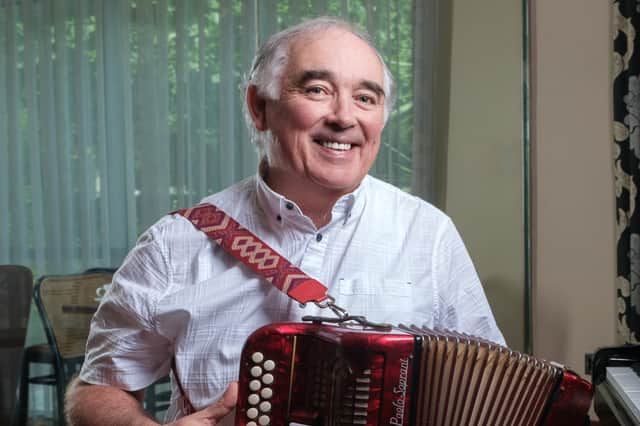
For him, the debate about the logo cannot be separated from memories of what 1984 meant for Galway and how the celebrations changed the way people viewed their city.
“It was huge for Galway,” he said.
“There was a great lift. It gave us a great appreciation for the city. We have wonderful memories of it. It changed the way we saw Galway. We saw it in a new bright light.”
That connection between the city and its creative community is also central to Fergus’s objection to the new logo.
“We have art coming out our ears, to be polite,” he said.
“I can name artists the length of my arm in Galway that would die to make a logo for our town.”
His concerns also extend to the decision to spend money on a new identity at a time when many small businesses are struggling to survive.
“For anybody up at City Hall who thinks this is a great idea, I don't know what they are thinking or whose money they are spending,” he said.
“I know small businesses and pubs that are closing weekly.
“I wouldn't have survived 40 years in this trade if it wasn't for my wife, family and friends. I would be out of this business years ago.”
Lack of consultation:
For Fergus, the issue is also about consultation. He believes people involved in the hospitality, arts and cultural life of Galway should have had a greater voice in a decision involving one of the city’s most recognisable symbols.
“It's disgraceful and an insult to us all,” he said.
“They can't just trump this out and think we will all accept it. No. I have had enough.”
Those concerns are echoed by Gerry, who described the proposal as “shocking” and questioned how the decision had been reached.
“It is shocking,” he said.
“Someone got a rush of blood to the head. You don't need expertise to pay a consultant to create a logo.
We, the public, only find out after they are done. We are not part of the debate.”
He argued that a full business case should be made available to explain the rationale behind replacing the existing identity.
“The public may not be as anxious if we had a business case,” he said.
“But when we hear this shot out of the blue, it causes concern.”
The cost of the project to date is €28,000, funded through the council’s communications budget.
Mr Hanley fears that the ultimate cost could be considerably higher once changes to signs, literature and digital services are taken into account.
“Why fix something that is not broken without rightly thinking through the consequences, cost and processes?” he asked.
“There is collateral damage – all of the literature, the letterheads, the cost to change websites, parking apps. We shouldn't defend the indefensible.
“People are getting cheesed off with this expenditure and the council are not listening to the wishes of the people.”
He also argued that public debate is particularly important.
“Why change something that is working?” he asked. “A lot of things happen because people stay silent. People need to speak out. Democracy needs to work in our own town.”
And he said it raises a wider question about where such changes should end.
“If you need to change the logo, does that mean changing the tricolour?” he asked. “When do we stop? Do we change the name of Galway altogether?”
Mr Hanley also believes Galway’s artistic community should be at the heart of any future design.
“Let's have a logo by a human rather than a computer-generated image,” he said.
For Brian Nolan, however, there is already a natural point on the horizon when Galway could consider what comes next.
In 2036, Galway will mark 800 years since its foundation – an anniversary he believes would provide a meaningful opportunity to look again at how the city represents itself.
“That should be the next time we change our logo,” he said.
“It will be for a real reason. Let us do it for a proper celebration. Galway was founded by the Normans in 1236. We can't change it every week willy-nilly, doing it for vicarious pleasures.
“We ought to wait and be calm. We have ten years to plan our octocentenary. That is where we should be focused – on where Galway will be in ten years' time.”