

Galway In Days Gone By

1925
Stopping the decay
Cities and towns, like all terrestrial things, get worn out; even the world itself will grow old.
If places or peoples are permitted to denigrate, they will crumble, slowly or rapidly according to the incidence of degeneration, to decay and ultimately inanimation.
It is the way with all things mortal; it is the way with things built by mortal hands. We are sometimes inclined to neglect this undisputed fact, to forget that constant change and renewal are of the very stuff of life and progress.
Old machinery must be renewed to be kept up-to-date, abreast of the times; effete, worn-out generations must be replaced by new blood. Fresh brains. The realisation of this master fact makes for definite progress; the refusal to appreciate it makes inevitably for decay.
The old City of Galway has had its evil days. Its ruins tell the story to every stranger. But a change came a year ago. A decade is as nothing in the life of a town. Yet we believe that within a single year, Galway has arrested the downward motion and has begun to make definite forward progress.
Hard, even cruel, economic factors combined with a magnificent civic pride, have supplied the driving force.
1950
Millions tossed about
In Ireland, as in most other countries, national Budgets have been getting bigger and bigger – so much so that the stage has long been passed at which the ordinary man in the street could be expected to grasp fully the precise meaning of all the millions so airily tossed about. It is only when one comes to study the results of public finance on the pocket of the individual that the revolutionary changes in life over the past couple of decades can be understood.
Some remarkable figures were produced in the Dáil on Tuesday by Mr. McGilligan in a reply to a question put by Mr. MacEntee. The Minister for Finance disclosed, for example, that the excise duty on beer last year amounted to more than £4,800,000, while the duty on sprits exceeded five million.
Reduced terms of individual drinks, this works out at about 3½d. on a pint of stout, 2¼d. on a pint of porter, and no less than 1/7¼d. on a glass of whiskey.
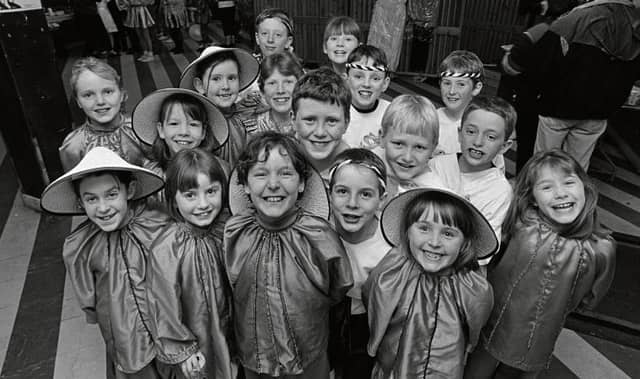
Pictured: Members of the Young Claddagh Tops who took part in the local final of the John Player Tops competition on April 5, 1991.