

Galway In Days Gone By

1925
Colonialism’s impact
Now that the English Government has left the country, a section of the English Press has become extremely solicitous about the condition of the famine-ridden peasantry along the western seaboard.
The Daily Mail utilises the pitiable plight of the peasantry as a weapon with which to discredit the Irish Government. It conveniently ignores the fact that the conditions that have been left to us to remedy are the direct outcome of years of the alternating British policy of tinkering with the problem and neglecting it.
Other newspapers, which adopt a different policy, are to-day busy revealing to the world the degradation and misery of the section of our people whom Cromwell herded on the barren coastline years ago in the hope that they might be driven to starvation and death.
Mr. Leonard Spray, in a message to The Daily Chronicle, declares that the hovels of the West and the life that is saved in them are a black stain on the fair green surface of Ireland, and a disgrace to European Civilisation.
The obvious retort is that British Parliaments controlled conditions in these poverty-stricken areas long enough to remedy them. It might also be said with cold, calm truth that morally, at any rate, a cleaner life is lived in the festering “agricultural slums” of Connemara than in the rich industrial centres of England.
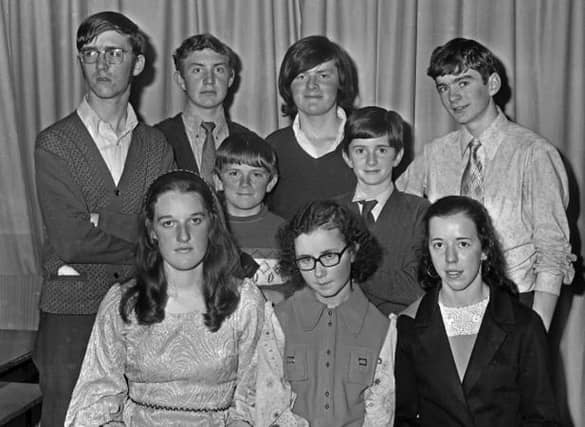
Pictured: Prizewinners in the Talent Competition at the Inter-Schools Quiz in mthe Jersuit Hall, Sea Road were, front, left to right: Anne Melia, Frances Waters and Margaret McBride. Centre: Colm Ó Duibhir, left, and Phelim McDonncha. Back, left to right: Conchubhar Ó Buachalla, Michael Ó Treassaigh, Séamus Gallagher and Fionán Ó Huiginn.