

Dolores bringing people back in time with Rebel Kin at Galway festival


Attending an event with family members in 2014 as part of Ireland’s Decade of Centenaries, Dolores Lyne recalls one of her clan remarking that they’d have to commemorate the anniversary of the death of her grand-uncle, Liam Lynch.
A key figure in Ireland’s War of Independence, he opposed the Anglo-Irish Treaty and was shot in an ambush in April 1923, during what became the closing days of the Civil War. Lynch died from his wounds. The guard of honour at his funeral included pro-Treaty soldiers, a testament to the respect he was still held in by former comrades.
Sitting in the Printworks Gallery on Market Street where her 3-Dimensional exhibition, Rebel Kin: To the Letter, is showing as part of Galway International Arts Festival, Dolores recalls that conversation about the need to ensure he was commemorated.
“I remember saying ‘I agree’. Then I thought, ‘who is this person going to be and what if nothing happens?’.”
An artist of enormous ability and energy, Dolores decided she would make something happen.
Thus began a journey that has taken her through the highways and byways of Munster, revisiting the places where Liam Lynch and others who were on the run, received shelter.
She stresses that Rebel Kin is not just her family story, nor is it a glorification of war. It’s an acknowledgement “that people did their best in a situation where things were not black and white, because things aren’t. And it’s also about a whole community of people, especially women who were erased from the story in the new Irish State”.
Entering the space in the gallery where Rebel Kin is displayed, viewers are met with giant, unframed canvases, containing various dreamlike images in pastel colours. Some are of houses where volunteers found refuge. Some are of letters Liam Lynch wrote to family members, mostly to his brother Tom, a priest in Australia. One is of his spectacles, which were returned to his family after his death, along with his religious scapulars and a watch for his sister – many other items were not returned, something Dolores learned more about as she pieced together the jigsaw of his life.
The paintings are tacked to the wall, unstretched and with fold marks, like letters that were folded many times over. The tacks convey a sense of transience, while the folds were inspired in particular by one letter, from the military barracks where his body was, telling Mrs Lynch it was ready to be collected.
The canvas used by Dolores acknowledges the role it played in these men’s lives. They slept under canvas, their reconnaissance maps were made of canvas and their backpacks – often sewn by women – were also of that “durable, resilient” material.
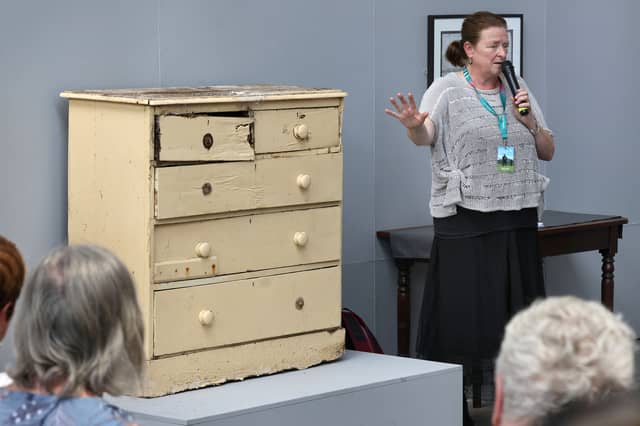
She’s put a remarkable amount of thought into this show, which also includes display cases with prison drawings, a dispatch bike used by Lynch and others, a table with information on the era, and a recently acquired chest of drawers, which contained a copy of the last letter Tom sent to Liam from Australia, which arrived after his death. The family who’d owned this piece of furniture had thought the letter was original, but it’s a copy. The original is owned by a relative of Dolores.
It’s there as part of the complex process of piecing together lives that can’t be fully recreated.
“What I wanted was to create an atmosphere, to try and give an understanding of going back.”
An award-winning set designer, Dolores brings theatrical skills to Rebel Kin.
“The 3-D view helps people to understand more of the environment of the time,” she says.
She decided on this approach, having “walked backward in time through lonely gates and yards in Kerry, Cork, Waterford, Limerick, Tipperary and Clare, meeting people who were connected to that time”.
The show also contains photos of houses where volunteers found refuge, many of which have gone back to nature and now offer a different kind of shelter.
Before ever picking up a paintbrush or camera, Dolores spent “nearly a year just reading about this period, because I didn’t know enough about it”.
She gives a wry laugh and says she left school knowing more about Surrender and Regrant, and Silken Thomas, from the Tudor period, than about the War of Independence or Civil War. They didn’t get the same attention.
Growing up in Killarney, politics weren’t really discussed. While her mother was Liam Lynch’s niece, Dolores’s father’s family been pro-Treaty. The Lynes were dairy farmers and cattle dealers, who supplied hotels in the tourist town with milk in the early 20th century and whose house was burgled by the IRA on the hunt for money to buy guns.
Her grandfather was inadvertently caught up the 1921 Headford Ambush, when the IRA attacked the Fermoy to Killarney train. The man sitting beside him was among those killed. But otherwise, the Lynes went about their business.
While politics didn’t feature large in her childhood, she recalls that the family went to Fermoy every September for a commemorative event for Liam Lynch and Michael Fitzgerald who’d died on hunger strike during the War of Independence.
This event transcended the ‘split’. And, says Dolores, people like Lynch thought it would be short-lived.
“In the early days of the Civil War, he put out an order not to shoot ‘any of the big lads because we’ll need them later’. He thought they would reunite.”
Her research is based on sources that include “official documents in the National Library and unofficial documents owned by various relations”.
An Arts Festival Elevate bursary allowed Dolores to collaborate with composer and musician Ellen Cranitch on a soundscape for a rolling slide sequence of other remote places she visited.
The pastel colours of the paintings link in with the autograph books, popular among prisoners of the time. The messages on their delicately coloured pages chimed with her theatrical approach.
“They were more of an aide memoir rather than telling the whole story.”
Another striking aspect of her canvases is that while they contain images of houses and co-ops, including places where “the people in between, the women and dispatch riders” were employed, there are no humans.
“That’s because they’re gone,” she says. And many of the people Dolores spoke during her research, who had direct family memories of this time, are now dead. “This is the tail-end,” she remarks.
What she loves about presenting Rebel Kin is people sharing stories about their families' part in this period. A notebook and pen in a corner of the room invite people to write these down. Many are fragments and may trigger other memories, “so that it becomes like joining the dots”.
Rebel Kin: To the Letter runs until this Sunday, July 26, at the Festival's Printworks Gallery in Galway City.