

Celebrating glass art – from Venice to Clifden


Arts Week with Judy Murphy
A unique piece of mosaic glass art created by Loughrea artist Alison Mac Cormaic, that makes a statement about gender inequality, featured at this year’s Venice Glass Week Hub.
Say Yes to the Test was chosen to be part of the annual exhibition in the Italian city, renowned for its glass.
The unique mosaic dress was made by Alison who’s originally from Scotland, and has been living near Loughrea for many years. She designed the dress in collaboration with fashion designer Mairidh Nic Cormaic, who is her daughter.
The two created used thousands of tiny mosaic pieces, many of them recycled glass off-cuts, to create the dress which was first displayed at last year’s Portumna Arts Festival. In addition to being a beautiful piece of work, it has an important message.
“It was designed to highlight the Irish CervicalCheck cancer scandal, an appalling example of gender inequality within Irish healthcare,” Alison explains. “The mosaiced surface pattern of the dress was formed from images of cancerous cervical cells, which are similar to those that went undiagnosed because of misinterpreted cancer screening samples taken from women in Ireland between 2011-2018.
“With hundreds of women wrongly diagnosed, the misreading of the tests occurred largely because of the outsourcing of the screening process, withholding of results that were found to be malignant, and subsequent cover-ups.”
While the dress is a testament to how the Irish health system failed women, Alison also wanted to deliver a positive message. That’s reflected in the artwork’s title Say Yes to the Test which aims to encourage women to attend regular cervical screening tests.
While Alison was organising to transport this fragile work to Venice and to attend Glass Week, she was also putting the final touches to Fourteen Fragile Forms, a joint exhibition at Clifden Arts Festival, which with fellow glass artist Lindsay LeBlanc. At the Alcock and Brown Hotel, Fourteen Fragile Forms explores and celebrates Ireland’s native flora through flameworked and mosaic glass pieces.
For this unique show, Alison and Leitrim-based Lindsay focused their attention on seven Irish plants, including gorse, dock, rushes and ivy.
They collaborated on the project during the Spring and Summer of 2025, meeting in Loughrea and Leitrim to discuss colour, texture, growth patterns and other elements that were specific to the plants they had chosen.
Then, they depicted these plants, via Lindsay’s colourful sculptural glass pieces and Alison’s mosaic drawings, all inspired by scientific collections
The flameworked sculptures from Lindsay offer a tactile, three-dimensional interpretation of the plants and she explains that the sculptures are more resilient than they look because they are made of Pyrex.
Her works are shown side by side with Alison’s mosaics, and having them so close together really demonstrates the different ways they use glass.
There are similarities too, as they both explore movements and life cycles, highlighting overlooked moments of growth and change.
Using gesture, structure and beautiful colour, this exhibition celebrates the beauty, complexity and importance of Ireland’s native flora.
Fourteen Fragile Forms, in the function room of the Alcock and Brown Hotel, also gives people an insight into how the two artists work, from drawings right through to the finished pieces.
The materials they use are also showcased, and anyone who wants to learn more about mosaic and flamework glass art will delight in the reference books.
Fragile Forms runs until this Sunday at 5.30pm.
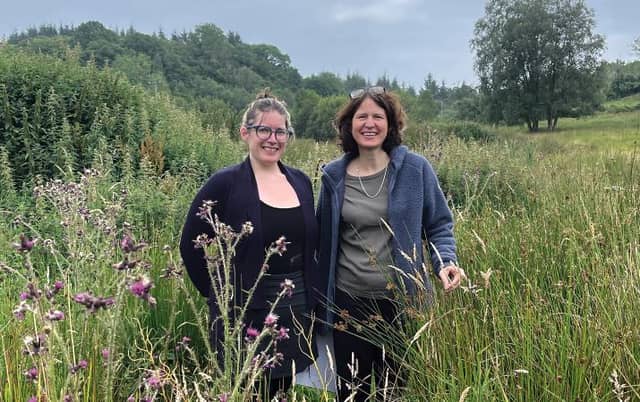
Pictured: Artists Lindsay LeBlanc and Alison Mac Cormaic researched the structure and life cycles of the native Irish plants in this show.