

'You're as welcome as the flowers in May': Tom Langan's charity legacy

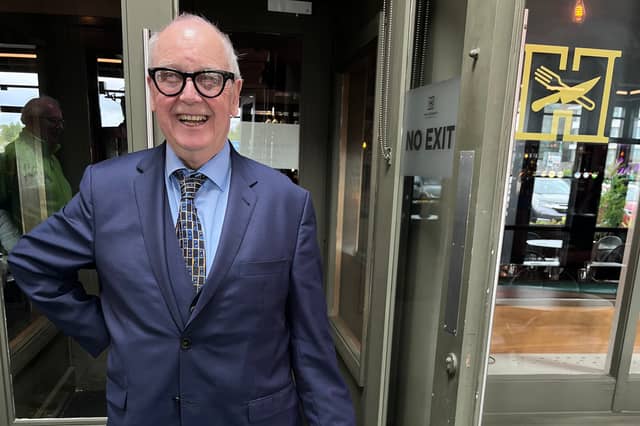

When Tom Langan returned home to Abbeyknockmoy from St Joseph's School for the Blind in Drumcondra, his grandfather waited for him at the front door.
His arms outstretched, he reached down to the young 12-year-old and said, "You are as welcome as the flowers in May”.
Nearly seven decades later, it is a memory that has never left him.
Tom's grandfather was heartbroken when he left rural Galway for Dublin. In the Ireland of the 1950s, there was little support available for children with disabilities, but Tom's mother Delia, his teacher Johnny Glynn and parish priest Fr Garvey knew that if he was to receive an education, he needed opportunities that simply weren't available at home.
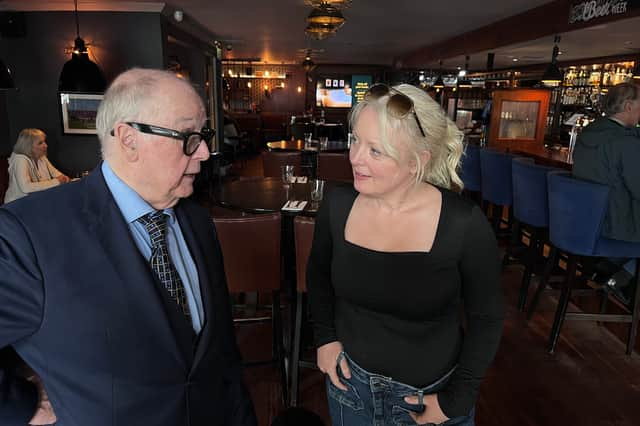
"My grandfather didn't want my mother to send me at all," Tom recalls. "He thought it was an awful thing to send a child away to a school like that."
When he returned home for the first time, however, his grandfather's welcome said everything.
That came from his heart. That's the kind of thing that holds a man together in difficult times
Looking back now, Tom can trace much of his life to that journey to Drumcondra. It gave him an education, introduced him to Braille and gave him the confidence to forge a path of his own.
Few could have imagined that the young boy leaving Abbeyknockmoy would go on to enjoy a 41-year career, become the first guide dog service user in County Galway and help establish the Galway branch of Irish Guide Dogs.
Born with retinitis pigmentosa, an inherited eye condition that gradually causes sight loss, Tom was the second youngest of five children born to Delia and Tom Langan. He grew up alongside his brothers John, Tim and Frank and his sister Maura on the family farm in Abbeyknockmoy.
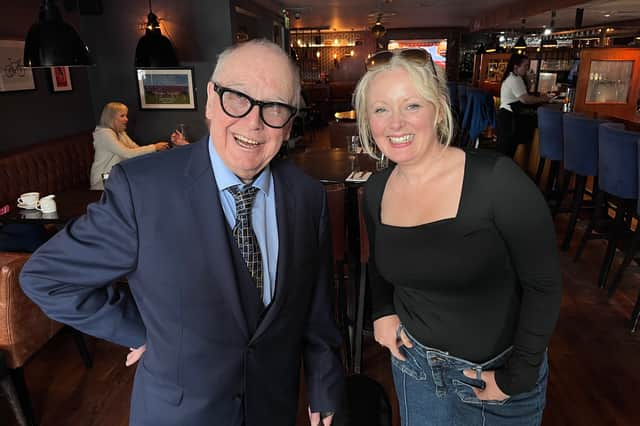
"It was a great place to grow up," he says.
"There was always something to do on the farm. You never sat down. People ran in and out all the time."
Although his sight was deteriorating, Tom retains vivid memories of those early years.
"I could see the fields and the hills and the bog,” he says. "I could pull turnips, pick potatoes and help with the hay and turf. Being able to see back then has helped me all my life. I know what an environment looks like."
At Crumlin National School, however, it became clear that he was struggling.
"I couldn't see the board."
Teacher Johnny Glynn recognised that Tom needed additional support and helped secure him a place in Drumcondra, where he would learn Braille and begin building the confidence he needed. The transition was not always easy.
"School was hard," he says. "The culture was very structured and difficult at times. At the age of 12 you're leaving your school friends behind. I was a country lad going into a city environment."
Even the language felt unfamiliar.
"They used to talk about going to 'the jacks,' and I hadn't a clue what they meant," he says with a laugh.
Yet looking back, Tom has no doubt the move changed his life.
"Without that environment to learn and cope with it, where would I be?" he asks.
"I'd probably be at home trying to live off the dole."
After school he trained as a piano tuner in Shannon, despite not being able to play the piano himself.
The apprenticeship lasted five years, but after four years the factory closed.
"I could have trained in England to finish the skill, but it would have been a different career entirely, going from place to place," he says.
"It would have been a different life."
Instead, he found himself in Shannon during the early 1970s.
"The population was very small,” he says. “There was only one bar and the Airport Bar. Outside of that there wasn't much happening.
"I used to be running with friends into Limerick and Ennis to sow the wild oats. Not easy when you can't see, but I enjoyed the effort of sowing!"
It was during this period that he met people who helped shape his outlook. Some of his closest friends were totally blind and living full, active lives.
He was surrounded by friends who challenged assumptions about blindness and demonstrated what was possible.
When you're around people living and doing it, it rubs off on you.
"You don't have time to sit around worrying about what you're going to do next."
Determined to find work, Tom approached Martin Conneally, then telephonist with Galway County Council, and asked if he could observe him on the job.
Three days a week, he travelled by bus from Abbeyknockmoy to Galway and back again, learning the trade. Not long afterwards, a position became available with the Western Health Board.
"Another great man in my life, Brendan Naughton from Mountbellew, asked would I be interested," he recalls.
"'Would I be what? Thank you very much. I can start tomorrow.' "I was mad to get work."
At the time, he was receiving welfare payments and remembers feeling uncomfortable about it.
"It was the same pension book my grandfather was drawing from.
"I liked the money, but I didn't like being 22 or 23 years of age and drawing it. I wanted to build my own life."
The position would become a career lasting 41 years. Another turning point came in the late 1970s.
A friend in Limerick had travelled to England to receive a guide dog. At the time, no guide dog service existed in Ireland.
Tom had always struggled with night blindness.
"I had to use a cane at nighttime from very early on,” he explains. “I thought if I had a dog, I wouldn't be going blind every night.”
Soon he found himself travelling to Exeter in Devon, where he was paired with his first guide dog, Bianco. The partnership opened up a new world of opportunity and set him on a path that would shape much of the rest of his life.
As discussions gathered momentum around establishing an Irish guide dog service, Tom became heavily involved.
"Bit by bit, the idea that we would establish the Guide Dogs Association ourselves took hold," he says.
"Our first meeting was at the Mansion House 50 years ago this year. You'll always meet resistance when you're trying to do something outside the box."
However, they persevered, with church gate collections, fundraising dances, information evenings and community events across Galway.
What began as a small fundraising effort in Galway would become a major part of Tom's life for almost five decades.
From helping establish the Galway branch in 1978 to serving for 15 years on the national board, Tom helped shape services, awareness and support for people who are blind or vision impaired both locally and nationally.
“When I came back from the meeting, I had started the beginnings of a fundraising branch in Galway for guide dogs and assistance dogs,” he says.
“I remember Kevin Kennedy, who was originally from Dunmore, did dances in New York for us. In the early years, we had two committees - one for fundraising - and one to show how guide dogs were trained. The ICA and womens' organisations were very good to help us get the word out there.”
One of his favourite memories involves a Christmas tree initiative that eventually spread nationwide. Volunteers sourced trees from forestry plantations in Moycullen, arranged lorries, found storage yards and sold them throughout the city.
"It was all done by volunteers," he says. "We weren't just looking for a handout. We were giving something back.
"We made contact with Jim Phelan in Moycullen and told him we wanted to buy trees. Fair play to McDonaghs yard who let us store a lorry load of trees twice a week."
For Tom, those early years were about much more than fundraising. "We'd be fundraising all day and socialising half the night," he laughs.
As the organisation grew, he became a passionate advocate for guide dog users. Back then, being refused entry to restaurants, taxis and businesses was a regular occurrence.
"You had to stand your ground," he says. "You'd get ready to go out for the evening and you weren't sure if you'd be allowed in with the dog. It caused huge anxiety.
"If you are turned away, you feel ashamed."
While attitudes have improved dramatically, he believes education remains the key. Life also brought happiness away from volunteering.
In 1989, he met a nurse from Renmore named Mary Harrigan while taking part in a fundraising campaign to send Irish athletes with disabilities to Seoul.
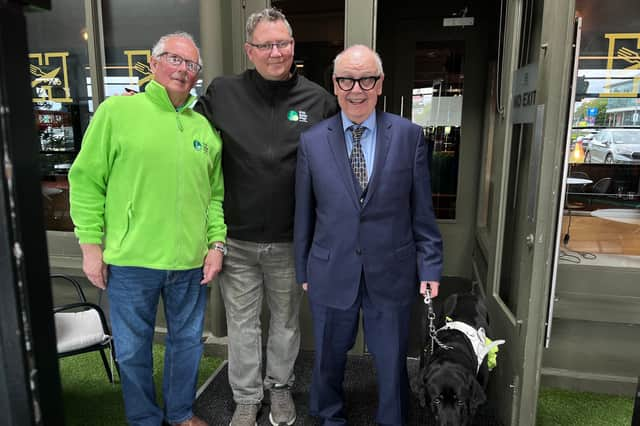
The couple married in 1992 and today live in Renmore with Lady, his seventh guide dog.
"When I got married, I reviewed everything," he says. "I was going away all the time and gradually stepped back. I can't go out and stand in the rain anymore. I am 75 now.
I enjoyed every aspect of it. I like campaigning. I am a campaigner by nature.
As Irish Guide Dogs celebrates its 50th anniversary, Tom takes particular pride in the organisation's growth, integrity and professionalism.
Having spent years on the board, he remains a strong believer in accountability and good governance.
"A voluntary organisation should always have an eye on its integrity and its public perception," he says.
"I'd love to see Irish Guide Dogs continue to have very safe structures to carry out their mission."
The Galway branch, which has grown from around 15 volunteers to 60 in the past three years, is currently seeking additional puppy raisers to help prepare future guide and assistance dogs for formal training.
Yet when Tom reflects on nearly five decades of involvement, it is not committees, titles or fundraising totals that stand out.
Instead, he returns to the importance of opportunity, encouragement and self-belief.
"You have to mix life with humour and take the punches and roll with them," he says. "I was always out there doing something. I had a mission."
Then comes the advice he would offer any young person facing sight loss today.
"If you have support from family, but not control from family, that helps,” he says. “Sometimes people overcompensate. You need to fall down in order to learn how to get back up yourself."
As our conversation ends, Tom points to the AI-powered Ray-Ban smart glasses he has worn throughout.
They can describe the world around him - technology that would have seemed unimaginable to the young boy who left Abbeyknockmoy for Dublin more than 60 years ago.
While much has changed since then, the memory of a grandfather waiting for him at the front door remains.
"You are as welcome as the flowers in May."