

Irish Workhouse Centre celebrates the power of Galway's local history


The Irish Workhouse Centre in Portumna offers a unique insight into Ireland’s Great Famine. On Sunday last, it hosted the National Commemoration ceremony, something Christy Cunniffe of the centre hopes will be the beginning of a new chapter for the organisation.
Hosted by Culture Minister Patrick O’Donovan, with Taoiseach Micheál Martin as guest of honour, the event was attended by dignitaries from around the world. For people like Christy who had helped save Portumna’s workhouse from destruction, this was an emotional occasion.
“Did we ever think we’d see the day that the tricolour would be raised here?”, fellow board member Pierce Joyce asked him as they watched the ceremony.
It was Pierce who, back in the 1990s, had intervened when he spotted bulldozers coming onsite at the dilapidated complex. He and like-minded people began a concerted campaign for its conservation and restoration, which began in 1999.
This workhouse which first opened in 1852, became the Irish Workhouse Centre in 2011, and is run mostly through donations and volunteerism.
“Sunday gave us invaluable national and international media exposure,” says Christy of an organisation that does extraordinary work on a shoestring.
That included creating the impressive programme of free community events around the National Famine Commemoration. These kicked off with a conference, ‘Reflecting on the Great Famine’, on May 9. This explored everything from philanthropy to how the famine has been depicted in art, and the impact it had on Ireland’s uilleann pipers.
That talk by Bearna resident Michael Kelly and one by Rebecca O’Regan about the philanthropy of wealthy women during the famine gave weight to a remark by Professor Christine Kinealy, the founder of Ireland’s Great Hunger Institute in Quinnipiac University, Connecticut, that “it’s about the human story”.
There were as many famine stores as there were people affected, she said. So, while much has been written about these terrible years and their legacy, many more stories are still unknown.
Some of these were revealed at events in the workhouse throughout the week, including one on Sunday, May 10, featuring 30 community groups from across the county, sharing oral histories of the famine.
A short, painfully powerful account of the Great Famine in one parish was also launched that day. ‘Hunger, Hardship and Relief: The Great Famine in Killimor, Co Galway’ used contemporary accounts from the 1830s, to document the desperate poverty of people who, even before the potato blight of the 1840s, were hanging on by a thread.
At the conference on May 9, Professor Kinealy stressed the importance of engaging with young people through “constant education and participation”, to ensure the Great Famine was not forgotten. She praised a new graphic workbook, ‘Children in the Workhouse’, written by Dr Gerard Moran and illustrated by Sarah Nylund.
This educational book is based on the life of Mary Fielding who was reared in Portumna Workhouse. It uses her life story to explain the history of Ireland’s workhouses and what life was like for people who were forced into these places by dire poverty.
Mary’s story is now available to visitors to Portumna, via a self-guided tour. That was also launched last week when historian David Broderick conducted a walk through the town.
The workhouse and its artefacts formed the basis of a moving poetry collection that was launched last week too. ‘The Silence of stone I and II’, which includes work from a similar project in 2023, was edited by Noelle Lynskey and Gerard Hanberry, and has photos by Kerry Kissane.
Professor Kinealy and other speakers at the opening conference stressed that famine remains a reality for many people around the world today. And like Ireland’s Great Hunger, modern famines are not due to crop failure, but to policy decisions taken by those in power. Professor Kinealy spoke of the need to highlight this and give a voice to those in need today. Her sentiment was echoed at launches and talks throughout the week, right up to An Taoiseach’s speech on Sunday.
Ensuring that the commemorations ran smoothly required all hands on deck and County Heritage Officer, Marie Mannion, who was key to organising the conference and events during the week, says the input of heritage groups from across the county was crucial.
More than 30 banners from these groups were displayed at the Workhouse Centre and attracted huge attention from diplomatic guests at Sunday’s commemorative event.
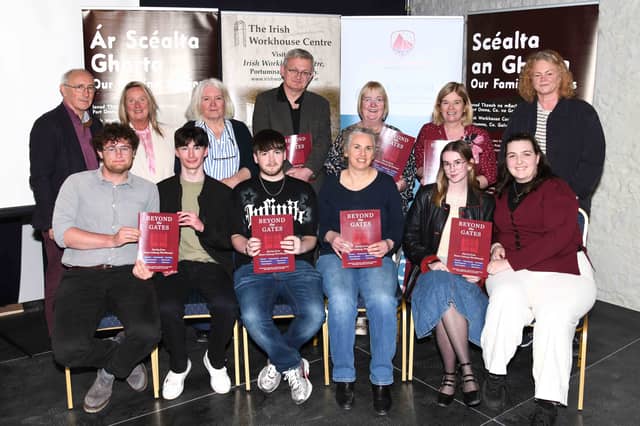
Several members of heritage groups were involved in a further commemorative publication, ‘Beyond the Gates: Stories from Seven Galway Workhouses’, compiled by five students from the University of Galway while on placement with the County Council Heritage Office. This was developed by Marie in collaboration with Antoinette Lydon of Oughterard Heritage and volunteer Síle Ní Thuairisg.
The institutions covered include Galway City, Glenamaddy, Loughrea, Mountbellew, Moycullen, Portumna and Oughterard, fulfilling Marie’s aim of matching the students with places they were connected to.
Some of them are studying history and others social science, and Marie is delighted at the way they shared their skills. All spoke at the launch last Wednesday, gaining invaluable experience for their future careers.
Read next: Friendship, rivalry and adventure as Eva's play premieres at Galway International Arts Festival
The final publication of the commemorative week was a reissue of ‘An Gorta Mór i Maigh Cuillin’, a book compiled in the late 1990s by the Moyullen heritage group, which has been out of print for years. It was launched on Wednesday as part of the packed programme.
No wonder Micheál Martin, in his speech, commended Galway groups for their trojan work on this year’s National Famine Commemoration. Marie Mannion and Christy Cunniffe also point to the many people whose work behind the scenes ensured its success – from the Tidy Towns team who had Portumna in shipshape for the occasion, to those volunteers who stacked chairs, assembled and dismantled stages and provided endless refreshments.
Events continue this Sunday with ‘Threadbare’, an exhibition by Joyce Little, which will be opened by writer Nuala O’Connor and will run until June 14.
But there’s no resting on laurels. The Centre has just received a grant from the Heritage Council to draft a new Conservation Management Plan. Work will begin on that immediately, with the aim of unlocking vital funding for a place which keeps alive a past that should never be forgotten.