

Mary's title of Connemara Princess is restored as Alan publishes new novel

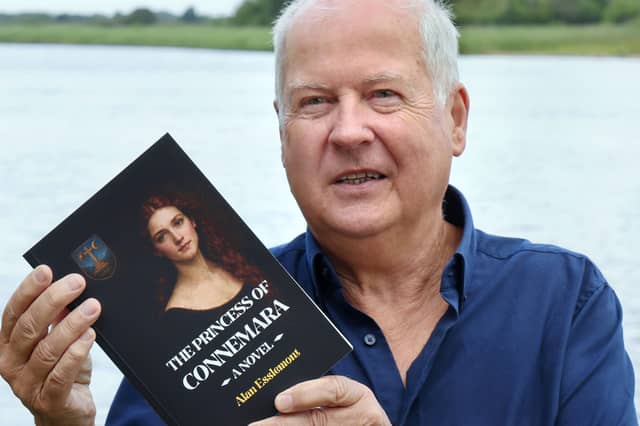

Sitting in Freeney’s Pub on High Street in Galway City over 40 years ago, Alan Esslemont promised a friend that he would learn Scots Gaelic. At the time, he was teaching English in Brittany, where his predecessor had been a Gaeilgeoir from Ireland.
“One day, someone asked me if I spoke Gàidhlig ” recalls Alan of his time there.
From Braemar in Scotland, “the same parish as the queen died in”, he had studied German, French and linguistics at the University of Edinburgh, but knew little about Gàidhlig. He rang his mother to learn more and discovered that it was spoken in his parish.
“The last speaker died in 1984, but it was never acknowledged in Scotland the way the Irish government acknowledged Irish,” says Alan who later went on to be Director General of TG4.
Alan’s pledge that night in Freeney’s began that journey. Firstly, it brought him the Isle of Skye where he worked in a knitting factory and learned the language from older speakers there, then on to UCG in 1984, where he taught it on a nine-month contract. That was after he'd returned to Edinburgh University to do Celtic Studies, graduating top of the class.
He met his Mayo-born wife, Máire, in Galway when she taught him Irish and the couple set up home in Connemara, initially in Derrygimla and later in Camus. They have five grown-up children and two grandchildren, with a third on the way.
Despite his time teaching in UCG and Brittany, Alan knew he didn't want to do it as a career. As well as knitting on the Isle of Skye while learning Gàidhlig, he'd also spent time working in a ski resort in Switzerland, so he was a late developer career-wise, he says with a laugh.
However, when Alan began a course in TV production in Tralee in the late 1980s and sat at an editing desk, he knew he had found his calling. He loved the process of making stories.
After work experience in RTÉ, he successfully applied to the pioneering production company, Telegael, based in An Spidéal, and gained huge experience there. He was then recruited to help establish Teilifís na Gaeilge, which launched in 1996. After its relaunch as TG4 a few years later, he became Director of Television there. In 2008, Alan returned to his homeland to help set up and run Scotland's Gaelic language station, BBC Alba.
In 2016, he became TG4’s Director General, and in that role, “I used things that I knew were working in Scotland that I had learned in Ireland”.
That included “doing things for your core audience, who see Irish as their language – a lot of them would be native speakers, but not all – and also for your national audience”.
Alan also wanted to create prestige projects in Irish and drove the establishment of Cine4 to develop Irish-language films for cinema. Among its successes was the Oscar-nominated ‘An Cailín Ciúin’, as well as the earlier ‘Arracht’.
In a bid to cater for future generations and break away from the State's traditional approach to Irish, he spearheaded the establishment of the children’s channel, Cúla 4, “infrastructure that was critical for the future of the language”.
After retiring as TG4’s Ard-Stiúrthoir in 2025, Alan began a new chapter.
The result is his debut novel, 'The Princess of Connemara', a sweeping story of 19th Century Ireland, based on the extraordinary Mary Martin, novelist and granddaughter of Humanity Dick Martin.
Born in 1815, Mary, who was heir to the family’s vast estate, was much-loved in Connemara but is now “almost unknown and never spoken about when people talk about Ballynahinch”, says Alan. That was despite the fact that she spent far more time in Ballynahinch Castle than her famous grandfather ever did.
Alan’s interest in Mary Martin began years ago, after TnaG's successful relaunch as TG4.
“I was looking for something new to drive the head forward and started reading about Alexander Nimmo, a Scotsman living in Connemara.”
Born in 1783, Nimmo was an engineer “who laid out strategies for improving life in Connemara, with local people front and centre”.
Reading that he may have been a mentor to the daughter of Connemara’s main landlord, Alan decided “to delve into that” story. He did so over many years, while he was working in Ireland and Scotland. After retiring, he felt it would be a shame to waste his extensive research, which gives a great insight into a complex family and how they had come to own some 200,000 acres of hill and bogland in Connemara.
His subject, Mary Laetitia Martin, was the daughter of Tom, Humanity Dick’s son from his first marriage. Alan’s first insight into her personality was courtesy of a ‘Tour in Connemara’, written in 1833 by renowned author Maria Edgeworth who documented a stay in Ballynahinch and the impressions she had gained of Mary and her mother, Julia.
That book, which Alan read in the National Library, depicted a “quite extraordinary” young woman.
Edgeworth and two friends had been travelling to Clifden in March 1833, when their large carriage got stuck in mud – there were no roads locally. After being rescued, they sought refuge in Ballynahinch where they had to remain for three weeks as one of the travelling group, Lady Culling Smith, fell ill.
Having initially perceived 17-year-old Mary as haughty, Edgeworth soon came to admire her intelligence and education – Mary spoke French fluently and quoted Greek and Latin literature, as well as being well-versed in maths and science. She and her father, Tom, both spoke Irish.
“Mary was born and brought up in Connemara and didn’t have a governess per se, but had tutors,” Alan says.
Guided by Edgeworth, Mary contributed to an important French encyclopaedia on matters relating to Ireland. She developed a close friendship with the older novelist, who was a source of counsel, professionally and personally.
Mary's father, Tom, and his sister, Laetitia, had moved from Galway City to Ballynahinch in the 1790s, following the controversial divorce of their parents, Humanity Dick and Eliza.
Eliza, who most likely had had a previous affair with Theobald Wolfe Tone, had eloped with Scotsman John Petrie, whom she later married.
Her daughter, Laetitia, who was beautiful and much-loved in Ballynahinch, was “the first princess of Connemara”, Alan explains.
Laetitia’s niece, Mary, who was the only child of Tom and his wife, Julia Kirwan, was the second. And while Connemara might have been remote in terms of London or even Dublin, it had its own rich life, with Ballynahinch hosting many people, including The Liberator, Daniel O'Connell.
Mary was presented at Court in London where she had at least two suitors, and she travelled in Europe but Connemara was where her heart lay, something Alan, a keen hillwalker, captures in his descriptions of its hills, valleys and islands.
Her first novel, ‘St Étienne’, published in 1845, was set in France and her second, ‘Julia Howard: A Romance’, published in 1850, was based Connemara, the place she loved most, even as her family were forced out of there by their creditors.
Mary inherited the estate when her father died of Famine Fever in 1847 after he had visited the recently opened Clifden Workhouse, where he was on the Board of Governors. Tom's will stipulated that she had to marry someone of whom her mother approved. That was her younger cousin, Arthur Gonne Bell, who took the surname Martin.
With Connemara having been ravaged by the Famine, Arthur's approach to tenants on the estate was less compassionate than the Martins had been. But the couple were unable to retain the heavily-mortgaged property.
They moved away, ultimately to the USA, and it’s at that point Alan’s novel becomes a mystery story.
Did Mary die in New York in 1850, as was reported at the time, or did she disappear, escaping her unpleasant husband and her extensive debts?
That possibility is proffered in the novel, via the character of her cousin, New York lawyer Charles John Peshall.
Alan’s research is extensive as he presents a plausible alternative for how her days might have ended; in poverty near Stourbridge in England, close to the ancestral home of the Peshalls. This was the family her aunt Laetitia had married into.
But, ultimately, her fate is a mystery, he says. And that's ok because 'The Princess of Connemara' is a work of fiction, which also includes a love story between the young Mary and one of her father's employees, Colmán Keely, something that allows Alan to explain the complexities of how the Martins came to own their massive estate.
Alan’s love of local history and the place where he and Máire reared their family is obvious as he talks about Connemara, its landscape and its community.
His work in TG4 and BBC Alba and Máire's as a teacher in Clifden Community School meant they needed support when it came to childcare, especially since they had no family locally.
They have lived in Cinn Mhara, Camus, since 1989, and this 'blow-in' fondly recalls local woman Peigí Bhreathnach who played a crucial role in rearing their five children, “rooting them in the community”. All are fluent Irish speakers, with two of them being teachers – one primary and one secondary. There's a Garda, a civil engineer and a physics graduate who is currently doing a PhD at the University of Galway on the circular economy.
They were solidly supportive when it came to his decision to self-publish the book, and others have been too. Alan has special praise for all in the Clifden Bookshop, who were the first outside of family and friends to express belief in this novel that restores Mary Martin's name in history.
When it came to the novel’s cover image, there were no portraits of Mary, so he used descriptions from Maria Edgeworth’s writing, and also included elements of his late mother, Margaret, to create a likeness.
He’s not sure what he’ll turn his hand to next – maybe a book for children, he says. With Conall in Moycullen, Aoibhí in Kilkenny and another grandchild due later this month in Edinburgh, that seems like a project that would find fans near and far.
‘The Princess of Connemara’ is available in Clifden Bookshop, where it’s proving very popular and it’s also in other local bookshops, including in Oughterard and Charlie Byrne's in Galway City.
Alan will discuss Mary Martin and ‘The Princess of Connemara’ on Friday, September 18, at 3pm, in the Station House Theatre as part of the Clifden Arts Festival. More information at clifdenartsfestival.ie