

Survivors of Tuam Mother and Baby home tell their stories in new exhibition


A simple lock of golden hair, framed and on a main wall in Galway City Museum tells a powerful story of love, separation and the cruelty of Church and State towards single mothers in Ireland for most of the 20th century.
The hair belongs to John Rodgers, who was born in the Tuam Mother and Baby Home in 1947 and was taken from his mother Bridie, against her will, the following year. Before he was taken, Bridie cut a lock of John’s hair, determined that as long it remained in her possession, her baby would be safe and would be hers.
That baby is now in his late 70s and a key member of the group advocating for justice for all who were affected by what happened in the home – including the 796 children who died there and whose bodies were placed in mass graves in an underground septic tank, most of them without burial records.
Standing in front of the framed lock, John’s eyes well up as he tells how, when he and Bridie were finally reunited 38 years’ later, his birth mother presented this treasure to his wife Julie, as a belated token of their wedding.
In late May, John gave the lock to the Museum’s Acting Director, Adam Stoneman for this exhibition, ‘Survivor Stories: Tuam and Ireland’s Institutional Past’, which opened there on July 1.
“We have gold and silver items here, going back over centuries, but in that moment, that lock of hair was the most valuable treasure we had,” the younger man says.
Now, framed, it’s a key part of ‘Survivor Stories’. “Double-mounted,” says John approvingly. The Williamstown man was a framer for nearly two decades and knows quality when he sees it.
‘Survivor Stories’, involving 18 people who were born in the Tuam institution, arose from the University of Galway’s Tuam Oral History Project. Initiated in 2018 by Sarah-Anne Buckley and John Cunningham of the University’s History Department, it invited people who had connections with the institution to share their memories.
The result is a hugely important written and oral archive, with further plans to document other institutions where innocent people – many of them children – were incarcerated.
Sarah-Anne has just come from the Museums Education Room, where she gave a 20-minute talk to a group of Americans who are touring Ireland. It was followed by a Q&A session, during which one person shared their story of institutional abuse there.
Education is key to this exhibition and this was supported by US organisation, the Ireland Circle Foundation, Sarah-Anne explains.
Teresa O’Sullivan, who was born in the Home and spent two years there, took part in the University’s Oral History project and her story features here. Her son Cian who is involved in tourism, is also a member of the Ireland Circle Foundation.
Friday’s group is one of 29 who will visit during the exhibition’s three-month run, learning about an often-hidden aspect of Ireland’s history.
“The next phase is a permanent exhibition,” says Sarah-Anne, stressing that the testimonies of people from other institutions need to be written into Ireland’s story too.
Those include the industrial schools in Salthill and Letterfrack, the Magdalen Laundry in Galway City, the Loughrea orphanage and St Brigid’s Psychiatric Hospital in Ballinasloe
“There’s no one story,” she says, stressing how the photos and biographies in the Museum “show the diversity of people’s lives”.
‘Survivor Stories’ arose from an event held in Galway Museum last September when representatives from the National Museum spoke of their plans for a Centre of Remembrance.
Several Tuam survivors who attended felt Galway needed its own space.
“We thought, we can’t wait for Dublin to show us how to do this,” Adam says.
They would make it happen in the Museum, a State building, run by Galway City Council – that’s important because of the State’s shameful role in the history of institutionalisation, they say.
Countries such as Canada and Australia have already had exhibitions about their institutions, but ‘Survivor Stories’ is a first for Ireland. While there was no blueprint here “we had to make it work”, Adam says.
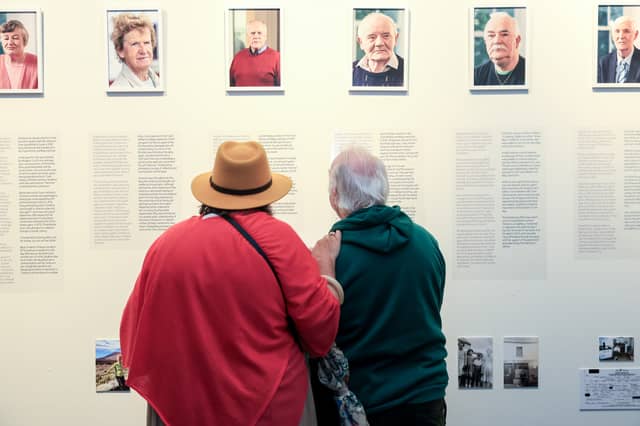
They’ve done that, in Museum foyer, where the survivors’ stories are told aurally and in written format. There’s a scale model of the Home, made by historian Catherine Corless, whose fearless pursuit of the truth about Tuam has done this country a great service.
There’s also a reflection box where people can share their thoughts on the exhibition and where other survivors who might not have yet told their stories, can make contact if they wish.
For John Rodgers, the exhibition is crucial to reclaiming a past that was concealed for so long. He believes shame is the reason the State has been so loath to address the wrongs done people like him, as it sought to hide what happened in institutions.
“This exhibition has removed that stain from my name,” he says, recalling the derogatory names he was called in the home as the child of a single mother.
“I was too young to know what it meant but I knew the tone.”
John moved to England in his teens, struggling to let people get close – he didn’t want them to know his story. He has long since realised it needs to be told, as do the other people who feature here. All have rich lives and, for all involved, it’s important the exhibition conveys that.
Everyone’s story is told individually, via a short biography and contemporary photo. Then, each person has shared two items that hold meaning for them. These are displayed under the text. Some people – including John – opted for photos of their younger selves, while others chose birth certs or Tusla documentation.
Some didn’t have archive items, which tells its own story, says Adam.
The text is bilingual, and for John, who loves Gaeilge, that’s important. He praises the work done by the Museum staff, while Adam adds that they’ve been trained to support visitors who might get upset.
This is the first collaboration between UoG and the Museum, and the survivors have been to the forefront of it all.
“It has opened up a space for conversation,” says Adam of the exhibition. All three feel this is something that other communities could do too.
It’s sensitive work and Sarah-Anne understands people might be afraid of making mistakes. But ultimately, it’s about doing justice to the survivors.
“We’ve made mistakes, but we’ve put up our hand when we did, and that’s important,” she says of the University’s Oral History project – the podcasts from that are also in the Museum.
‘Survivor Stories’ will run in until the end of September with events around it. More information at GalwayCityMuseum.ie