

Gardai masterplan to cut Galway road deaths


Safety strategy launched amid revelation that Galway saw 51 lives lost on the roads in five years
A NEW road safety strategy has been launched for Galway after 51 people were killed and 360 seriously injured on roads across the city and county between 2021 and 2025.
Speaking at the launch, Chief Executive of Galway County Council Liam Conneally said five people have already lost their lives on roads in the county this year.
“Of the 128 deaths to date in 2026, five of those have been in our county,” he said.
More than half of those killed or seriously injured in Galway between 2021 and 2025 were involved in collisions on roads with speed limits of 80km/h or higher.
Young people also featured heavily in the casualty figures, with those aged between 16 and 25 accounting for more than one in five of the 411 people killed or seriously injured.
The figures were highlighted as Galway City and County Councils launched their new Road Safety Strategy 2026-2030.
The plan contains 50 actions and sets a target of halving road deaths and serious injury collisions in Galway by the end of the decade.
Of the 411 people killed or seriously injured during the five-year period, 295 were involved in collisions in the Galway County Council area and 114 in the Galway City Council area.
The local authority area is currently unknown in two cases.
The figures reveal that drivers accounted for 37 per cent of all casualties, while passengers and pedestrians each accounted for 18 per cent.
They also showed that there were marked differences between the city and county.
In Galway city, pedestrians made up the largest group, with 36 killed or seriously injured, compared with 23 drivers and 23 cyclists.
In the county, 130 of those killed or seriously injured were drivers and 61 were passengers.
Almost two-thirds of all casualties were male, while 21 per cent were aged between 16 and 25.
The time of day also emerged as a factor, with 28 per cent of casualties injured between noon and 4pm and a further 26 per cent between 4pm and 8pm.
Galway’s two local authorities have set an interim target of reducing road deaths by 15 per cent and serious injury collisions by ten per cent by 2027, before seeking a 50 per cent reduction in both by 2030.
Mr Conneally said statistics could obscure the impact a serious or fatal collision has on those left behind.
“Behind every collision statistic is a person,” he said.
“It is a family, a friend, a community dealing with consequences that last a lifetime.
“Deaths and serious injuries are not inevitable.”
Galway has particular challenges, he said, including busy commuter routes, a growing city and an extensive rural road network.
Galway County Council alone is responsible for almost 7,000 kilometres of roads.
But he said responsibility for making those roads safer could not rest with one agency.
“Safer roads cannot be delivered by any one organisation,” he said.
He urged people to slow down, remove distractions, wear seatbelts and watch out for vulnerable road users.
“The real test of the strategy is actions and implementation,” he said.
Leas-Cathaoirleach of Galway County Council Cllr Michael Regan (FF) said poor driver behaviour remained a factor in collisions despite continued investment in road infrastructure.
Living in Loughrea, he acknowledged the long journeys many people in the county have to make for work, school and healthcare.
“Road safety is a shared responsibility,” he said.
“Every road leads back to the community and not a single one is not touched by tragedy.”
Mayor of Galway City Cllr Helen Ogbu (Lab) said she receives representations on road safety “every day”, ranging from rat-running and pedestrian crossings to traffic lights outside schools and cycle lanes.
While the demands can differ from one area to another, she said communities ultimately want safer roads.
However, Mayor Ogbu warned that infrastructure alone would not solve the problem.
“We cannot engineer our way to safer roads through infrastructure alone,” she said.
“We have to change behaviours. Dangerous driving can never be excused. Putting lives at risk is simply unacceptable.”
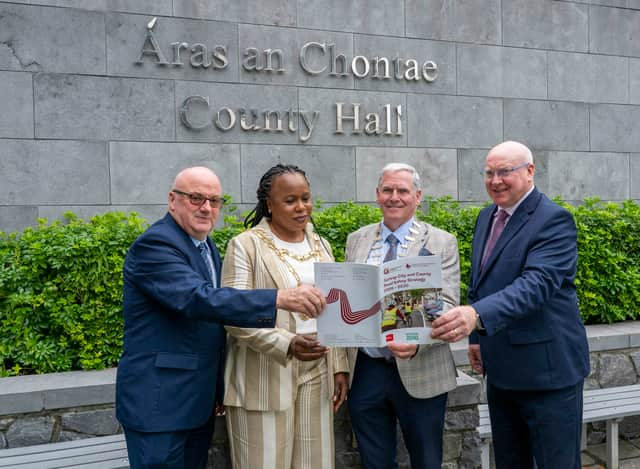
Galway City Council Director of Services Patrick Greene said road safety measures were delivered at 87 locations across the city during 2025.
He said the council would continue to invest in safer infrastructure while also encouraging safer behaviour among road users.
“We must continue to improve our roads and encourage safe behaviour,” he said.
“We will continue to invest in safer infrastructure.”
The new strategy adopts the ‘Safe System’ approach, based on the principle that while people will make mistakes on the roads, those mistakes should not result in death or life-changing injuries.
Its 50 actions cover road and infrastructure improvements, speed management, education, safer road use and enforcement.
Former Galway Division Chief Superintendent Gerard Roche said enforcement was only one element in reducing deaths and serious injuries.
“Lasting progress depends on strong partnerships, education, safer infrastructure and responsible behaviour from every road user,” he said.
Gardaí will continue to target speeding, impaired driving, mobile phone use and seatbelt offences as part of the strategy.
The plan was jointly developed by Galway City and County Councils with support from An Garda Síochána, the Road Safety Authority, Transport Infrastructure Ireland, the National Transport Authority, An Taisce and community partners.
Funded by the Local Democracy Reporting Scheme