

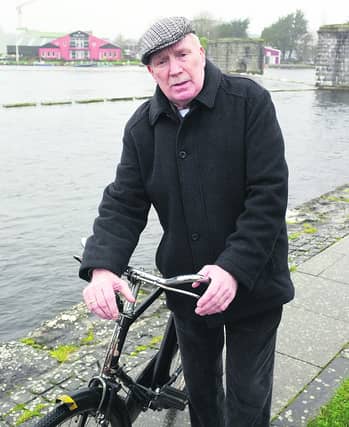
Durcan puts Sickeen's glory days on the map

Date Published: {J}
Imagine a street where everyone knows one another, looks out for each other’s children, a street where cows were milked every morning in one yard and where the local rowing clubhouse is like the communal sitting room.
That was the way life was lived in one particular street called Sickeen in the general area of the city that is widely known as Woodquay.Though say that to Durcan Forde and he will quickly correct you that Sickeen is not Woodquay, but the heart of Galway City.
In fact the memories of Durcan’s native street are still so vivid to him fifty years later that he decided to put them into a book.
Durcan was baptised Patrick, but was given his nickname by a regular visitor to his home, a name that stuck and that he still uses. He enjoyed every minute of gathering old photographs, putting captions on them and writing his own memories of a street that is no longer the community it once was.
“Everyone on the street knew each other. No door was locked, many were left open in the summer months and the children played in the street like it was their own playground. And it was because there were few cars passing through and it was a safe place in a safe time.”
Durcan, who is now retired and living in Corrib Park where he and his wife Della reared five daughters and a son– all grown up now living their own lives – is thrilled with the positive reaction to the book, Sickeen in the Rare Auld Times.
He now realises that he could have included a lot more photographs and written a lot more, following readers’ reactions to it, some with their own stories of their experiences in Sickeen.
Will he compile a follow-up?
“No, it was something I wanted to do for a long time and it’s done now. It was hard enough doing the one book and I can’t see myself doing another.”
He admits he is nostalgic about a time that is long gone and wishes that communities today couldn’t be more like what it was in Sickeen in the 50s, 60s and 70s.
It was a simple way of life in a place that was then just a town. Just beyond Sickeen, there were green fields, a countryside which was extensively explored by Durcan and his friends.
“We could be gone all day and our parents wouldn’t worry about us because there was nothing to fear in those days. People looked out for one another.
“The idea for the book was in my head for a long time because I would think of the street and all the families in it when I lay down at night.
“In my head, I would go up and down the street naming who lived in each house . . . but the place has changed so much now. My sister, Nora Power, still lives in our old family home and I visit her every Sunday but many of the other families have moved out. The younger people moved out into new estates built in the city. When I got married we got a house in Corrib Park and gradually the families moved out from Sickeen though there are a few still living in their family homes.”
Durcan left school when he was 14, which was the norm, and went to work in Lydons Bakery, which was in High Street then. Durcan remembers a very hot work environment where he slaved on the wash-up for £2 a week.
His next job was with Connacht Minerals in Lombard Street and then a new factory, Steinboch, opened in Mervue and Durcan jumped at the chance of a new adventure.
For more, read this week's Galway City Tribune.