

The name game

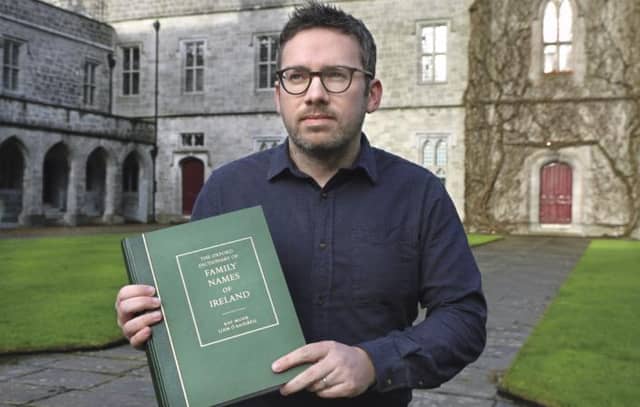

Lifestle - A major new dictionary offering unparallelled insight into almost 4,000 surnames in Ireland has just been pubilshed by Oxford University Press. Liam Ó hAisbéil who lectures in Irish and Celtic Studies at NUIG is one of its etitors. He tells JUDY MURPHY about it.
Liam Ó hAisbéil sounds like a dream travelling companion or a total nightmare, depending on how you feel about Irish placenames.
Liam, who is an expert in the field, laughs as he says that any time he’s driving through the country in the company of other people, he invariably ends up explaining the original names of towns and villages to his travelling companions.
The Renvyle man who lectures in Irish and Celtic Studies at NUIG, was awarded a PhD for his work on the placenames of County Roscommon and explains that knowing the original meanings of these names – which are usually Irish – can unlock a great deal about our landscape and the concerns of the generations who preceded us.
That interest in placenames has led Liam onto other, related projects which also involve delving into history to shine a light on the present.
Along with Belfast researcher Kay Muhr, an expert on Northern Irish placenames, Liam has edited a comprehensive dictionary of surnames, which has just been published by Oxford University Press.
That Oxford Dictionary of Family Names of Ireland gives new insights and information on more than 3,800 surnames in this country. It’s a large handsome hardback volume, bound in green, as befits such a study.
To open it at any page is to delve into a world of wonder – you’ll learn how Foley and McSharry are derived from the same Irish name MacSearraigh (relating to foal). Likewise with Watters and Whoriskey – names that are derived from the Ó Fuarghuis.
Ireland’s history of invasions and colonisation is significant in how these differences have occurred, Liam explains. They can complicate the process of genealogy – Americans searching for their roots often struggle to understand how people with the same genealogical origins could have names that seem totally unrelated. No blame to them for that.
For the dictionary, Liam and Kay limited their selection of surnames to those that had 100 bearers in the 1911 Census. That was the last all-island census and it contained almost 24,000 surnames – including variations.
Just under 4,000 of the names listed had more than 100 bearers. Most of those 3,828 were of Gaelic origin, followed by English, Scottish, Scottish-Gaelic, Norman, Welsh and Huguenot surnames.
For more, read this week’s Connacht Tribune.
Connacht Tribune Digital Edition App
Download the Connacht Tribune Digital Edition App to access to Galway’s best-selling newspaper.
Click HERE to download it for iPhone and iPad from Apple’s App Store, or HERE to get the Android Version from Google Play.
Or purchase the Digital Edition for PC, Mac or Laptop from Pagesuite HERE.
Get the Connacht Tribune Live app The Connacht Tribune Live app is the home of everything that is happening in Galway City and county. It’s completely FREE and features all the latest news, sport and information on what’s on in your area. Click HERE to download it for iPhone and iPad from Apple’s App Store, or HERE to get the Android Version from Google Play.