

Precious project on Tuam Babies

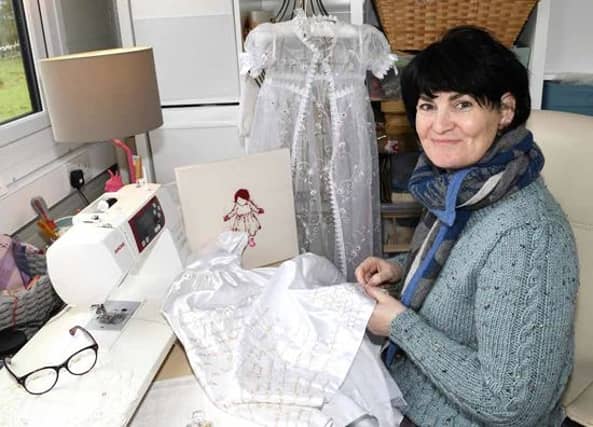

When artist Karena Ryan became aware of the children who had died in the Tuam Mother and Baby Home and how their bodies were disposed of, she was devastated. She is now remembering them by embroidering their names in gold on the best christening robe available. She tells JUDY MURPHY about this labour of love and honour.
These views could not be in greater contrast to the delicate, painstaking project that the artist embarked on some 10 years ago in her desire to give recognition and dignity to 796 children who died in the Tuam Mother and Baby Home between 1925 and 1960.
The infant mortality rate there was double that of other Irish mother and baby homes during those years. Various causes of death were listed for the Tuam babies, including TB, convulsions, influenza, bronchitis, meningitis and measles, but in some cases, that information was not given.
Their bodies were buried at a former sewage tank in the religious home, but no records were kept.
Many years later, thanks to the tireless work of historian Catherine Corless, the identity of these babies and information about their burials entered the public domain, and inspired Karena to honour them in her own, unique way.
The artist gestures to a christening robe on a mannequin in the centre of her studio.
It is on this white robe that Karena is embroidering the names of the children who died in the Tuam Home; her response to how they were treated in life and in death.
When she first began reading reports into the Home about a decade ago, her son Rossa was two and daughter Lisa was just a few months old.
Karena kept thinking about the contrast between her much-loved children and those who had died in the Home.
“I couldn’t sleep,” she says. She had to do something.
“I went to O’Toole’s Drapery Shop and bought the best christening robe there. I got the best gold thread I could get and decided I would embroider every one of the children’s names onto the gown, to recognise them there together.”
Everything is personal. If I can’t feel it, I can’t do it
An award-winning artist, Karena specialises in textiles, and processes emotions through her work, so this response made sense.
The GMIT graduate focused on painting at college, but her degree show was in 3-D. “I was always interested in texture,” she says.
For that show, she used handmade paper to create sculptural pieces, relating to a back injury she’d suffered that year.
Using her medical records, Karena made her own paper, and used it for the sculptures, including one of her injured spine.
“Everything is personal. If I can’t feel it, I can’t do it.”
Karena grew up in a creative house, thanks to her late mother Pauline. Make and Do and Childcraft books were central, while crayons, paints and cardboard boxes were always on the kitchen table, and Karena laughs, recalling how she and her siblings “would be fighting over a cardboard box”.
She was born in Dublin to parents from Mayo and Sligo. Her father, Séamus, was a Garda and they moved frequently, depending on his postings. In the 1980s, these were to County Galway, and ultimately Tuam, which became home. Karena is married to Stan Loftus, who was born and bred the town and their two children have inherited her love of making. She laughs as she says Lisa is in the house, upcycling socks into fish.
This light-filled studio, meanwhile, is Karena’s creative space.
“It was a choice between this or a new car,” she says and there are no regrets about her decision.
It’s filled with works in various stages of development, with inspiration boards on the walls. Colourful felt material, Irish wool, traditional Foxford blankets and linen table-runners and chair covers are neatly stacked on shelves and on the floor.
The Foxford blankets, striped in either pink or blue, will evoke childhood memories for many and Karena uses these and the vintage linens to explore and document aspects of her own family’s story and the West of Ireland landscape. A table-runner has been embroidered with images of her children, while her parents and grandparents feature on blankets. There are cushions too, with domestic images – one-off pieces. She turned her hands to craft for a while, she says, but quickly realised she didn’t have a commercial sensibility.
There’s a well-used sewing machine and a framed certificate on the wall from the Mallow College of Design and Tailoring with a qualification in Dressmaking and Pattern Development. A life-long learner, Karena did a Master’s in Agricultural Innovation last year, with sustainability at its core.
And there, on the mannequin, is the christening robe on which some 160 names have been stitched, in beautiful gold thread. The gown’s lace overlay has subtle red motifs – again she used the best thread available.
“I kept thinking of the bishops and priests and their vestments with all the beautiful stitching,” she says, contrasting that splendour with the treatment of the children in the Tuam Home.
The first name she embroidered on the robe was that of Patrick Derrane, His was the first death recorded there, in 1925, aged five months. The ongoing process involves writing each child’s name in pen, and then applying the gold thread. It’s poignant to hear her say that her son Rossa who drew Joseph Fenigan’s name on the fabric “was the same age as Joseph at the time”. Joseph was four when he died in 1927 – most children there died in infancy.
Karena worked on the gown at her kitchen table in the beginning and is continuing the project in her studio. As she embroiders, her mind fills with thoughts of the children and their mothers, and how the babies might have died.
You have to be in the headspace
“You have to be in the headspace,” she says.
She displays the intricate needlework on the reverse side of the gown, pointing to the tension of the threads and comparing the pattern to a secret script.
When she finishes the gown, she’d love it to be on public display, saying there should be a permanent collection to remember the children and mothers.
Karena’s artistic recording of often-overlooked history deals with less troubled subjects too and she received Creative Places funding for her project on the Tuam sugar factory, part of the towns fabric until it closed in the 1980s.
She’s currently interviewing people who worked there, including one man who is now 101.
“I want to capture the history before it’s gone.”
She collaborates across genres too, and a highlight was exhibiting in the Hague last year, with poet Annmarie Ní Churrain in a show for which artists created pieces inspired by particular poems. Like all her art, that was rooted in emotion, executed with care and consummate skill.
For more go to https://karenaryanartist.com.