

Patrick left us with curious legacy of religion and craic


Country Living with Francis Farragher
IT’S that time of year again when we all put on the green jersey (well at least metaphorically) and celebrate our great feast days in many different ways. Our Irish history, speckled as it is with poverty and emigration, means that St. Patrick’s Day is celebrated in many corners of the world with parades and parties.
Why Paddy’s Day falls on March is a question without a really definitive answer but tradition has it that our patron saint departed this life on the 17th day of our third month either in 460 or 461, possibly in County Down.
While there are those who bemoan the fact our national feast day falls in mid-March when our wintry weather can still be hanging around, the date often tends to mark the start of the spring season coming just four or five days before the Spring Equinox.
As children, the run-up to St. Patrick’s Day often involved sometimes fruitless searches for little enclaves of clover or shamrock, well hidden away in beds of early spring grass.
There were classmates of slightly more affluent families who on the customary church visits for Mass would sport fancy green badges which always seemed to a lot more glamorous than our sprigs of clay laden clover.
Again, as tradition has it, Patrick used the three-leaved shamrock to illustrate how there could be three persons in the one God, and ever since then, the ‘bit of clover’ has come to symbolise everything that is Irish.
As we all well know at this stage, Patrick wasn’t Irish, being born into a wealthy enough English family, possibly in the Cumbria area, before a gang of Irish pirates on the lookout for a few young slaves, pounced on him.
After five or six years of feeding the pigs on a Mayo farm, legend has it that he walked across the country, and boarded a boat before returning to his native England.
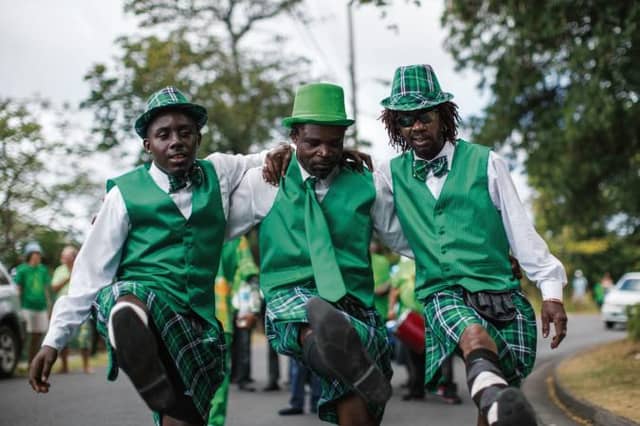
Pictured: In the Caribbean island of Montserrat, most of its 5,000 population enjoy a 10-day celebration of St. Patrick’s Day.