

Cathy's Galway roots run deep as she gives voice to those who are gone

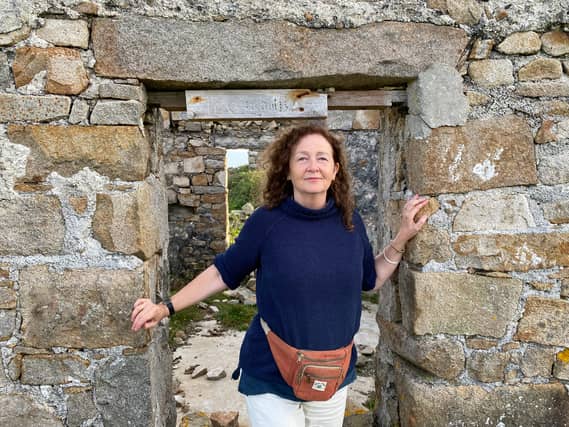

Cathy Galvin spent years in journalism, working as a senior editor for Newsweek and the Sunday Times before turning her focus to creative writing.
Her poetry has since been nominated for many awards and now, Cathy has published her first full-length collection, Ethnology: A Love Song for Connemara, with UK publishers, Bloodaxe. It will be launched next Tuesday, May 26, at 6pm, in Charlie Byrne’s Bookshop.
In it, she explores themes that, for most of her life, she had felt were out of bounds. Coventry-born Cathy didn’t feel she had the right to write about her mother, Bríd’s, birthplace in south Conamara, although she had spent many happy childhood days there. This was the place that “shaped me”, she says now.
Cathy vividly recalls the beauty of sunsets on Oileán Máisean (Mason Island) during visits there with her uncle and grandparents in the early 1960s. The island where her family had lived became uninhabited in the late 1950s and people relocated to the mainland nearby. On visits to Conamara, she also witnessed a way of life that hadn’t changed in centuries, where people lived without electricity and running water.
Cathy’s mother, Bríd Ní Chonghaile, left Conamara in her youth, like most of her siblings. Bríd went to Yorkshire where she worked in the mills and met Patrick Galvin – English-born of Irish ancestry – whom she married. They moved to Coventry, where car manufacturing was booming, found work there and had two daughters.
Cathy’s childhood summers were spent in Conamara, but when she was 11, Bríd died. Her maternal grandmother, Kate, also died later that year.
Patrick reared the girls and they remained close to their mother’s sisters who also lived in Coventry. But the Conamara visits stopped for some years. When Cathy started university, she returned with friends.
Today, she owns the ruined cottage on Mason Island, which was built by her great-grandfather after the Great Famine.
“Although I suppose none of us own anything really, we are just custodians,” she muses via Zoom from her home in Cornwall.
About 15 years ago, Cathy began writing poetry as a way of connecting with the mother and grandmother she had lost in childhood. She had previously tried doing that via fiction and short stories, but they weren’t for her. Poetry worked.
“Poetry isn’t just about getting things right. It’s about language and truth, and the struggle with it.”
Cathy realised she needed to write about Conamara to connect with the women she’d lost.
“It’s taken a lifetime to feel I have the right,” she says. But while she was on that journey, her 29-year-old son Connor died from cardiomyopathy in 2021.
Her powerful collection goes backwards in time to imagine the lives of Cathy’s ancestors and their neighbours on Mason Island, and it deals with recent history, including Connor’s death. Those heart-breaking poems feature in the book’s final section, ‘Son’.
In the first section, ‘Specimens’, Cathy revisits the 19th century, using poetry and prose to write about Victorian anthropologists, including Charles Browne from Trinity College, who visited Conamara and its offshore islands, seeking ethnographical information about “primitive people”.
Alongside her reimagining of these anthropologists’ work – measuring men’s skulls, observing people’s lives and recording their surnames – she has recorded the island wildlife, based on her own recordings.
In the book’s second section, ‘Mother’, she writes of her mother’s life and death, and her memories of listening to Bríd and her sisters chatting in a language she didn’t understand.
“There was never a sense that they’d pass it on,” Cathy says of Irish. Their language identified them as being from Ireland at a time when Irish people didn’t have it easy in England. “And it marked you out as poor.”
Section three, ‘Love songs of Connacht’, is based on the 1893 collection of the same name by Douglas Hyde, who would become Ireland’s first president. In it, Cathy has included an imagined conversation between her grandmother, Kate, and Hyde; what Kate chose to tell him and what she left unsaid.
Unlike the anthropologists, Hyde and the Gaelic Revivalists respected Conamara people and their culture. But both groups regarded them as either “inferior beings or noble savages”, needing to be researched and categorised.
However, those studies gave Cathy an insight into how her people lived.
She also writes about more recent times, including of poet Richard Murphy and the ‘Ave Maria’, the boat he used to bring tourists to Inishbofin in the 1960s. Its wreck is now in the boatyard of her distant cousin.
Irish is interwoven beautifully through many of the poems, including words and phrases her mother used. She’d initially included more but that didn’t feel right.
The loss of Cathy’s mother and mother tongue left their mark and, during Covid, she signed up for online classes with the Manchester-Irish Language Group. She reflects on how attitudes to the language have changed and her enthusiasm for learning it remains undimmed. But events, including Connor’s death, led her to putting classes on hold.
Cathy, who has three daughters and seven grandchildren, including Connor’s daughter, remains deeply connected to Conamara. She and her artist husband Richard Sharland visit Mason Island at least once a year, and the book’s atmospheric cover painting, From the Quay on Mason Island’ is Richard’s work.
Having remained close to her Coventry relations, Cathy muses that her aunt, Sally, who died four years ago, would have been proud of this book.
The ‘Ethnology’ of its title reflects on the attitude of the Victorian anthropologists towards Conamara. For years, Cathy was involved in a campaign – spearheaded by Inishbofin woman Marie Coyne – to have 13 skulls from Inishbofin graveyard that were stolen by anthropologists in 1890 and kept by Trinity College, brought home. That finally happened just three years ago, something that still astounds her.
Right now, she’s delighted with the response to her book, having wondered, “am I going to be too Irish for the English and vice versa?”.
In Ireland, the reaction has been uncomplicated. In England it’s been warm, but accompanied by shock about how Irish people were treated.
Even as she’s happy to have given her people a voice, Cathy isn’t complacent.
“I didn’t intend writing a book like this. I wonder what the ancestors would make of it.”
‘Ethnology: A Love Song for Connemara’ will be launched next Tuesday at 6pm, in Charlie Byrne’s Bookshop. Cathy is thrilled that fellow poet Louis de Paor will join her for the event. All welcome.