

Galway In Days Gone By

1923
Potato shortage
In view of the wet weather recently experienced in many parts of the county the Department of Agriculture and Technical Instruction would direct the special attention of farmers and others to the necessity for the exercise of the greatest care in lifting and storage of this year’s potato crop.
When being lifted, or shortly afterwards, potatoes should be carefully picked and graded and all diseased tubers should be removed from the others and put away for pig or poultry feeding.
Every effort should be made to get potatoes pitted or otherwise stored in as dry condition as possible. Where potatoes are stored in pits or clamps out of doors – and this is the method adopted with the bulk of the crop required for seed – the pit or clamp should be situated on the driest part of the ground.
Low-lying damp land subject to flooding and sheltered places in the vicinity of trees, are most unsuitable positions for pits. Potato pits should be not more than three feet wide at the bottom, gradually tapering to a width of a few inches a height of about two-and-a-half-feet.
On very dry land, the pit bottom may be hollowed slightly, but the best results are obtained when the pit is made on level ground.
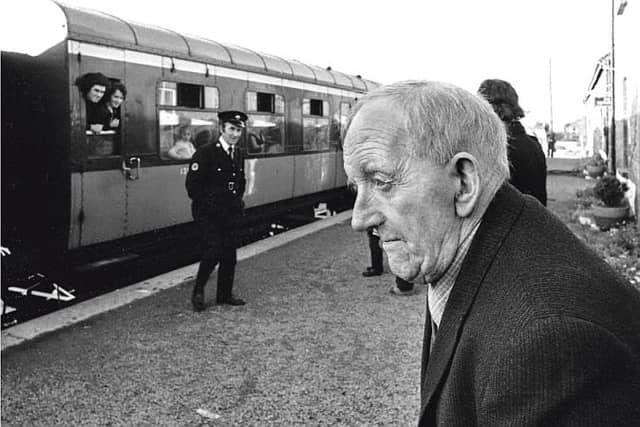
Pictured: John Hynes, Baille Ban, Loughrea who was born on December 1st, 1890 - the day the first train arrived at Loughrea Station. John is pictured at the station on the day the Loughrea-Attymon line closed in November 1975.