

Galway's own error count and intensity of rivals proves fatal in All-Ireland hurling final
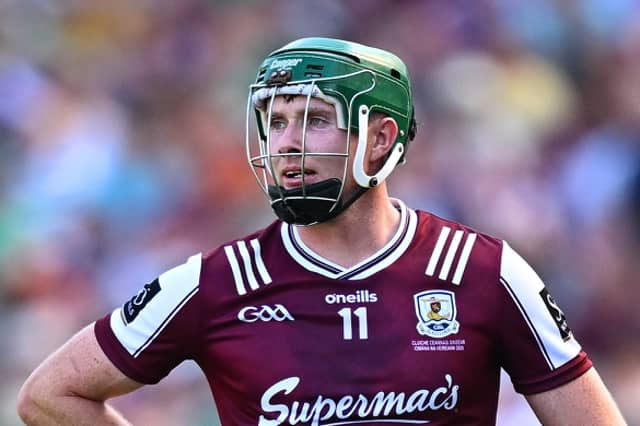

WHEN the Galway hurlers reflect on their defeat to Limerick in last Sunday’s All-Ireland Final, they will naturally feel disappointed by not doing themselves justice on the day.
The quality which characterised most of Galway’s championship run this season was absent in Croke Park. The Tribesmen failed to replicate the fluency and coherence of the attacking play which fuelled their run to the final.
For this, one can attribute two main causes. One being the intensity with which Galway’s opponents imposed themselves on maroon players in possession, the other being their own unforced error count, which was off the scale compared to previous matches.
Galway’s primary method of engineering scores this season has been their short passing and running game, which proved highly effective during this year’s championship run. For this to be successful, the player on the ball must have support players within hand passing range when approaching contact with opposition tacklers. Too often, Galway players in possession found themselves isolated when approached by green jerseys.
Another feature which undermined the Tribesmen was their failure to execute passes under pressure on numerous occasions, which resulted in their turnover count skyrocketing. On 21 occasions during the game, Galway players were directly turned over in possession. On more occasions, their passes were intercepted, with many of these leading directly to Limerick scores.
By contrast, the Shannonsiders only turned over the ball on seven occasions. Teams at the highest level always aim to have minimal turnovers, particularly within scoring range of their own goal. Unfortunately for Michéal Donoghue’s charges, the loss of possession, either through effective Limerick tackling or Galway’s own handling errors, was a consistent feature of this final.
For any team playing a running and short passing game as Galway do, the execution of their passes must be absolutely on point, otherwise attacks break down before they get within shooting range. In previous games, Galway’s ability to retain possession was excellent and a huge asset to the side. When this broke down on Sunday, they found it very difficult to create scoring opportunities.
Transitioning the ball from defence to attack was a huge problem for Galway, underlined by their lack of scoring chances, particularly in the first half. They had only five shots from open play to Limerick’s 16 in the opening half.
The half-time stats showed Limerick having seven different scorers to Galway’s two, which told its own story. Galway almost completely failed to create scoring chances by working possession to overlapping runners coming from deep, as they had so successfully done throughout 2026.
Limerick deserve credit for identifying Galway’s gameplan and exerting immense pressure when the Tribesmen were in possession. Many Galway turnovers came as a result of this pressure, but a hugely disappointing aspect for Galway on reflection will be the amount of turnovers which were the result of handling errors, misplaced passes, or a lack of support for a Galway player in possession.
In a departure from the norm, Galway went long from their first three puckouts in the first half, which played into Limerick’s hands. With one of the most physically imposing half back lines ever assembled, the men in green were surely delighted to see Darach Fahy launch the ball down on top of them. It was a puzzling approach, when retaining possession with short puckouts, as they ended up doing later, would surely have helped a young Galway side settle into the contest.
Galway struck seven long puck outs in the first half and won only two. It is important to emphasise that Fahy’s decision making was not the cause of this development. On far too many occasions, the outfield players failed to align themselves appropriately to give Fahy the option of a short puck out.
This was very disappointing from a Galway viewpoint, as it was something which they had generally executed very well this year. In previous matches, every short puckout was the starting point for engineering a scoring opportunity, and the effectiveness of Galway’s transition play from defence to attack made them very difficult to play against.
Unfortunately, this broke down on Sunday, and Galway really struggled as a result. The intensity with which Limerick tackled and closed down Galway players was certainly a level above anything the Tribesmen had encountered in previous matches. This should serve as a major learning experience for a Galway side with eleven of the starting XV playing in their first senior All-Ireland.
Despite the obvious disappointment for all involved last weekend, the reality is that Michéal Donoghue and the Galway management have struck on a highly effective style of play this season, which they are still at a relatively early stage of implementing.
The next challenge for Galway will be developing the ability to execute their gameplan under the sort of pressure which the they faced against Limerick last Sunday. Composure comes with confidence, and the more familiarity they gain in the coming years with their adopted style of play, the more confident they will become. Donoghue has consistently said this season that Galway are a work in progress, and that shouldn’t be lost in the aftermath of their All-Ireland Final defeat.
It’s very easy to forget that the lack of expectation within the county for the Galway senior hurlers at the beginning of 2026. Donoghue’s charges may still be a work in progress, but they have certainly given the Galway supporters something positive to get behind in the coming years. After a very bleak end to 2025, that represents enormous progress.