

Wildflower conservation project starts to blossom

Date Published: 12-Apr-2012
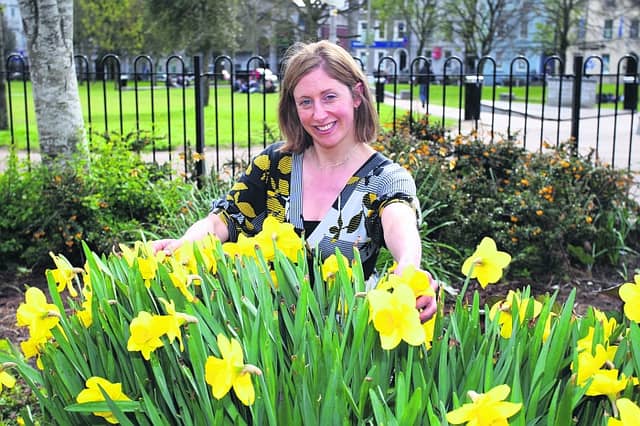
A day that gives you the chance to enjoy some exercise and fresh air while doing some good for your community – that’s what’s on offer under a new scheme by Conservation Volunteers Galway. The project involves planting wildflower meadows to attract bees and butterflies, which are so vital in pollinating flowers and the crops we eat.
The wildflower scheme is being organised by the group which has already planted over 1,000 native trees in Galway city, pruned an oak plantation in Portumna Forest Park and planted a host of daffodil and tulip bulbs in the Doughiska area of the city.
The organisation, which has the support of Galway City Council’s Parks and Wildlife Department, relies heavily on volunteers for its work, explains its chairperson Caitríona Cunningham.
As the name implies the group is all about conserving and enhancing the environment in which we live, and wildflowers have a huge role to play in that.
“There has been a serious decrease in birds and bees, because of urbanisation, increased infrastructure and agricultural intensification,” says Caitríona. And that’s a cause for concern, because 99 per cent of our flowers are pollinated by bees and butterflies, she adds.These include strawberries, apples, blackberries, raspberries, onions and carrots.
“So, to protect them, it’s important to plant wildflowers in April and May and to leave some long grass in your garden,” explains Caitríona about the difference people can make at home. Because a wild flower area only needs to be mown just once a year, like you would a field of hay, it means less mowing of the lawn. So, it’s also more economically viable than wheeling out the lawnmower on a weekly basis, she points out.
On a larger scale, there’s the planting of wildflower meadows in public spaces, as is happening this Sunday, April 15 and on Saturday, April 21 under the auspices of Conservation Ireland Galway.
At present this wildflower programme is confined to the city, but there are plans to extend the scheme to towns in the county at a later stage. The three areas earmarked for planting in Galway City are Lough Atalia, the children’s playground at the Atlantaquaria, and Grattan Terrace.
Volunteers will also be asked to take part in litter picking on the day, as part of the An Taisce’s national clean-up project, which runs throughout April.
The City Council will supply the seed for the public plantings, says Caitríona, who adds that people who want to create a wildflower area in their own garden can buy these seeds in garden centres. There are special ones for attracting bees and butterflies, as well as flowers which thrive in shade or semi-shade, so there are lots to choose from.
“We are going away from flower hegemony; it’s kind of going back to basics because birds and bees are declining.”
Caitríona’s enthusiasm for the work of the conservation group is infectious – she talks a mile to the minute during our interview and simultaneously jots down notes, reminding her to forward further information by email.
The habit of writing a task list comes from her days of teaching, she laughs.
She trained as a primary teacher in Dublin and later went to Canada, where she did a degree in Environmental Science in Nova Scotia, subsequently working as an environmental consultant with an engineering company for a few years. But education was where her heart lay.
So she did a Masters in Trinity College on pollinators. It was part of a programme funded by the Environmental Protection Agency, which researched biodiversity in Ireland.
The study found that at a local scale, small areas of fragmented habitat are of equally high importance for wildlife as large areas and should be protected.
After graduation, while still living in Dublin, Caitríona got involved in Conservation Volunteers Ireland, which had started off in 1990 and was restructured in 2006. Based in Fingal, its revival was spearheaded by Fingal County Council’s biodiversity officer Hans Visser.
When Caitríona, who is originally from Ross, Castlebar, moved to Salthill in 2009, she saw a need for a similar conservation scheme in Galway.
“People were enthusiastic and wanted to conserve their environment,” she says, pointing to the strong Tidy Towns committees and the high rates of recycling locally. But there was no niche for these people when it came to conservation.
For more, read this week's Galway City Tribune.