

Watersports are not all banned at Galway's Silverstrand

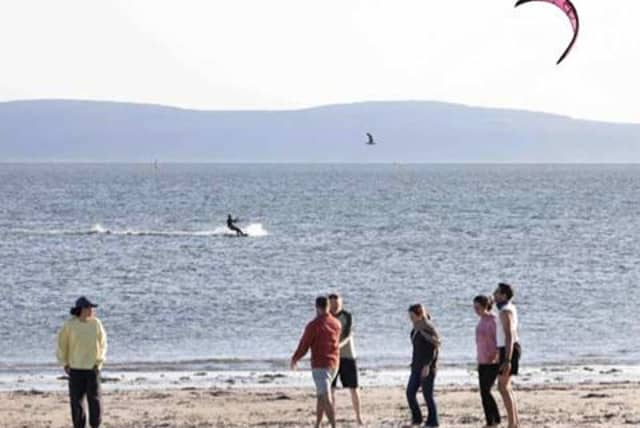

GALWAY City Council has confirmed that signs at the popular Blue Flag Silverstrand beach do not ban paddleboarding, body boarding, canoeing and kayaking.
Meanwhile, campaigners say confusion remains and are calling for proper zoning to separate swimmers from water sports users.
The council says signs installed at the beach last summer “do not prohibit paddle boarding, body boarding, canoeing or kayaking” following the most recent risk assessment carried out by the International Life Saving Federation of Europe (ILSE).
The signs sparked widespread backlash as they banned a broad range of activities such as windsurfing, kitesurfing and “surf craft” - terms which can include surfboards, kayaks and stand-up paddleboards (SUP).
A campaign by the Galway City Watersports Group to reverse the restrictions and introduce zoning has since gathered more than 1,500 signatures.
Please note contrary to other public information in circulation, the risk assessment and the signage at Silverstrand do not prohibit paddle boarding, body boarding, canoeing or kayaking.
Last week, the council sought to clarify the issue, stating:
“Please note contrary to other public information in circulation, the risk assessment and the signage at Silverstrand do not prohibit paddle boarding, body boarding, canoeing or kayaking.”
READ MORE: Galway City Council warns councillors it 'may need' supplementary budget to balance books
It says the most recent ILSE risk assessment recommends prohibiting windsurfing, towed water activity, mechanically powered craft, surf craft, personalised watercraft (meaning small, fast recreational vessels that use a jet pump to propel themselves through water) and kitesurfing.
However, campaigners point to the council’s own document, the Silverstrand Code of Conduct, which states that “the designated bathing area is strictly for bathing only. Do not surf, windsurf, kite surf, paddle-board or kayak inside the bathing area”.
The Galway City Watersports Group says that “therefore, based on the Galway City Council document, the signs do prohibit surf boards, paddle boarding, kayaking and canoeing”.
Questions have also been raised about the reported width of the beach, which is fully zoned as a designated bathing area.
According to the council, “the beach in question in full is only 200 meters in width”.
However, the watersports group says the beach is listed as being 250 metres wide on both the council’s website and the EPA national bathing water website, Beaches.ie.
“The designated bathing area (DBA) marked on the beach signs covers the full 250 metres of the beach and is the area that is within the red and yellow lifeguard flags that are used to identify the lifeguard patrolled area and safest place to swim on the beach,” the group says.
“Approximately 50 metres of the west side of the beach is covered in rocks and there is a potential safety issue including this area of rocks in the designated bathing area (DBA). These rocks are not shown on the beach signs, which only show a sandy beach area.”
Campaigners say the issue could be resolved through a simple zoning system separating swimmers from water sports users. They say this approach is standard under Blue Flag guidance, which requires beaches to manage different activities to avoid conflict.
“The issue of the watersports ban at Silverstrand beach could be resolved through a straightforward approach: relocating one flagpole and amending the beach signage maps to show separate swimming zones and a designated watersports launch zone,” the Galway City Watersports Group says.
“We are requesting that Galway City Council follow best international practice and implement a Blue Flag-compliant beach management and zoning plan for all Galway city beaches, one that ensures safety, inclusivity, and shared access for all members of the community.”
They also point to a 2017 Water Safety Ireland / ILSE risk assessment report for Silverstrand beach, which recommended zoning.
“The report recommended that 'clear zoning needs to be put in place to identify where the lifeguards patrol, where it is best and safest to swim and where other beach activities can take place,'” they highlight.
“This recommendation to zone the beach in the 2017 report was not implemented by Galway City Council. If the zoning was implemented at that time, the current issue with the watersports ban at the beach would have been prevented.”
The council says that last August it contacted “all relevant water sports groups, as provided by Cllr Clodagh Higgins,” but that “out of seven invites, only three took up this offer”.
Following a meeting with stakeholders in November, the council says it was agreed to hire an independent environmental expert to assess whether a safe launch area could be created on the western side of the beach, and to explore alternative locations along Galway Bay.
However, it says the environmental assessment found that creating a launch area - including works to remove beach material or build a slipway or raised ramp - would “give rise to Likely Significant Effects on the site specific Conservation Objectives for the Galway Bay Complex SAC”.
As a result, it says it is “not feasible to consider a project to create a functional access or launch area at this location”.
The Galway City Watersports Group says it has consistently sought a launch zone outside the area examined in the study.
“It is regrettable that neither Galway City Council nor the consultants engaged with watersports users at Silverstrand at any stage during the study,” the group says.
“The report considers interventions far beyond what is required...The area of rocks examined in the study lies outside the watersports launch zone that we have requested since our initial contact with Galway City Council in 2021.”
The council says it will now explore alternative locations where water sports activities “could potentially be accommodated” along Galway Bay, adding that it values “the input of all stakeholders and will continue to engage constructively going forward.”
Funded by the Local Democracy Reporting Scheme