

Thousands leave the car at home in Galway and surrounding areas

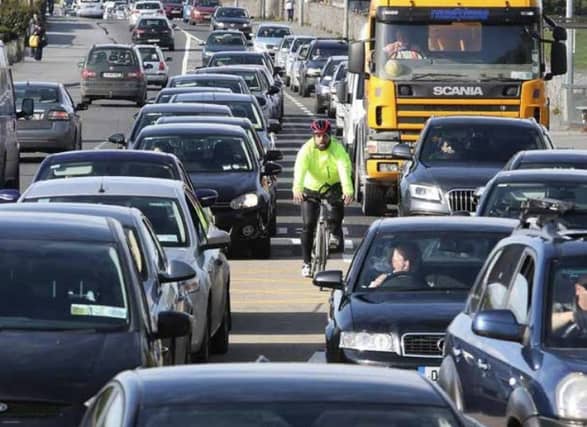

Pedestrians and cyclists are taking up to 23,000 cars off the roads in Galway city and surrounding areas every day.
Pedestrians and cyclists are taking up to 23,000 cars off the roads in Galway city and surrounding areas every day.
That’s according to the National Transport Authority in its latest survey of walking, wheeling and cycling within the Galway Metropolitan Area, which extends from Bearna in the west , north to Claregalway and east to Oranmore.
The report shows a marked increase in the number of residents now walking or wheeling at least five times a week, up from 60% in 2023, to 67% in 2025.
The survey also reveals that at least one in five (21%) adults here cycle at least once a week, with the number of young people aged between 16 and 25 who cycle at least once a week having increased to 35%, up from 31% in 2023.
The Walk Wheel Cycle Trust defines ‘wheeling’ as someone who use wheeled mobility aids – for example a wheelchair or a mobility scooter.
“We recognise may not identify with the term walking and may prefer to use the term wheeling. We use the terms walking and wheeling together to ensure we are as inclusive as possible,” said the Trust.
The Walking and Cycling Index provides the largest assessment of walking, wheeling, and cycling in Ireland and the UK.
It is delivered in collaboration with Galway City and County Councils, the National Transport Authority and the sustainable transport charity, Walk Wheel Cycle Trust.
The Walking and Cycling Index reveals that 64% of residents are in favour of additional investment in cycling and 66% are in favour of additional investment in walking and wheeling.
Support for the development of more protected cycle infrastructure within the Galway Metropolitan Area remains high, with 82% of residents supporting building cycle tracks physically separated from traffic and pedestrians, even where that means less room for other traffic.
The Index reveals that 67% of adult residents walk five or more days a week, while 55% use a car five or more days a week – and 44% of residents want to walk more, and 38% want to cycle more in the future.
A massive 82% of residents support building cycle tracks physically separated from traffic and pedestrians, even where that means less room for other traffic.
Every day those who walk, wheel or cycle for non-leisure trips when they could have used a car take up to 23,000 cars off the road in the Galway Metropolitan Area. If all of these cars were in a traffic jam it would tail back 112 kilometres.
Walking, wheeling and cycling was seen to improve public health in the Galway Metropolitan Area, preventing 278 long term serious health conditions annually and saving the HSE €3.6million equivalent to the cost of over 60,000 GP appointments.
The report also found that walking, wheeling and cycling save 4,000 tonnes of greenhouse gas emissions in Galway each year, which is equivalent to about 36,000 residents taking flights from Shannon Airport to London Heathrow Airport.
The benefits of walking, wheeling and cycling to the Galway Metropolitan Area are outlined in the report, with the physical activity benefits preventing 278 long-term serious health conditions annually, valued at approx. €3.6million equivalent to the cost of over 60,000 GP appointments.
The Index showed that residents’ travel choices and their perceptions of walking, wheeling, and cycling vary between different groups’.
It found that 50% of residents with a disability walk or wheel at least five days a week in Galway, compared to 68% of residents without a disability.
While 69% of women and 65% of men walk or wheel at least five days a week, there is a larger gender gap when it comes to cycling with 28% of men cycling at least once a week, compared with 15% of women.
Overall, 23% of women say they do not cycle but would like to.
Those walking, wheeling and cycling instead of driving, save greenhouse gas emissions equivalent to 36,000 flights from Shannon Airport to London Heathrow Airport.
There is a €1.67 net economic benefit for each km cycled instead of driven and €1.19 net economic benefit for each km walked instead of driven.
Mayor of Galway Cllr Mike Cubbard said the report demonstrated the value of active travel.
“I’m pleased to see the progress of recent years, including the successful delivery of projects at Doughiska Road South, Wolfe Tone Bridge and Eglinton Canal,” he said.
With the support of funding partners including the National Transport Authority and the Urban Regeneration and Development Fund, more high-quality infrastructure will soon be delivered in other areas of the city, along with newly enhanced bus and train facilities.
“All of this will help Galway to develop in a sustainable fashion, benefitting residents, those who work here, and visitors for many years into the future,” he added.
Cathaoirleach of Galway County Council Cllr. David Collins said that the report offered ‘valuable insights into the behaviours and perspectives of residents in Oranmore, Baile Chláir and Bearna regarding walking, wheeling, and cycling’.
“It provides a clear picture of the investment and infrastructure our communities wish to see and highlights opportunities to plan more effectively for the future,” he said.
CEO of NTA Anne Shaw said that the report provided valuable insights into how people travel ‘and what is needed to make walking, wheeling and cycling safer, easier and more attractive’.
“Since the last Index in 2023, we have worked closely with Galway City Council and Galway County Council to invest in schemes that reflect our shared commitment to creating safe, connected streets,” she said.
“The feedback in the report is clear: people in Galway want to walk, wheel and cycle more.
“We are responding with infrastructure that supports this ambition and helps create a healthier, safer and more liveable Galway Metropolitan Area,” she added.