

Ring Road: schools and poor planning are to blame for traffic chaos

Schools and poor planning are to blame for much of Galway City’s traffic problems, according to An Taisce.
In its submission to the oral hearing for the proposed N6 Galway City Ring Road, An Taisce claimed that the historic positioning of primary, secondary and third level facilities in the centre of Galway is a major cause of traffic congestion.
An Taisce representative, Peter Butler, said that school traffic in the morning and afternoons has a disproportionately high impact on traffic in the city. Indeed, the Galway resident claims that without school traffic “there is not a traffic congestion problem in Galway”.
Mr Butler highlighted a number of other contributing factors to congestion in his submission including a lack of bus lanes and the lack of a year-round park and ride facility.
This is a preview only. For extensive coverage across four pages of the Ring Road oral hearing, see this week's Connacht Tribune. Buy a digital edition of the paper here.
“These traffic congestion problems have come about from a history of doing nothing but waiting for a bypass to come along. This is not good planning. These problems should have been solved well ahead of time,” he said.
“The city has been allowed to develop in a way which has forced the need for these ring roads. The houses have been allowed to be built on one side of the river and the jobs on the other side. Now we end up with a crisis and another road is being seen as the solution.”
Mr Butler claimed that the situation of schools at city centre locations, and away from population centres, is the main cause of the traffic gridlock in Galway.
Referencing a section of the Galway Transport Strategy (GTS) he says that 35 per cent of the traffic at peak times is between home and education.
“Without the school traffic there is not a traffic congestion problem in Galway. That statement [from the GTS] has not been picked up upon and analysed enough,” he said.
Meanwhile, it was claimed at the oral hearing this week that it is “utterly unsustainable” to proceed with the Galway City Ring Road project in the next decade at a time when huge efforts are being made to reduce Ireland’s greenhouse gas emissions.
Chartered Engineer and sustainability campaigner Brendan Mulligan told the An Bord Pleanála oral hearing for the proposed N6 Ring Road that the development would cut through a 17.5km swathe of land – resulting the destruction, displacement, disturbance and fragmentation of vital natural habitats for thousands of species.
Speaking at the hearing module examining the ecology and hydrogeology elements of the project, Mr Mulligan said the construction of this road would be happening at a time when biodiversity loss was the “greatest environmental challenge facing humanity”.
“Yet biodiversity underpins the ecological functions that provide the many natural goods and services on which life, livelihoods and sustainable living depends,” Mr Mulligan told the hearing on Monday.
This was the last generation that had an opportunity to prevent the collapse of the planet’s biodiversity in the face of habitat destruction and climate change – something Mr Mulligan said was recognised by the declaration of a climate change and biodiversity emergency by the Dáil in May 2019.
The construction of the Ring Road would contradict that, he said.
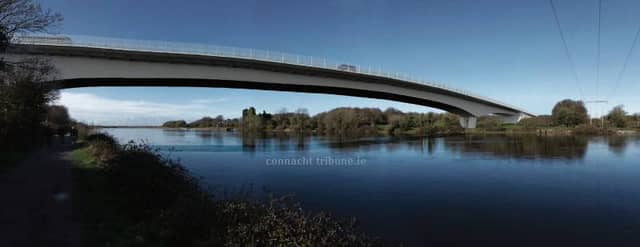
(Picture shows a photomontage of how the proposed fifth bridge over the River Corrib would look.)