

Referendum less a ringing endorsement and more indicative of apathy for change

Date Published: 14-Nov-2012
Ihad to take a double-take when I read a statement that the Tanaiste, Eamon Gilmore, put out on Sunday following the result of the referendum.
I won’t burden readers with too much of the turgid stuff like it being a vindication of all the values that we hold and how much we value children and childhood – the rather grand adjective axiomatic was made to describe that.
In fact all I’ll repeat is a sentence that stuck out, for me, like a sore thumb: “Today, the people made a strong and unequivocal statement on the values they attach to children and childhood.”
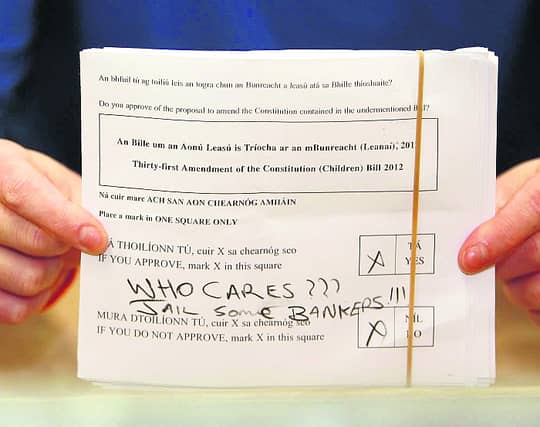
When I read that I wondered had the two of us witnessed the same spectacle or were we occupying different planets? If any statement were made in the children’s referendum, it was neither strong nor unequivocal.
The miserly turnout of 33.5 per cent was compounded by a result of about 57 per cent to 43 per cent that was much, much closer than anybody had anticipated.
If you look at how the sides ranged up against each other. On one side you have virtually every political party, every church, every NGO, every trade union and civic society group.
On the other you had a ragbag of, not even groups, but individuals, the most prominent of whom were journalist John Waters and former MEP Kathy Sinnott. And yet, despite all the money, all the information, all the airtime, the gap was only 14 per cent.
In fairness to Gilmore, the statement he issued might have been pre-cooked, prepared beforehand, primed to be released once the results were announced. But even so, the sentiments expressed are an affront to reality.
I’m not going to dwell on the ins and outs of the referendum – like many other people I took a view that its effect would be marginal but perhaps a little beneficial – but look at what the result may mean for the Government’s big ambitious for Constitutional reform and change. On December 1, the long-delayed new vehicle for delivering this change, the Constitutional Convention, will hold its first meeting in Dublin Castle. It has been asked to examine a number of issues (about seven in all) in the Constitution and then make recommendations.
A few of the issues are relatively weighty but most are Mickey Mouse in the context of the all-encompassing document drawn up for Eamon de Valera 75 years ago – such as reducing the voting age to 17; reducing the term of the presidency from seven years to five.
The one massive Constitutional change – the abolition of the Seanad – will not be discussed by the Convention but will be put to referendum sometime during the lifetime of this Coalition. And given what happened last weekend, I would say it’s not going to happen anytime soon.
So what are the lessons from last weekend? Well number one is that if you really want the citizens of Ireland to engage and come out in big numbers to vote in a referendum you need to be a bit engaged yourself.
It was unusual that all the parties were voting Yes but the evidence was that while they dutifully put up the posters and wheeled their spokespeople onto radio and TV, there was no ground war – or hard-graft knocking on doors. Part of that was to do with the fact that there was no real No campaign (with the exception of the last week of the campaign).
The lack of an opposition meant a lack of debate, which meant a lack of scrutiny or criticism of the amendment. It was like looking at a football game where only one team turned up and it ended up having a practice game. There was no engagement. Everybody thought it was a walkover and didn’t bother to vote.
For more, read this week's Connacht Tribune.