

Play about Ireland's past throws light on shape of country today

Date Published: {J}
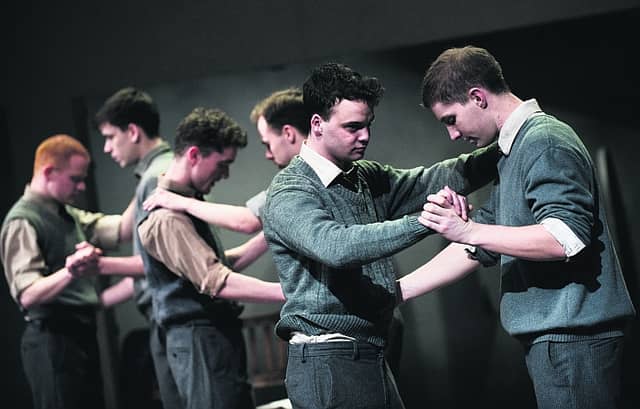
“This is not a play about our current clerical scandals, but it’s a play behind the current clerical scandals,” says Thomas Kilroy about his play Christ Deliver Us!, which will receive its world premiere at the Abbey Theatre next week.
Christ Deliver Us!, by the former professor of English at UCG (now NUIG) and Kilmaine resident, was inspired by a controversial 19th century German play, Spring Awakening, which is “one of the famous plays about adolescence” explains the author, who is referred to by his full name, Thomas as a writer, but is more familiarly known as Tom.
That drama about youngsters growing up in a repressed society was written by Frank Wedekind in the 1890s and first performed in 1906 when it proved to be highly controversial.
More recently it was adapted into a successful Broadway musical, winning eight Tony awards in 2007.
Tom has transposed Spring Awakening into an Irish setting, which has allowed him to write a play about his own schooldays in Kilkenny in the 1950s.
“I’d wanted to do it for a long time, and it had been commissioned several years ago by the Abbey but it wasn’t produced at the time,” he says of the play.
He is stoic about its slow trip from page to stage – it is a large production with a cast of 25 – and he is just happy that it’s being produced by the national theatre
“It’s the kind of play I love but it’s very expensive [to produce] and I’m very lucky to have the Abbey. It’s the only theatre that could afford to do it with a full cast.”
Christ Deliver Us! is “about the Church and the control that the Church and State exercised. You would not have been aware of it at the time, because that was the world as it was”, Tom explains.
At the centre of the drama is a love relationship between a young boy and girl, but it’s a play with lots more going on.
“There are several different stories, with teenagers going through their romantic crises, there’s a teenage suicide, a hurling match – it being Kilkenny – a teenage pregnancy, a ghost . . . it doesn’t last long, but it’s a large scale play,” he explains.
“Essentially it’s about a young boy and how he has to find a way out of that life and into the future.
“It is much more character driven than the original play and the characters are created out of memories that I have,” he says of Christ Deliver Us!.
The action takes place in various locations, outside and inside, including a diocesan college and an industrial school, so it’s a big technical production.
It’s being directed by Wayne Jordan who is making his debut on the Abbey’s main stage – he has previously directed work for the smaller Peacock venue. There’s a cast of 25, many are young actors and, says Tom, Wayne is particularly good with them.
Despite the presence of the reform school, there is no sexual abuse in the play because Tom never experienced such abuse. “But there is physical abuse, and that was endemic or systemic in Ireland. Young people were beaten regularly, not just at school but at home and that had a profound effect. It made violence more acceptable.”
Tom feels that the play “is saying something about Ireland in the past, but it also casts a light on Ireland in the present”.
That exploration runs through Tom Kilroy’s work in plays such as Double Cross, which was produced by the groundbreaking Field Day Theatre Company; and in his only novel, The Big Chapel, which was shortlisted for the Booker Prize in 1971 and which won the Guardian Fiction award among others.
Double Cross, first staged in 1986, explored the lives and careers of two very different Irishmen, Nazi propagandist William Joyce (Lord Haw Haw) and Churchill’s wartime Minister for Information, Brendan Bracken. Set during World War II, it examined the issue of identity: “the influence of colonisation on a people and the confusion it creates in terms of identity”, something which still resonates today.
The Big Chapel is based on anti-clerical riots that occurred in Kilkenny in the 19th century, and addresses the tragedy that occurs when people blindly follow ideological dogma. Its story remains hugely relevant to contemporary society.
But it is for his plays that Tom Kilroy has earned his reputation. His drama The Death and Resurrection of Mr Roche, which had homosexuality as a central theme, caused a major stir when it was produced at the Dublin Theatre Festival in 1968. It went on to become a festival hit.
For more, read page 27 of this week's Galway City Tribune.