

World of Politics: Is it time to revisit the nuclear power debate?

The suggestion of a nuclear reactor being built in Ireland was made as far back as the 1950s. Back then however, the costs would have been enormous, especially for a relatively poor country like Ireland.
Over the following decades, both Britain and France pressed ahead with nuclear projects. France eventually constructed 58 power stations. Nuclear power remains pervasive there. Anyone who has taken the TGV high-speed rail line will be told at some stage that it is powered by nuclear energy.
The Nuclear Energy Board was established in the late 1960s, with the aim of developing a nuclear power plant in the Republic. The ESB took up the mantle in the 1970s and drove the project forward. Eventually, a site at Carnsore Point in Wexford was identified.
The 1973-1977 coalition government gave the green light to proceed, on the basis that the site was optimal from both a geographic and geological perspective. Had it gone ahead in the 1950’s or 1960’s, it is unlikely there would have been much opposition, but things had changed during the 1970’s.
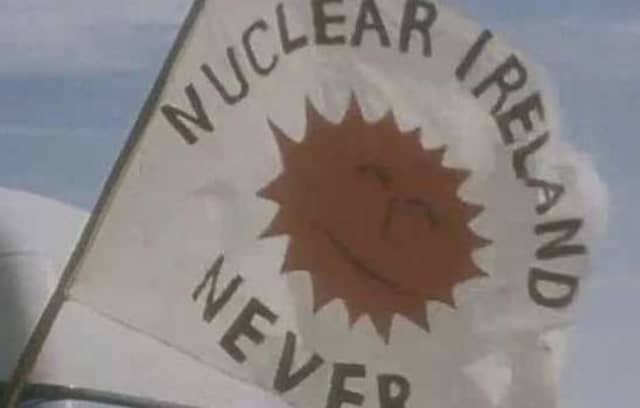
For the first time, nascent environmental groups began to emerge, and the influence of the British-based CND (the Campaign for Nuclear Disarmament) was increasingly felt in Ireland. This saw the beginning of protests against nuclear power by small groups opposed to nuclear energy, which grew into wider-scale opposition.
The high point of the opposition occurred at the proposed site itself, Carnsore. A series of protests and music festivals from 1978 to 1981 saw thousands gather, not only to hear music but also to discuss the dangers of nuclear power.
These protests received widespread media coverage and growing support—not just from the fringes, but increasingly from mainstream society and politicians.
In my view, a combination of Carnsore, the accident at Three Mile Island in Pennsylvania in 1979, and the Chernobyl disaster in Ukraine in 1986, put paid to any nuclear ambitions in Ireland. And there were serious concerns about possible radioactivity leaking from Sellafield just across the Irish Sea from Louth.
By the late 1980s Ireland was firmly established as an anti-nuclear country. Nuclear power was effectively off the agenda.
By the late 1980s Ireland was firmly established as an anti-nuclear country. Nuclear power was effectively off the agenda, and it has remained so for the past four decades.
But it has cropped up again in recent years. That has been mainly because Ireland relies heavily that virtually all other EU countries on fossil fuels and also pays the highest energy prices in Europe.
There have been some advances in recent years. Around 40% of our electricity now comes from renewable sources, most of it from wind. However, as a share of overall energy use, renewables account for only about 14%.
In Finland, over 80% of electricity is generated from hydro, wind and nuclear energy. Sweden has a similar profile, with only about 5% of its power coming from fossil fuels.
Of course, those countries benefit from geography that allows for extensive hydroelectric power, something Ireland lacks. Even with expanded wind and solar, it will take a long time for Ireland to reach similar levels of self-sufficiency.
In recent years, the debate has re-emerged in a somewhat indirect way. One of the first indications came when Ireland signed an agreement with France for an electricity interconnector between both countries. This means Ireland can import electricity from France—much of it as nuclear power.
The current energy crisis has also sharpened minds, with diesel prices rising again to almost €2.20 per litre. There is concern that fossil fuel prices may continue to rise, with little prospect of falling significantly.
In the past, the argument against nuclear power in Ireland was that it was too expensive and that the population was too small to justify it. Circumstances have changed. The population has grown rapidly, and the cost of nuclear technology has fallen.
According to some studies, a modest nuclear power station generating 300 megawatts could cost around €1 billion. That is still a significant sum, but in the context of other infrastructure projects in Ireland, it is not exceptionally high.
There are, of course, risks associated with nuclear power, and these must be acknowledged. The world has seen the consequences of major failures in nuclear plants.
At the same time, some argue that nuclear energy should be seriously considered as an alternative to fossil fuels, particularly given its lower impact on climate change (that is barring any accidents).
Whatever the merits of that argument, it would take a brave politician to propose a site for Ireland’s first nuclear reactor, given the likelihood of strong local opposition. Carnsore Point is still occasionally mentioned, as is Moneypoint in County Clare, given its history as a power generation site.
There are, of course, risks associated with nuclear power, and these must be acknowledged
Nuclear power is an issue that needs to be examined seriously and soberly in Ireland, from a 2026 perspective rather than that of 1978.
One politician who has expressed enthusiasm for such a development is John McGuinness, the Fianna Fáil TD for Carlow–Kilkenny. His party colleague, Timmy Dooley from Clare pointed out that even building a wind farm can be extremely challenging, let alone a nuclear reactor.
He noted that there is significant resistance to some wind farms and said that when he asks constituents whether they would accept a nuclear reactor instead, “the response is not especially positive”.
Any such project would take years to navigate the planning process, given the likelihood of objections and legal challenges. Even so, nuclear power should not be dismissed outright. It should at least be examined as a potential part of Ireland’s future energy mix.
It may ultimately prove unviable, but it is worth at least considering all the issues.
Harry McGee is political correspondent of The Irish Times.