

Oireachtas submission by Galway ‘bogus PhD’ professor contained legal and academic errors
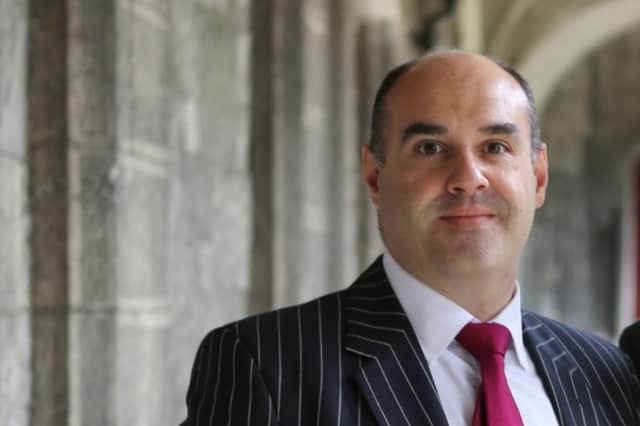

Tom Felle was the subject of an RTÉ Prime Time investigation earlier this month, which alleged that he had falsely claimed to have a PhD from a prestigious London university
An Oireachtas committee submission co-authored by the University of Galway professor accused of having a bogus PhD contains a number of embarrassing legal and academic errors, Galway Live can reveal.
Tom Felle, a ‘fake news’ expert and associate professor at the university’s Department of Journalism and Media, was the subject of an RTÉ Prime Time investigation earlier this month.
It alleged that he had falsely claimed to hold a PhD from City St George’s, University of London. It was subsequently reported that he had also claimed to be a PhD researcher at University of Limerick.
He is referred to as “Dr Tom Felle” in a submission that he co-authored and presented to the Oireachtas Committee on Arts, Media, Communications, Culture and Sport in January.
The paper related to the regulation of online platforms but contained several serious legal errors and academic referencing issues, recommending that the Oireachtas enact legislation incompatible with EU and constitutional law.
It called for the introduction of domestic legislation imposing deadlines on Coimisiún na Meán to enforce systemic risk obligations on Very Large Online Platforms (VLOPs), citing the Digital Services Act to propose domestic intervention or ‘red ball’ notices.
Under the Digital Services Act, however, only the European Commission can order such measures in systemic risk proceedings. The Oireachtas cannot pass legislation overriding EU regulations, suggesting that the proposal was based on a fundamental misunderstanding of the law.
The submission also called for the Oireachtas to amend Irish law to ban behavioural advertising to minors, and mandate ‘why am I seeing this’ disclosures. Both of these protections are already binding law across the EU under Articles 28(2) and 26(1)(d) of the Digital Services Act.
It also advocates the use of “automatic fines” against online platforms. This would be incompatible with Article 37 of the Constitution as interpreted by the Supreme Court, which ruled that non-judicial regulators cannot impose automatic fines without fair procedures and High Court confirmation.
The submission twice relies on the authors’ “own empirical research” on cyberviolence against female politicians, citing “Felle, 2023”. However, there is no corresponding entry in the bibliography.
It appears that the submission was referring to an opinion article by Mr Felle that was published in The Conversation in September 2023. This contained statistical percentages relating to the types of cyberviolence experienced by politicians.
However, there was no underlying peer-reviewed study, methodology report or dataset explaining where these figures originated. The same figures were used in a 2020 NUI Galway study that was not referenced in the submission.
There were a number of other basic academic referencing errors in the document, including missing bibliography entries, mismatched publication dates, and broken hyperlinks.
The submission’s biographical note describes co-author Dr Rounwak Bseiso as “an internationally recognised scholar whose research and teaching engage with media and communication, political communication, and media literacy…”.
However, Dr Bseiso’s peer-reviewed publication record is focused on visual culture, revolutionary street art, and decolonial studies in the Middle East. It includes no research on online safety, platform regulation or media literacy.
The Oireachtas submission was one of 27 accepted by the committee and published alongside its final report on May 13.
University of Galway did not respond to queries.