

Galway's heroic flying ace of the Great War gets new life

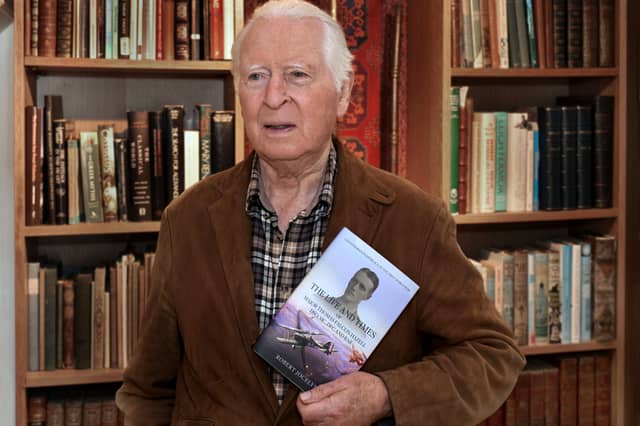

One of the bravest and most skilled pilots to fight with the Allies in the First World War was Thomas Falcon Hazell, who was born in Cashel, North Connemara in 1892.
In a war where aviation was in its infancy and where Germany had superior aircraft, leading to thousands of Allied pilots being killed, this top ace was one of the lucky survivors.
However, in later times, with no family left in Connemara and no awareness of his war heroics, Hazell was in danger of being forgotten. That was before Robert Jocelyn, the current owner of Doon House, where Hazell was born and spent his early years, decided to tell his story. Thanks to Robert’s book ‘The Life and Times of Major Thomas Falcon Hazell, DSO, MC, DFC and Bar’, the deeds of this Galway airman have been documented and his place in history restored.
Hazell joined the Royal Air Corps in 1916, having briefly served with The South Irish Horse and as a second lieutenant with the Enniskillen Fusiliers, based mostly in Ireland and England. He was sent to France in December 1916, and having found his ‘aerial feet’, became one of the Allies’ main aces. Between March and August 1917, he had 20 aerial victories and an encounter with Herman Göring – later a leading Nazi – who erroneously believed he’d killed the Irishman.
Hazell was ordered home to rest later that year, due to stress, having “cut a swathe through the Germans”, says Robert.
In June 1918, after time in Connemara and probably training pilots in England, he returned to France, cutting another swathe through enemy lines.
Towards the end of the war, there was much low-level flying, which was deemed necessary to destroy the enemy’s reconnaissance balloons and weaken their positions. Pilots hated because it was so dangerous.
Robert’s book includes terrifying contemporary accounts from Hazell and fellow pilots of dog-fights over the Somme, and reports from one of Germany’s leading pilot fighters, Ernst Udet.
A later, self-serving account by Göring of a battle with Hazell, also features.
Hazell continued to serve in what became the RAF until the late 1920s and while there’s no hard evidence, Robert believes he became disenchanted after bombing raids on innocent civilians in Britain’s North-West Frontier of India.
Back in Ireland, in the 1930s, Hazell was key to setting up the Irish Aluminium Company which provided significant employment in the new State during a time of serious unemployment and emigration. By then, his family had relocated to Dublin.
When he died in 1946, a local woman, Mary Barrett, who had worked for the Hazell family and had joined him in Irish Aluminium, was at his side. She went on to become managing director of the company – it’s highly likely they were in a relationship and in various bequests following her death in 1979, she stipulated that prayers be said for both families.
Robert’s interest in Hazell began in 1997 when he and his wife Ann were visited by relatives of the pilot, the Hackett family who live in England. Before that, he'd been aware of the link between Doon House and the Hazells, and that they had started a kelp industry locally, but not much more.
That visit piqued his interest and, despite the lack of family letters, Robert’s research has yielded a book that gives a fine overview of Hazell’s life and times – including details of his grandfather who became the first recipient of the Victoria Cross for his role in the Crimean War.
Robert's own love of Connemara began in childhood, when he visited regularly with his Kildare-born mother, Clodagh. Her father used to buy cattle in Connemara, bringing them to Kildare to fatten them, then selling them on to England.
Clodagh was married to the ninth Earl of Roden and Robert was reared in County Down, in the family's ancestral seat of Tollymore Park House. He was sent to school in England, aged eight.
“Hence my accent,” he says, adding that education in England was the norm at the time for Protestant families like his.
His grandfather sold Tollymore to the Northern Irish government in the early 1940s but the family stayed on. Robert’s parents and their children lived in the Dower House, although his father, who was in the Royal Navy, was rarely at home.
In 1960, Robert “took the boat to England” for employment, working there for almost 40 years in re-insurance. But Ireland drew him back and he had a special grá for Connemara. When Doon House came on the market in the 1960s, he bought it and divided his time between there and London.
In the 1980s in London, he met writer and translator Ann Henning and, when she needed a place to finish a project she was working on, Robert offered her Doon House. She fell in love with the place, which sealed both their relationship and his move to Ireland.
“She never came back,” he says, laughing. “We were going towards marriage anyway but that settled it.”
Their son Shane attended primary school locally, then went to St Columba's in Dublin and on to Trinity.
“His grounding in Cashel and Connemara has stood him in good stead,” says Robert of the 36-year-old, who lives in London.
Robert got satisfaction out of developing and taking over companies while he was in business but, “the time I have spent here, either involved in the community or writing, has been far superior to the time I spent in London. When you do creative work here, you have something to show for it”.
His love of Connemara is apparent when speaks of his childhood visits there, and learning how to fish. There were also trips to the Aran Islands with his mother, where the keen sailor later apprenticed himself to a boat-builder.
Robert's affection for his home place in County Down is also deep. “We had the run of Tollymore Park and it was a wonderful place to be brought up”, he says, adding that it was sold on the basis that it wouldn't be developed on; it remains government-owned and is open to the public.
He has written a book about Tollymore and one about his uncle, Major DM (John) Kennedy MC, who died in the Second World War. For those, he had access to rich family records. But with Hazell, it was different.
Robert’s painstaking research involved visits to the British National Archive in Kew, where records helped him piece together Hazell’s missions. He also offers vivid descriptions of Connemara and Ireland at the turn of the 20th century and dedicates the book to the Connemara men who never returned from the Great War.
He is hopeful that as people read it and make connections it will unlock more material on Thomas Falcon Hazell who received many military honours for his bravery.
* Robert’s book will be launched in the Alcock and Brown, Clifden, at 5pm on Sunday, September 20, during Clifden Arts Festival and is available in local bookshops.