

Farmer admitted lighting gorse fire which threatened house

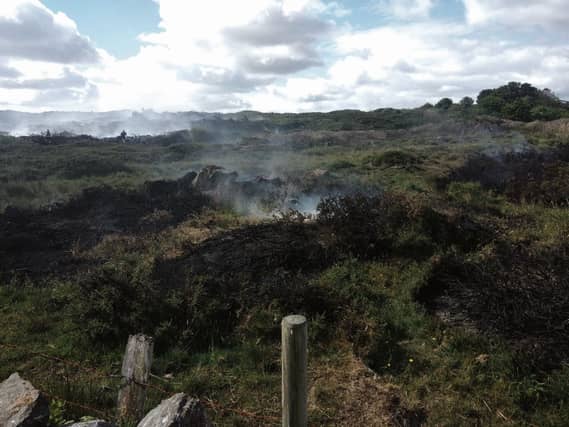

A part-time farmer was banned from driving for two years after he was caught lighting gorse fires in Connemara which threatened a house.
Gerard Roche of 24 Bayview Rise, Ballybane, Galway pleaded guilty to destroying ‘by burning vegetation growing on land not then cultivated’ at Gowla, Cashel on June 5, 2020.
Galway County Council Community Warden Martin Mannion told Clifden District Court he attended the scene of the fire at 9.45am where he met the defendant who admitted to lighting the fires at 8am but which had spread out of control.
The land belonged to his wife Bridie Roche but he was taking full responsibility for the blaze.
A nearby resident described the gorse fire as terrible and feared it would burn down her home, he recalled. It took three fire engines hours and multiple attempts to extinguish the fire as it kept smouldering throughout the day.
“It’s a very big property. It was very close – ten feet – away from this house. That lady was very frightened,” he recalled.
He explained that gorse fires were a really big problem in South Connemara. The land was particularly dry as there had been a red fire warning in place days before following a prolonged heatwave.
“Eleven fire engines had to come to Carraroe last year – 40 firefighters had to come from as far away as Athenry and Castlebar.”
Defence solicitor Sean Acton asked him if the extent of the damage was 1.5 acres across the 20-acre farm, which lies beside a mountain with commonage grazing.
“It’s all covered in gorse heather. Everything was destroyed.”
Conservation ranger Aonghus O Dónaill said Roche did not understand the gravity of what he had done when he was questioned. Fires are banned to protect wildlife during the nesting season between March 1 and August 31.
“He said, ‘all I did was light a small fire’. He stated that he wanted to do some more burning after being told there was a ban in place as it was the nesting season. I explained about the dates and the reason you cannot burn because it’s a catastrophe for every living thing.”
Mr O Dónaill said this was on peatland that released carbon when burned which was bad for emissions. It took between ten and 15 years for the land to recover.
“It’s very difficult to catch people in the act. The damage to wildlife and the habitat is irreparable. It’s a huge problem because there’s no real deterrent.
“This was a few metres from a house and was beside a special area of conservation. If it had got into that it would have been catastrophic.”
He explained that gorse was burnt by land owners to clear lands as farmers were afraid they would lose their farm payments. It also promoted new growth which was more nutritious for cows and sheep.
There were just three rangers covering all of Connemara.
“It’s the lazy option to put down a match and walk away. There was an orange weather warning when this happened. He showed very little remorse. I don’t think he was cognisant of the damage done and the damage it could have done. Anything that could not run or fly away would have been incinerated.”
The court heard that it cost €1,400 to fight the fire and Roche had paid €670 to Galway County Council so far.
Defence solicitor Sean Acton said this was not a case that his client lit a match and “vamoosed back to Galway”.
He remained on site and owned up to the fire. A former factory worker and taxi driver, the 66-year-old father of two was separated and living in a chalet.
He used to keep cattle on the land until some were stolen. He now rented land in Headford where he kept cattle and just had donkeys on the land in Gowla.
Judge Alan Mitchell was he was surprised that the maximum penalty for conviction was €5,000 with no prison term attached.
“It doesn’t seem to be much of a deterrent because it’s happening so regularly. That’s what’s of concern. A serious view has to be taken. A 'laissez faire' attitude is taken by people in places like Connemara.”
He decided to impose a two-year driving ban - a little used penalty in these cases - as a car was used in the commission of the offence.
He also imposed a fine of €750 and ordered the defendant to pay €605 in the State’s legal costs.
“People should be aware that if they decide to go out driving to do this, they can also face a disqualification.”
Mr Acton indicated that he would appeal the decision.
Afterwards, the National Parks and Wildlife Service welcomed the decision of the court and Judge Mitchell’s comments on the seriousness of the issue of burning vegetation during bird nesting season.
“This illegal practice is a problem across the country and can be difficult to investigate by its nature,” said a spokesperson.
“Unregulated and uncontrolled vegetation fires are not only catastrophic for nesting birds but for biodiversity in general with large areas of sensitive peatland habitats in particular being destroyed annually as well as potential significant economic damage to commercial forestry.
“Some habitats can be destroyed or altered permanently or take decades to recover.
“Deliberate and unauthorised burning can be regarded as a traditional practice in some areas to manage scrub and promote better grazing opportunities.
“The NPWS considers that vegetation fires are a major threat to Ireland’s biodiversity and is committed to tackling the issue with the resources available, including increased dedicated patrols during high risk periods,” they concluded.