

Dublin hospital name ward after Galway nurse behind 'landmark nursing achievement'

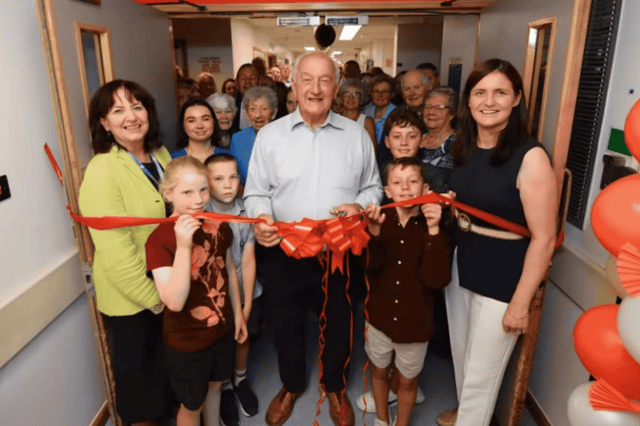

In 1984, she led the nursing team caring for the first patient to undergo a bone marrow transplant in Ireland - a landmark achievement in Irish healthcare
The name of a dedicated Galway nurse will forever be enshrined in the hospital she served so faithfully – and in the area of oncology where she left such an indelible mark - over her remarkable nursing career.
Because St James's Hospital in Dublin now boasts the Sheila Clarke Ward, called after the native of Gurtymadden as a fitting tribute to a woman whose contribution to nursing and patient care left an enduring legacy.
The Sheila Clarke Ward is a thirty-bedded, acute mixed medical ward including oncology, haematology and palliative care patients - one of five wards in St James’s Hospital in Dublin renamed after staff members who had an 'exceptional' impact on the hospital and on its patients.
Sheila was born in Gurtymadden, Galway on September 24 1948 to Mary and Dermot Clarke, growing up with her siblings Charlie (RIP), Maureen, Cora (RIP), Oliver (RIP), Pat, Dermot and Gerry.
Throughout her life, she remained deeply connected to her family, her Galway heritage, and the values of kindness, compassion and dedication that would come to define her remarkable nursing career.
Sheila lived the last seven years with her husband John in Kilconnell and was Secretary to the Ballinasloe Retired Nurses Association.
Sheila began her nursing career in St James’s Hospital in the 1970s after completing her nursing training in Galway.
She later spent a period working in South-East Asia, gaining valuable experience and a broader perspective on healthcare, returning to St James’s, where she brought with her renewed enthusiasm and expertise at a transformative time for cancer and haematology services.
As Senior Ward Sister, Sheila held responsibility for the National Adult Bone Marrow Transplant Unit, the National Haemophilia Treatment Centre, and the Haematology/Oncology Unit.
In 1984, she led the nursing team caring for the first patient to undergo a bone marrow transplant in Ireland—a landmark achievement in Irish healthcare.
And as her old colleague, and nursing staff representative, Liz Higgins reflected at the naming ceremony, the contribution of specialist nursing care to the success of this milestone cannot be overstated.
"Few people have contributed more to the development of specialist Haematology and Oncology nursing in Ireland than Sheila," she said.
"Her knowledge, clinical expertise and dedication to patient care set the highest standards for those who worked and trained with her. She was a role model in every sense of the word—respected for her professionalism, admired for her leadership, and loved for her kindness, empathy and wonderful sense of fun," she added.
And she spoke most particularly of her work when the Denis Burkitt Unit opened in 1996, providing a new home for Haematology, Oncology and Bone Marrow Transplant services.
"Sheila’s commitment, vision and determination were instrumental in bringing the project to fruition," she said.
"She understood that excellent facilities alone were not enough; it was the people within them, delivering compassionate and expert care, who truly made the difference.
"Her leadership continued with the opening of the Haematology/Oncology Day Care Centre in 2004, a service she managed directly until her retirement in 2005.
"Throughout her career, Sheila was a passionate advocate for education and professional development. Having undertaken specialist oncology nursing training herself, she actively encouraged and supported others to do the same.
"In doing so, she helped shape generations of nurses who continue to provide outstanding care today," she added.
Liz Higgins said that Sheila's influence also extended far beyond St James’s Hospital.
"Sheila was instrumental in establishing the Irish Association for Nurses in Oncology, an organisation dedicated to advancing oncology nursing practice across Ireland," she said.
"Such was the significance of her contribution that the Association established a travel bursary in her honour.
"The bursary continues Sheila’s legacy by enabling nurses to attend international oncology conferences and visit centres of excellence around the world, bringing new knowledge and innovations back to Irish patients."
But she added that, while Sheila’s professional achievements were extraordinary, those who knew her personally remember much more than her accomplishments.
"They remember her generosity with her time, her encouragement of colleagues, her quiet determination, and her remarkable ability to reassure patients and families during some of the most difficult moments of their lives," she said.
"When Sheila retired in 2005, many were delighted that she would return home to Galway and begin a new chapter of life. Sadly, fate had other plans.
"The very illness that she had spent her life helping others confront would ultimately claim her own life. It was a cruel irony and a profound loss for all who knew and loved her," she added.
Liz pointed out that there was also a poignant significance in the naming of the Sheila Clarke Ward - because the ward that now bears her name is the same ward where her beloved brother Charlie spent his final days.
"It seems especially fitting that a place associated with both personal loss and compassionate care should now stand as a permanent reminder of Sheila’s extraordinary life and service," she said.
"Today, we remember Sheila Clarke as a leader, pioneer, mentor and friend. Her contribution to Haematology and Oncology nursing transformed services, influenced countless careers and, most importantly, improved the lives of thousands of patients and families.
"Her legacy lives on in the services she helped build, in the nurses she inspired, and in the patients whose lives were touched by her care and compassion," she added.