

David scaling musical heights ahead of Galway visit

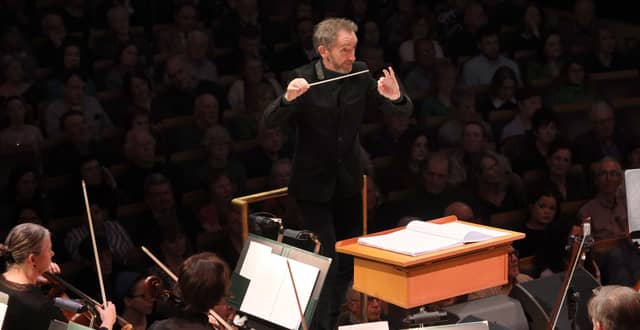

David Brophy’s ability to embrace all musical genres is one reason the Dubliner was appointed chief conductors of one of Germany’s best-known orchestras in 2024.
Fulfilling that role while retaining his professional links with home requires him to work 16-hour days currently. It’s a bit of a roller coaster but he’s confident life will settle.
David who will visit Galway on Saturday March 28, to conduct the National Symphony Orchestra for its concert in Leisureland, had an unconventional route to music.
His father worked as an electrician and he grew up in a house where music wasn’t central. He only began piano lessons aged 13 and had no exposure to traditional music until he was in his late teens or early 20s. He did encounter classical somewhat earlier, hearing Vivaldi’s Four Seasons when he was 18 and thinking “this is interesting”.
Having packed in a lot of practice, he went on to pursue a career in music, embracing all styles, with equal ability.
He has worked with international and Irish musicians, and was musical leader of the homeless choir, High Hopes, as well as setting up the Frontline Choir, made up of healthcare workers, during Covid.
“Music is music,” this down-to-earth man says simply. His early love was ska and rock, and he played in a band during secondary school. Then, as he discovered other musical genres, he realised it was possible to enrich his life by broadening his palate.
It was like Irish people who had lived on traditional fare until the 1980s discovering new cuisines around that time, but not abandoning our own.
“Music for me is the same. You add things to it. And you don’t leave potatoes behind because you’ve discovered rice.”
David is as happy conducting Abba’s music as Beethoven’s and that’s what led to him being chosen as Chief Conductor of Cologne’s WDR Funkhausorchester – somewhat similar to working for the BBC Symphony Orchestra.
In WRD Funkhausorchester, it’s the orchestra who appoint their chief conductor, voting from a shortlist chosen by management. After taking up the job, David asked one of the members why they’d overwhelmingly voted for him. In German, she told him it was because he was “an egg-laying, full-milk female pig”. He chuckles, adding that the nearest equivalent expression in Ireland is “as rare as hen’s teeth”.
When David is at home, working with the RTÉ Concert Orchestra, National Symphony Orchestra, or Ulster Orchestra, which he does regularly, nobody takes any notice when he moves from genre to genre.
“I’m ordinary in Dublin, but in Cologne, I’m an exotic creature,” he says with a laugh.
That’s because in Germany, the demarcation between what’s regarded as classical and popular music is very defined.
“But I’ve always done it that way. The notion of just doing classical music fills me with dread. And the notion of just doing Irish music also fills me with dread.
“I bring my Irishness to the European way of doing things.”
Mixing things up is good, he feels.
“If you are going to be creative you don’t limit yourself to one particular area. It cuts down the interest.”
For his first gig with the WDR Funkhausorchester in 2024, David mixed classical and folk, including Felix Mendelssohn’s Hebrides Overture as well as Róisín Dubh and Seán Ó Riada’s Mise Éire.
To hear the horn being played by a Dutch musician for a German audience and witness the response, “made the hairs on my neck stand up”, he says.
David points out that a lot of classical music has strong folk elements. Stravinsky, for instance, drew heavily on Russian traditional music while Czech composer Antonín Dvořák, who moved to the USA in 1892 to take up a prestigious music post in the National Conservatory of Music, drew on the folk culture of his native country and the spiritual music of Black people in the US.
Dvořák’s renowned Symphony No 9 From the New World will be performed at next week’s concert in Leisureland, along with Shaun Davy’s The Brendan Voyage. They are reprising this concert following its success at the National Concert Hall last year
He’s delighted to be bringing The Brendan Voyage to Galway 50 years after English explorer Tim Severin and his crew sailed from Brandon Creek in Kerry to Newfoundland on a primitive leather-skinned boat, to prove that the Irish saint, Brendan the Navigator, could indeed have travelled that distance in….
The voyage took Severin from Kerry up Ireland’s west coast, to the Faroe Islands, Iceland and through battles with Labrador gales and ice, before arriving in Newfoundland.
These pieces are perfect companions for a concert with has travel as its theme, says David, mentioning the SS Saale, the boat on which Dvořák travelled to the US in 1892. That was a stormy nine-day crossing, but somewhat less arduous than that of St Brendan or Tim Severin, he adds with a laugh. And he points out that Shaun Davey in the Brendan Suite, paid homage to Dvořák’s New World Symphony.
The Brendan Voyage was originally written for legendary uilleann piper Liam O’Flynn and the soloist’s mantle has now been passed on to the talented and versatile Mark Redmond, who has retained many elements of Liam O’Flynn’s playing, while making the piece his own.
David conducted the piece in Cologne last week, with Mark as soloist. That programme was completed by a performance from traditional Irish musicians Zoë Conway and John McIntyre on fiddle and guitar.
“The reaction was incredible,” says David, who adds that he’s mindful of catering for a German audience while also incorporating elements of his own tradition. That’s helped by the fact that Germans love Irish music, he observes.
He recalls conducting a performance at a Finnish folk festival about 10 years ago, with Liam O’Flynn as soloist in what was his last performance of the piece. Again, the audience loved it. Again, he comes back to the point that “music is music”.
David recalls that, a couple of years ago, his oldest son who is now 22 and is into rock music, came to him one day and asked “what’s with the last movement of Beethoven’s Ninth symphony?”
The teenager had heard it while playing an online game and was intrigued.
The conductor points out that the links between Irish and classical music span the centuries, citing the famous O’Carolan’s Concerto, written by harpist Turlough O’Carolan (1670-1738). It’s believed that baroque musician and composer, Franceso Geminiani, who lived in Ireland, influenced its composition.
David’s grandfather, a blue-collar worker, knew the Chopin Military Polonaises, thanks to Jesuit education, and Joyce’s Ulysses contains many classical connections. The links are there and he is never happier than when he’s exploring them. Tickets for next week’s concert at www.musicforgalway.ie.