

On crest of wave with model ships
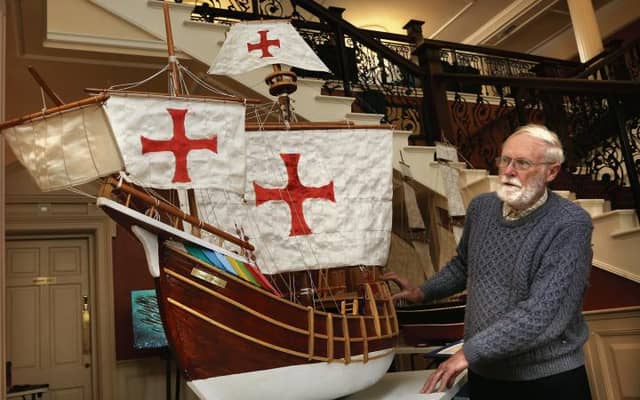

Lifestyle - Making scale models of historic boats is a skill master craftsman Jim Horgan has perfected over the years. Examples of his work, ranging from the vessel in which Columbus sailed to the New World to a post-Famine coffin ship, are displayed in the Galway Crystal shop on the outskirts of the city. The aim is to establish a museum to house these and more historic models, as BERNIE NÍ FHLATHARTA learns.
Galway based boat-builder Jim Horgan is considered to be one of the finest craftsmen in the trade here in Ireland – and another string to bow is his ability to make scale models of traditional Irish vessels. He plays down his skill in this regard, implying that anyone could do it. Indeed, he shares his knowledge through classes and many other people are now building their own models as a result of this.
But Jim has a real talent in being able to scale down naval architectural boat plans so that the end results reflect each boat perfectly.
And anyone with an interest in boats, especially in historical vessels, can see three of Jim’s models in the foyer of the Galway Crystal building on the city’s Old Dublin Road. These exhibits were made to commission and the long-term aim is that they’ll be part of a bigger permanent exhibition of Galway’s maritime history, dating back to the 1400s.
Jim’s model of the Santa Maria, Christopher Columbus’ flagship vessel on his journey to the Americas, depicts Galway’s wine trade with Spain and Portugal. Columbus himself is believed to have prayed in the city’s St Nicholas’ Collegiate Church in 1477, 15 years before he took the voyage which led to the European discovery of the Americas.
The second model, the Brig St John was a ship which left Galway in 1849, in the aftermath of the Famine, bound for Boston. She dropped anchor at Leitir Mealláin in South Connemara, taking on additional passengers. Her master was Martin Oliver from the Claddagh. The ship reached Boston a month later but a storm drove her out to sea where she was battered and, despite rescue attempts, 120 passengers perished. Only 22 people survived.
Built in Canada as a cargo ship, she was sold in 1848 to Henry Comerford of Merchants Road and subsequently used to transport some of the thousands of people who emigrated to America from the West of Ireland after the Great Famine.
The third model on display is of the PS Connaught, a paddle-steamer which was the second-largest and most luxurious liner of her time. In her second trans-Atlantic crossing from Galway in 1860, she was carrying 50 first-class passengers, 470 in steerage and 125 crew. She was also carrying a consignment of gold coins.
She sprang a leak when she was only 150 nautical miles from Boston but unfortunately the pumps on board were unable to cope and she sank after one of the boilers on board exploded. However, everyone survived after the Minnie Schiffer, a small cargo ship nearby, managed to rescue all on board. The wreck of the Connaught which went down 160 years ago this week, was discovered by a US salvage company in 2016 and work is still underway to recover the gold coins which had then been valued at about $15 million.
Get the Connacht Tribune Live app
The Connacht Tribune Live app is the home of everything that is happening in Galway City and county. It’s completely FREE and features all the latest news, sport and information on what’s on in your area. Click HERE to download it for iPhone and iPad from Apple’s App Store, or HERE to get the Android Version from Google Play.