

From Galway to Spain on a return to sacred ground


Sitting at the bar of a packed restaurant in the northern Spanish city of San Domingo, a person tapped my shoulder. Such was the warmth of the gesture it seemed like someone from home had chanced upon us on our Camino journey.
But no, it was a local woman telling us that her group were leaving their table and we’d be more comfortable sitting there.
This was one of the many kind gestures from people we met on a 150km walk from Logroño to Burgos this Easter, continuing our pilgrimage towards the city of Santiago de Compostela, reputedly the burial place of St James the Apostle.
Last year, my friend Bairbre and I had walked 165km of the Camino Francés, having prepared diligently for a six-day hike that took us over the Pyrenees, on through the hills and valleys of Navarra, into the capital of the Rioja region, Logroño.
This year, our preparations included physiotherapy sessions and resting. Bairbre had a calf injury while a trapped nerve had curtailed my walking. It was a worry.
Yet, as the Easter holidays began, we were back in Logroño, hoping we’d complete 150km over five days, while accepting we might not.
Happily, perseverance and taking life handy, as well as welcome distractions – budding trees, ever-present birdsong, endless vineyards and chats with strangers – carried us through
On the second day, we got lost on a detour from Nájera to the village of San Millán de la Cogolla. The pain in my knee was so bad, I considered quitting, but focusing on the majestic hawks soaring overhead, helped me muddle through.
We met not another soul during a 10km trek through valleys and hill. Eventually, we spotted farmers in their vineyards as we reached a road that led to a tiny village about 10kms from San Millán. We took refuge in a café, busy with locals, where lunch of tortilla and coffees cost the princely sum of €6.60 in total. Heaven.
San Millán, a UNESCO world heritage site, isn’t on the Camino proper, but it’s home to two breath-taking monasteries, the 6th century Suso and 11th century Yuso, and is so important in terms of Christianity and history that a detour there is recommended.
The first record of Spanish as a written language was in Suso and it's attributed to an unknown 9th century monk. Yuso, meanwhile, has a magnificent parador, where the hotel receptionist came to our rescue.
Our original plan that morning had been to return from San Millán to Nájera by bus. But that was before we went astray and arrived there an hour later than planned. We wanted to spend time exploring, so decided a taxi home would be a better alternative. Having explained our situation to the receptionist, she phoned several drivers to get us the best rate. More kindness.
During our first few days of walking, the biting cold meant windburn was a bigger risk than sunburn – the weather was far colder than last year, with snow on the distant Pyrenees.
However, we were spared the relentless mist and rain that dominated much of last year’s walking. And our final few days were beautifully warm and sunny.
But it was bitter on day one, as we walked out of Logroño, picking up from last year after staying in the same Albergue. In the neighbourhood café, we had coffee and croissants. Then they filled our water bottles and wished us ‘Buen Camino’.
It was a good start. Fuelled by adrenaline, we walked the 29km to our first destination, Nájera, with stops for food, coffee and scenery. In Nájera, the stunning Monasterio Santa Maria de la Real offered a snapshot of local royal history and of Spain’s colonial past.
It being Holy Week, local priests and lay helpers along the 29km route were preparing their churches for Easter. Boy, do the Spaniards ‘do’ Easter.
Our Holy Thursday lodgings were in Santa Domingo de la Calzada, a small city that was incorporated into the Camino de Santiago route in the 11th century, thanks to the efforts of local hero, St Dominic.
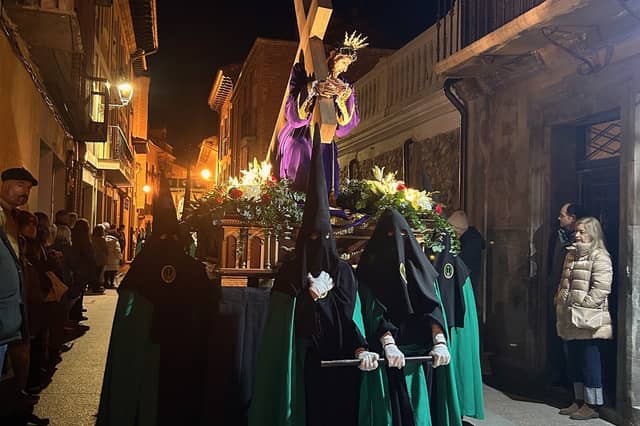
Strolling home from dinner that night, we came across a religious parade, which had floats showing scenes from Our Lord’s Passion in vibrant colour and unsparing detail. Children and adults walked in darkness, with a brass band providing the soundscape. It was memorable.
In Belorado, 22km further along, the Good Friday parade was even more intense, as barefoot children carried large wooden crucifixes on their backs, again in darkness.
We’d been informed about that parade by a lovely local woman. She and her husband were at the next table as we enjoyed a pre-dinner beer and she explained that they had visited Tipperary’s Rock of Cashel after being told it offered a cure for infertility. They now have a young son and she was in no doubt Cashel was the reason.
Everywhere we went, there were Irish connections. A young Dutchwoman we met en route to Belorado told us about her PhD thesis in the London School of Economics, for which she interviewed former housing minister Eoghan Murphy about his time in office – he’d told her about institutional obstacles but had also been very honest about where he felt he’d failed. She was walking alone and we met again, as happens on the Camino.
In the tiny hamlet of St Juan de Ortega, in the pilgrim hostel where we were spending Holy Saturday night, she was with buddies she’d met while walking. These young people from the US and Europe were having a great chat in the sunshine which had replaced the cold. Old-style conversations about their lives. We agreed it was lovely.
The following day, Easter Sunday, we began the long slog into Burgos, our final destination for 2026. Rolling hills with majestic trees and horses gave way to tarmac roads and traffic as we approached this city, Franco’s local headquarters during the Spanish Civil War. Our hotel was beside the brilliant, bonkers cathedral for which Burgos is also famous. We spent two hours contemplating its beauty and Spain’s complex history.
We wandered the old town, visiting the castle, eating, drinking and resting our weary feet, feeling elated that we’d overcome painful shins, knees and blistered toes to finish stage two, still standing and still friends. After we returned home, a final act of kindness.
Early in our journey, Bairbre had lost her Camino passport – a document that pilgrims get stamped in churches and hostels en route to Santiago. Three days after she came home, a letter arrived from Navarette, the first village we’d stopped in on day one. The passport was inside.
Roll on 2027!