

Baleno will be a hit with motorists looking for something new in a compact car

By Gerry Murphy
Even with the growing trends towards SUVs, the battle to tempt compact car customers to part with their money is as hot and spicy as ever. It’s a battleground that is fierce between the big brands like Ford, Volkswagen, Toyota and Opel, to name just a few.
Now though, more and more car makers are targeting buyers with additional spec, smaller engines, PCP offers, and lower prices. Mainstream buyers are becoming clued in more than ever, and many are weighing up the balance between value for money and the technology being offered.
Different brands offer different driving qualities, higher specification and the promise of higher resale values but, customers don’t necessarily want to spend their hard-earned cash for stuff that they feel they don’t need or, for that matter, will never use.
In the past couple of years, a price threshold of €20,000 has become an important water level for many car makers. Although it is an SUV, the success of the Dacia Duster has awoken and consciousness in the industry that people will buy a less expensive car if the package fits their needs and their financial circumstances.
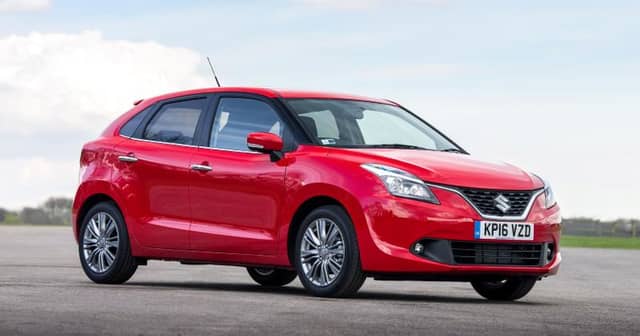
A recent arrival that fits the bill perfectly is the new Suzuki Baleno. A new car from the ground up, it has all the hallmarks that endeared the brand to its loyal fans over many years. It completes the catalogue of simple-to-drive; economical modern cars with a high standard of build quality. Plus, this car, while in the cheaper end of the scale, still packs in a lot of goodies for the buyer.
First introduced in the Vitara S, the Boosterjet engine continues in the new Baleno collection with an all-new 1.0-litre three cylinder 111ps direct injection turbocharged engine. Suzuki tell us that it has the same level of power and torque of a much larger capacity normally aspirated engine (1.8-litre) and it certainly performs effortlessly and is a pleasure to drive. You can also have a 1.2-litre (SHVS) smart hybrid version.
Economically, the Baleno has a lot going for it with combined fuel consumption over 1,100 kilometres coming in at 5.3L.100km under tough test conditions. Suzuki advertises a possible figure of 4.5L/100km and that by most standards is pretty decent and definitely attainable. CO2 emissions of 105g/km put it into tax band 3 and an annual charge of €190.
Visually, while it may not win too many beauty contests, to be fair, it is far from objectionable and the front end is the best view. Also, it is more spacious on the inside than the exterior portrays.
The cabin, which is well presented, is big enough to take five adults with comfort and the seats are sturdy with decent quality materials all round.
For more, read this week's Connacht Tribune.