

Peadar doing Pádraic proud with translation of M’Asal Beag Dubh
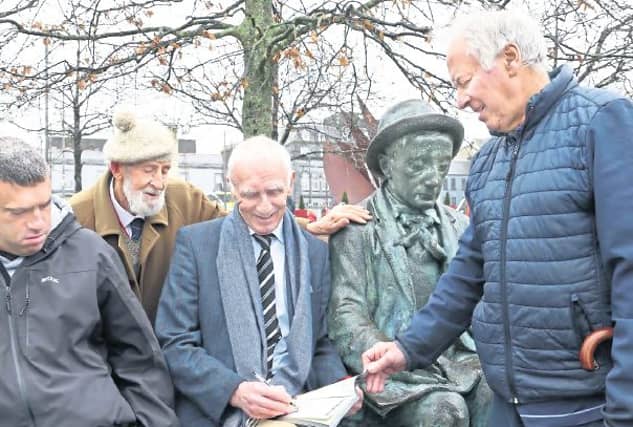

When Peadar Macken was a student in Coláiste Éinde in Salthill, six decades ago, Pádraic Ó Conaire’s ‘M’Asal Beag Dubh’ was among the texts he studied for his Inter Cert.
“If you looked out the classroom window, you’d see Galway Bay and the Burren, and I used to think it would be a great idea to be sailing out there instead of being in the classroom,” he chuckles.
Such sentiments showed the kinship he felt with Ó Conaire (1882-1928), who spent much of his life rambling the roads, documenting his travels in the very book that Peadar was studying in Coláiste Éinde. The title story, ‘M’Asal Beag Dubh’, was first published in the Freeman’s Journal in 1917 and appeared in the short story collection ‘An Crann Géagach’ in 1919.
Peadar has now translated ‘M’Asal Beag Dubh’ and its stories for a handsome new publication which he hopes will benefit the growing number of people who are interested in Irish, as well as those who studied Ó Conaire in school.
The writer's collection ‘Scothscéalta’, which was on the Leaving Cert course, covered all of human life; themes included jealousy, poverty, alcoholism, loneliness, prostitution and politics.
Born in Dublin, Peadar was reared in Rosmuc, where his father was a woodwork teacher in the local school.
He learned his Irish from the older people there, and also learned boatbuilding, which has remained central to his life. Colm Walsh, “one of the best builders of Galway Hookers”, was an early mentor
In recent times, Peadar has been involved with the revival of currach-building in Galway City.
He has also built largescale, replicas of famous sailing ships, including Ernest Shackleton’s ‘Endurance’, and the Spanish Armada boat ‘Concepcion del Cano’, which was wrecked off Carna in 1588. These are now on display in a museum in Waterville, County Kerry.
Like Peadar, Pádraic Ó Conaire, who was born in Galway City, spent much of his young life in Rosmuc. His parents died when he was a child and he was looked after by extended family there and in West Clare. It was in Rosmuc he learned his Irish.
Ó Conaire moved to London in 1900, working for the civil service. He joined the Gaelic League there and began writing short stories, continuing to pen stories, novels and articles after he returned home in 1915.
Many of his stories dealt with the bleaker side of life but ‘M’Asal Beag Dubh’ has a gentle, lyrical tone. The narrator describes the purchase of an ass in Kinvara, in hilarious circumstances, and the adventures that befall them on their rambles.
When Peadar was learning Irish, the old Gaelic script was still in use, and he has drawn on it for the Irish language version of the story.
He mourns the passing of something with links to such a rich past, but accepts that if adopting a modern font helped keep Irish alive, it was necessary.
“It’s better off being half there than not there.”
Likewise, he explains that the Gaeilge he learned in Rosmuc in his youth – which was similar to what Ó Conaire learned there a half-a century before – had a richness and poetry that 'standard' Irish hasn’t got.
‘An Caighdeán Oifigiúil’ – the Official Standard – which was designed to unify Irish grammar and spelling, was introduced in by the State in 1958 to facilitate teaching the language, he explains. The arrival of Raidió na Gaeltachta in the late 1960s also led to greater standardisation.
Peadar, who lives in Castlegar, feels that the most important issue is to ensure the language remains alive and he welcomes the addition of words like ríomhaire – computer – that didn’t exist in Ó Conaire’s time.
Ó Conaire didn’t have an easy life, and Peadar says that, despite his rich literary output, he wasn’t always popular in his native city, where Irish wasn’t valued and where he was seen as being too fond of alcohol.
Peadar feels he should be more celebrated – and the Rosmuc man has served him well with this translation.
“It was at the back of my head through the years to do it. I’m in my mid-70s now and I had the time and the interest,” he says of this labour of love.
‘M’Asal Beag Dubh: Aistí agus mion-scéalta;, is in Charlie Byrne’s and all good bookshops.