

Novel approach helps people learn Irish in a creative way


The opening of the art exhibitions at Galway International Arts Festival every July takes place on a Sunday, the day before the launch of the festival itself.
It’s a sociable day. Normally, you’d hang around afterwards, maybe go for a drink.
But not this year. This July, an important Zoom meeting meant going straight home after the formalities.
It was the first Zoom of ‘Dúshlán an tSamhraidh’, a novel Summer Challenge that had started just three days previously.
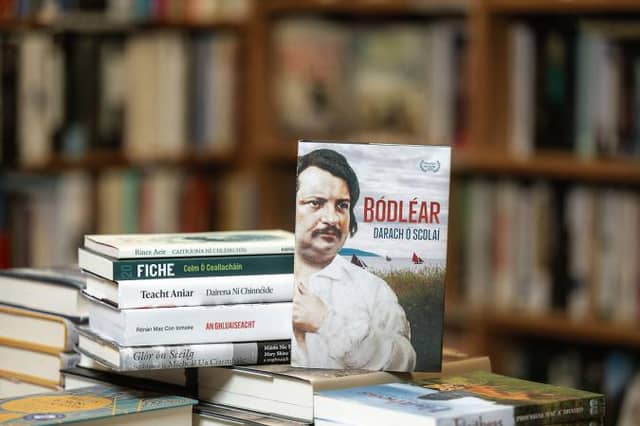
The brainchild of Listenupirish.com, the challenge involved reading a chapter of a selected Irish-language novel every two days until early September. The book was Darach Ó Scolaí’s Bódléar, which people who signed up for the course had already received in the post, alongside a timetable to keep us on track.
That Sunday evening in July, as the first Zoom meeting took place, some 100 eager readers from Ireland, the US, the UK and as far away as Australia and New Zealand, were already two chapters in.
The team behind Listen Up Irish are Patricia Nic Eoin and Joe Ó Fátharta, both experienced teachers. Patricia’s passion is Irish grammar and vocabulary and Joe’s is literary analysis.
Every two days, at 8am, we’d get an email that brought us to the website, and to a video of either Patricia or Joe, providing an overview of the relevant chapter.
Then, Patricia gave us a ‘stór focal’ of words for the chapter. Next, we could listen to a recording of Joe reading the chapter in Conamara Irish, adding dramatic touches as required.
In addition, we could download each chapter with the Irish and English versions side by side. Patricia and Joe often joked that the translations – theirs – wouldn’t win any awards. But they unlocked a door on days when we struggled with the Gaeilge.
Bódléar, which this week won the Oireachtas Irish Language Book of the Year for Adults, is set in Conamara in the mid-1800s and draws on history, poetry and human foibles for its story. Humorous, engaging and highly descriptive, its characters are worthy of another life on the big screen.
The language is rich and of its place, with words and phrases you won’t encounter elsewhere. That’s why we needed support.
As the Bódléar emails landed every two days, a routine emerged.
I’d begin by listening to the overview and the stór focal while out walking. Later in the day, I’d read the chapter on my own before listening to Joe’s recording, reading along wth him and focusing on any words I’d struggled to understand or pronounce. Finally, I’d read the translation. Sometimes, I’d repeat this process several times.
The timetable and regular emails kept me entirely on track. Despite a busy few weeks at work, followed by holidays and a family wedding, I didn’t once fall behind in our reading schedule.
Without the deadlines and ongoing support, that would never have happened, despite the novel being so compelling.
There were chapters I returned to, savouring the richness of the language, including one where the local priest excoriates the parishioners from the altar for what he perceives to be their stupidity and ignorance. His insults are magnificent – and you’re learning words you’d never know otherwise.
For Patricia and Joe, who ran the challenge, that’s part of its appeal as a way of learning Irish. Regular exposure to words and phrases, something you get when reading a novel, allows you to become familiar with them and remember them.
As someone who has happily taken Irish classes where the focus is on grammar, and who listens to Raidió na Gaeltachta regularly, this was a fascinating new departure. The richness of the Irish, the story, the support. I loved it, even as it was a challenge.
Patricia and Joe had previously used poetry and short stories for this method of teaching Irish, but Bódléar was their first novel and it challenged them at times too.
Joe had selected the book, partly because the chapters were short and wouldn't overwhelm participants. Having already read it and enjoyed the plot, the characters and the descriptions, Patricia agreed it was ideal.
“But I hadn't realised on my first reading, how much I had skimmed over. I'd only read the story at surface level,” she says.
Creating the course involved explaining the novel’s historical context and catering for participants’ different levels of Irish. That was a different ballgame.
“It contains so many references; to other pieces of literature and poetry. I especially enjoyed the historical references,” Patricia says.
But decoding them required work – and support from the author. She mentions a chapter late on, about an elderly man in the local pub, who’s wearing a historical bicorne hat. She asked Darach why this man, in the West of Ireland, would be wearing such an item.
“Darach was extremely helpful and answered all the questions sent to him over the summer.”
He also took part in the final Zoom call of the dúshlán, answering participants’ questions, and seemed delighted by the response of this enthusiastic group of readers, all of whom had finished Bódléar.
Joe Ó Fátharta of Listen Up Irish feels the combination of listening and reading helped people complete the book.
Learners often ask him to recommend radio shows or podcasts that they can listen to in Irish, and he does. But that doesn’t always work.
“They can become disheartened when they don't fully grasp what is being said. That wasn't an issue here because you had the tools to tackle any incomprehension, to keep you moving through the story.
“And the short chapters every second day really worked. It was important that we didn't overload anyone,” Joe adds.
Now, following the success of Bódléar “we’re already thinking about the next one and what we can add to these courses”.
* More information on various courses at listenupirish.com.
Pictured: Bódléar by Darach Ó Scolaí was the novel chosen for the course. This week it was named winner of Novel of the Year for Adults by an tOireachtas.