

Finghin embraces diversity in Music for Galway role


Arts Week with Judy Murphy
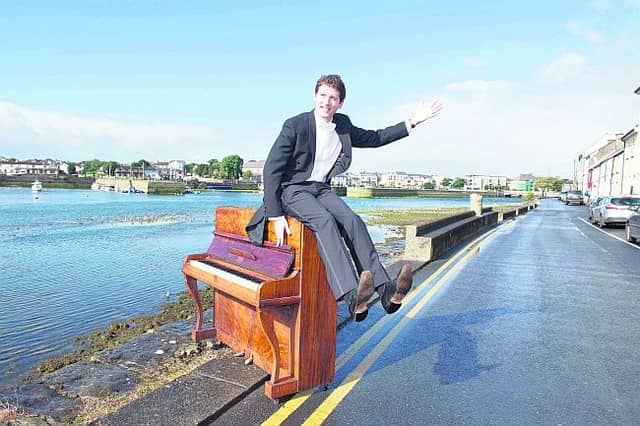
I’m not trying to re-invent the wheel and I’m not introducing radical changes,” says Music for Galway’s recently appointed Artistic Director, Finghin Collins as he prepares to launch the organisation’s programme for 2013-14.
Finghin, who has taken over the role from Music for Galway’s co-founder and longstanding director Jane O’Leary, is also one of Ireland’s leading classical performers who is on the international stage for much of the year. He’s just back from Switzerland and is preparing to spend three weeks in America, so the old adage ‘if you want the job done, ask a busy man’ certainly is relevant when applied to him.
The work he is doing with Music for Galway can be summed up simply, he says.
“I’m introducing fresh, new musicians who I am aware of through my own work and I’m offering a diverse offering of events. There will be things people recognise and a few new things; there is an opera and an oratorio and a little bit of everything.”
The season will open on November 14 with a new piece from Jane O’Leary, which was commissioned by Finghin, who “wanted to pay tribute” to his predecessor. O’Leary is a renowned composer and her new solo piece, Five Bagatelles will be premiered by Korean pianist Ah Ruem Ahn on November14.
The Irish premiere of Ian Wilson’s The Little Spanish Prison by David Cohen and Sasha Grynyuk will take place on October 30. Both O’Leary and Wilson will be present at each of these concerts to introduce their works.
A highlight of each season is the Midwinter Festival in January. Te event for this season focus will on the period from 1893 to 1913.
“They were 20 years in musical history when things changed dramatically. Composers were leaving tonality behind and not wanting in any particular key,” explains Finghin. During the Festival, which runs from January 17-19 audiences will get to relive the ground-breaking new sounds created by Debussy, Schoenberg and Stravinsky alongside contemporary ‘old-style’ masterworks by Brahms, Fauré and Vaughan Williams. The event is programmed so that people can hear the music in a chronological order, as would have happened when these new, often controversial works – most notably Stravinsky’s 1913 piece, The Rite of Spring – were performed.
The world of visual art also took off during in the late 19th century with the Impressionist movement, says Finghin, and art will be involved in this Mid-Winter Festival too. Music for Galway is hosting a competition for students and recent graduates of the Centre for Creative Arts and Media (CCAM) of the GMIT, where the students are asked to respond to the music of the era. The resulting exhibition will be launched along with the Festival at the Town Hall Theatre. Fifteen leading classical musicians from all over the world will take part in the event.
It’s a big undertaking, says Finghin, as he praises Music for Galway’s board and administrator Anna Lardi Fogarty for their role in bringing it to this stage.
“I’ve thought big on this one. I’ve had the idea and worked it and pushed for it.”
The brochure features a drawing by French artist Jean Cocteau of Stravinsky performing the Rite of Spring, which Anna located and is absolutely striking.
Other highlights in Music for Galway’s 2013-14 season include Handel’s popular Messiah in a period performance by the Irish Baroque Orchestra and Resurgam in St Nicholas’ Collegiate Church on December 8.