

Artist Sean Henry captures essence of being human in major show for Galway Festival

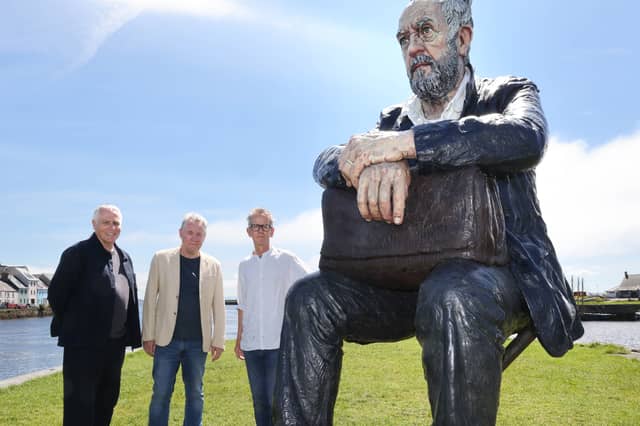

Sean Henry stands beside one of his evocative human sculptures in the Galway International Arts Festival Gallery on the city's William Street and recalls his father, who inspired it.
The older man, who was born in Monaghan and emigrated to England, where he worked as an accountant before retiring at 54 and embarking on a new career in engineering, encouraged Sean to follow his dreams when it came to work. Sean, the youngest of four, was 17 when his father first retired.
“He and my mother were very encouraging and supported me, even when I nearly burned the place down,” Sean recalls with a laugh of his early endeavours, which involved a kiln in the family garage.
Sean and his children now have Irish passports, thanks to his father, something he’s grateful for post-Brexit.
He’s in Galway to oversee the installation of his exhibition, ‘Presence’, at the Festival Gallery. Two largescale outdoor figures also form part of the show.
‘Seated Figure’ has already been placed at the Middle Arch of the Claddagh, while ‘The Wanderer’ – coming soon – will be in Eyre Square.
At the Arch, on a hot, humid Thursday the ‘Seated Figure’ provides shade for a group of young American holidaymakers who are less concerned about the wonderful detail of his clothes, hands and satchel than they are about taking refuge underneath him.
Sean laughs as he looks at a photo of the scene, happy that people are engaging freely with this monumental bronze work. More care will be needed in the gallery where half of the 22 pieces by the renowned artist – some specially created for Galway – are ceramic or fired clay.
There’s a theatrical feel to ‘Presence’ in this wonderful but unfortunately temporary gallery, which has been cleaned and prepared by festival staff once again this year.
Sean’s polychrome sculptures, which vary in height, are either based on individuals who’ve resonated with him or a mix of people. Some figures are standing, some are reclining, some are turning, or crouching. One striking piece features two men embracing.
The artist avoids making life-size human sculptures, saying that smaller figures allow viewers to feel sympathy towards them. Meanwhile, the larger ones can invoke feelings of awe.
Many of the figures are on plinths and at eye level, something that allows viewers to connect, Sean explains. Paul Kelly’s lighting has a similar effect and adds to the dramatic feel of the show.
While Sean has his own stories in mind when he’s making the work, he prefers to let viewers form their own opinions about what’s happening in each piece.
For instance, tucked away in a corner, there’s an arresting sculpture of a sleeping man with a smaller man dancing on his chest. The nimble dancer could be a demon or he might a protector, in a piece that draws you in and rewards attention. 'Lying Man' was made during Covid and took on new meaning as Sean worked on it, he says of the vulnerable, sleeping figure.
Next door in a space that embraces darkness, there’s more drama. The first piece to greet viewers is a distressed kneeling woman, ‘Hedda’, also beautifully lit. This was inspired by Ibsen’s play, 'Hedda Gabler' and the isolated figure, in dramatic attire, is displayed to full advantage on a giant, stage-like plinth.
Across the room, an untitled work in fired clay features two men. They look alike but have different expressions and stances; they could be brothers or different versions of the same person – again, the viewer can decide.
A third piece in this room is ‘You’re Not the Same’, a sculpture comprising three male figures, each one a different height. One man stands confidently with arms folded, the second sits on a sofa looking contemplative and the third crouches, with his hand to head.
‘You’re Not the Same’ examines “how we change as we go through life and how well do we know anybody”, says Sean, adding that the figures need to be displayed with the standing man facing the crouching man. Here, he difference in their height captures the changes wrought by time.
All the characters in ‘Presence’ are clothed and painted, with their diverse apparel offering an insight into their internal lives.
Sean models the clay pieces by hand and, then works oil paint into the clay so the colours are embedded in the material rather than sitting on it. As with the bronzes, there are no buttons or zips, allowing viewers to focus on texture.
For the bronze sculptures, he builds up paint in thin layers, using light and shade in and around the eyes to convey different emotions, again allowing viewers to connect.
“The indoor sculptures are oil-painted and I use different paint for the outside pieces,” he says, explaining that marine paint is ideal for external work, as it offers protection from sun and rain.
He’s not trying to copy the human form but rather to convey emotions and experience, and he has the gift of knowing when enough is enough.
“I build them rather than finish them, building roughness into the texture,” he says of his creations. That makes them seem human, unlike figures in a wax museum, which might be smooth, life-size and have real hair, “but are dead”.
“I’ve been making figures since I was 15,” Sean says of his lifelong passion. Early influences included painted religious sculptures, while his love of theatre is reflected in the way this show is presented – including the dramatic lighting.
He “came to sculpture through ceramics”, having studied pottery at school before graduating in Ceramics from Bristol Polytechnic in 1987. He focused on ceramics for about a decade before he began exploring bronze.
The installation of a largescale piece, ‘Walking Man’, in London’s Holland Park in 2000 “was a good break”, says Sean. Since then, his larger sculptures have been displayed in vastly different spaces worldwide. In England, locations have ranged from the Yorkshire Moors to Ely Cathedral and one piece is out at sea, off Northumberland.
“I really enjoy working in the public realm,” Sean remarks, describing the ‘Seated Figure’ in Claddagh’s Middle Arch as “a form of non-verbal communication”.
Location is vital when it comes to outdoor work, because the surroundings dictate people’s reaction to a piece, he says, heading off with Mike O'Regan, Adam Fitzsimons and Paul Fahy of GIAF to check the site in Eyre Square where ‘The Wander’ will live during the festival.
Sean loves that people who mightn’t go into galleries will engage with the outdoor figures. But not to enter the Festival Gallery, William Street, for 'Presence' would entail missing a show that’s moving, beautiful and enriching. It runs from July 13-26 with free admission. More at giaf.ie.