

Biding our time as we await the Grim Reaper


As the years and decades roll on at what seems a frenzied pace, the ‘funeral’ and ‘death’ words seem to feature with increasing regularity in casual conversations.
The ageing process brings with it the attendance at more and more funerals and sometimes it brings a kind of grim relief, that you have dodged the bullet for another while at least.
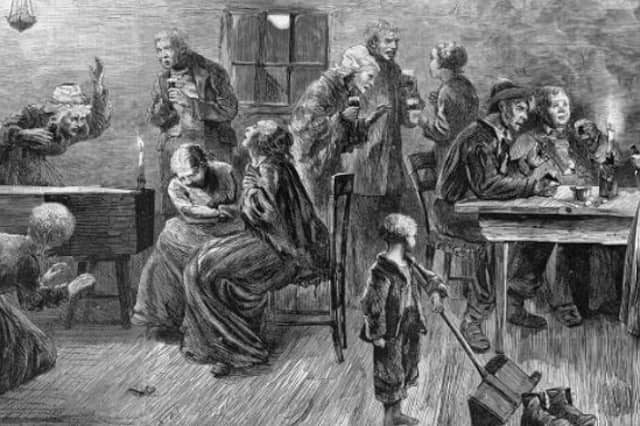
It seems to be commonly accepted that we Irish ‘do death well’. The grieving process takes on a life of its own based on the traditional Irish Wake, where a mix of food, drink, sometimes music and song, prayers and laments, could go on through the night and into the following day or days.
Giving someone ‘a good send-off’ was always regarded as a tribute to the life and times of the deceased as tales of good and bad times were recalled. All mild antidotes in reaction to the arrival of The Grim Reaper.
Years back, I remember being at a funeral in England of someone who was quite well known locally, but it struck me that there was a coldness, detachment and silence to the process, which I had never been used to in Ireland. It was . . . almost too business like.
And while the evening of reposing at Irish funerals can be a lengthy enough affair, there is too a great consolation for the bereaved at seeing ‘a great turnout’ for such-and-such-a one’s removal, with more often than not, hundreds turning out.
The traditional Irish funeral also seems to have been firmly rooted in the Catholic traditions over the centuries but there are genealogists and historians who can trace the practice back to pre-Christian, or so-called pagan times, when the Ancient Celts ‘celebrated’ the passing of a loved one, on the basis that they were moving on to a better life somewhere else.
Ironically, even though we called them pagans, what they were doing was actually a forerunner to Christian principles – a belief that there was an after-life, once their physical existence on earth had ended.
From the 1700s onwards, the Irish Wake and the Catholic Church, were deeply embedded into Irish funeral traditions, with the visit of the local priest to the house, giving the family the consolation that their loved ones had just moved on to a better place.
Even for those of us with just a mild sprinkling of faith, the spirituality of the prayers, the visit of the priest to the family, the funeral Mass with the accompanying eulogy, and the ‘laying of the person in the soil’ followed by a decade of the Rosary, has always seemed to bring a sense of consolation and hope, to what is – looking at it from a cold perspective – a very bleak event.
The winds of change though are blowing in Ireland in terms of changing to the funeral and wake traditions with the ‘house private’ notice on RIP.ie now a common inclusion in the death notice while cremations are now far more common. There are more secular ceremonies now, as individuals and families of non-religious beliefs, do things their own way and that’s fair enough too.
Back the centuries though, wakes were almost ‘a minding’ of the body and soul of the deceased with strong drink – sometimes including Poitín and whiskey – in plentiful supply as well as snuff and clay pipes filled with strong tobacco.
It was thought that smoke would prevent the evil spirits from getting near the soul of the deceased while ‘strong drink’ would help to partly anesthetise the family and mourners at the time of sorrow.
And then there were the ‘keeners’, normally women who would deliver a tribute to the dead person by way of a wail and cry, sometimes delivered with a poetical or musical tinge. The ‘keener’ word obvious comes from the Irish language phrase of ‘ag caoineadh’ which roughly translates into crying or lamenting the passing of someone close.
A few decades back, I remember being at a funeral in Mayo – an era when there was a greater tolerance towards being fit to drive after a few pints – and a few of us pleaded that we had to leave ‘the afters’ of the funeral, a bit prematurely [that meant two or three hours following the burial!] to ensure we could drive safely home.
We were politely chided by a journalistic colleague of ours [still hale and hearty, thank God] from the land of ‘red-and-green’ that we shouldn’t be concerned about rushing off as he proclaimed to us: “Sure, you can’t be done for the bag, after laying a man in the soil.”
Oh, how times have changed!
With the passage of time, more and more of us of a certain generation, seem to be averaging an attendance of one or two funerals per week, to express our condolences to family members and close friends of the deceased, while at the same time breathing a sigh of relief that we have been lucky enough to escape the trapdoor to immortality . . . for another while at least.
The old Irish funeral traditions are probably best summed up by listening to the late Ronnie Drew’s version of Finnegan’s Wake and one of its verses which describes the preparations when news broke about Tim’s passing after he broke his skull after falling from a ladder.
“His friends assembled at the wake,
The widow Finnegan called for lunch,
First she brought in tay and cake,
Then pipes, ‘tobaccy’ and whiskey punch,
Then Biddy O'Brien began to cry,"
Such a nice clean corpse, did you ever see,
Tim avourneen, why did you have to die,
Will ya shut your gob, said Pat McGee.”