

Woman’s plea to Council after three years confined to hospital bed
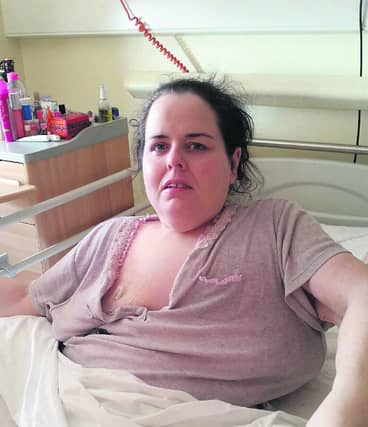

A young Galway woman who has been forced to live in hospital for over three years has repeated her plea to the City Council to help her move back home.
Thirty four year old Maggie McGinley from Knocknacarra has been living in hospital since April 21 2012 when she was admitted following advice from her GP.
And Maggie is not allowed move home until Galway City Council completes an essential extension on her house in Knocknacarra.
“There was meant to be an engineer calling out to see if the house is suitable for extending. Since 2009 they haven’t even gotten that far.
“My illness is up and down but in general could be managed at home on IV antibiotics with weekly visits to hospital,” she says.
In 2009, paramedics arrived at her home but were unable to get her on a stretcher as there was insufficient space to do so.
Born healthy and able bodied, Maggie then developed transverse myelitis when she was five years old – a viral infection in her spinal cord leaving her paralysed.
She then developed osteomyelitis in her twenties, a bone infection that led to her needing three amputations.
“Living in hospital is hard. It’s not a life I planned, nor is it easy. I’m lucky with my mother and those I’ve around me.
“I’ve a few close to me who help me day-to-day with staying here and keeping me happy.
“I have a couple days off, especially Christmas and other occasions. I’ve tried my whole life not to let my disability define me but, now I’m here, I’ve no way of stopping that,” she says.
Her situation has only gotten worse since 2009 and in April 2012 she was forced to stay in hospital permanently due to the spread of the infection to her pelvis.
“I just don’t understand how it’s taking so long. We’ve met with the council representatives numerous times and they promise they’ll send someone out but to date we’re still waiting.”
“I’m hoping this week someone will be out.
“I just wish they’d tell us either way so we could know what’s going on.
“Noel Grealish has been the only help to us; he’s tried everything to help us.”
During the 2009 incident, Maggie had no option but to get on her wheelchair and go out into the hall where she then got on the stretcher with an oxygen mask on.
According to her doctor, clots in her lungs could have been dislodged by moving in such a manner, prompting the need for an extension.
“It’s hard as I’m only 34 and I’m living in a hospital.
“I’m lucky with the ward and staff. I’ve been in the same room since 2012.”
Originally, Maggie was offered residential care in a nursing home along with people of various disabilities, mainly intellectual ones.
“Honestly when they mentioned a home I was so upset and mad all at once. To think that that was their solution for me after all I’d accomplished in spite of my illness and ongoing disability.
“The thought of ongoing institutional care was scary and I walked out of the meeting in floods of tears. I can’t remember crying like that in front of strangers before.
“Their solution to hide me away when I don’t need that care which is invaluable to others made me feel like I wasn’t cared for by them,” she says.
“Obviously if I had suitable accommodation we could organise discharge.
“There would be a lot to sort out as I’ve been here and undergone a lot of treatment and this isn’t going to stop as IV antibiotics are a lifelong treatment for the bone infection I have.
“My strain of infection is unusual as it hadn’t responded to the usual course of treatment, so planning discharge would be lengthy,” she adds.
The NUI Galway graduate has two Masters Degrees in Public Advocacy and Activism and Community development.
She completed her thesis from her hospital bed, using the hotspot on her phone and typing on her iPad.
On her future, Maggie now hopes to live as normal as she can, with the hope of obtaining a PhD and or perhaps a TEFL course.
“I’ve completed two masters already, both in hospital over the last few admissions.
“I’ve had friends who loved TEFL but ideally I’d love to go back to university.
“I’d love to do some course if I could, like a PhD or something to help me put my mind to something more positive.”